Guide:Class D6 (pod): Difference between revisions
No edit summary |
No edit summary |
||
| Line 48: | Line 48: | ||
</gallery> | </gallery> | ||
==Notes== | ==Notes== | ||
| Line 54: | Line 53: | ||
* The dimensions are placeholders, to be modified to match final art. | * The dimensions are placeholders, to be modified to match final art. | ||
<br> | <br> | ||
Latest revision as of 18:00, 6 November 2022
.png)
| |
| Class D6 | |
|---|---|
| Class Overview | |
| Category | work pod |
| Operational | 2229-2271 |
| Constructed | 7,500+ |
| Dimensions | |
| Length | 3.4 m (manipulators stowed) |
| Beam | 3.6 m |
| Height | 2.1 m |
| Mass | 0.96 tons |
| Performance | |
| Cruise Speed | sublight (thrusters) |
| Max Speed | sublight (thrusters) |
| Endurance | 2 days |
| Complement | |
| Crew | 1
|
| Canonicity | |
| Design | Jon-Michael-May; SFC |
| Name | Timo, SFC |
| History | Timo, SFC
|
At the very lowest end of the scale for maintenance spacecraft, the Class D6 was in essence a heavy, armored pod, endowed with two cybernetically-boosted arms for the operator. Between the 2230s and the 2270s, it was the most popular maintenance craft in Star Fleet, as a design capable of fitting into the small maintenance bays sometimes embedded on ships & stations, but equally capable on a broad hanger deck. This gave an extremely rapid reaction capability for time-critical repair and containment work—an operator could dive into the pod without prior preparation, hitting a starter button while entering and performing a clean ejection within seconds prior to unsealing the external hatches. Some bay systems could give an optional initial delta-vee via deflector technology, but “swim-out” launching was far more typical.
The basic D61-10 variant featured twin extendable multiple-articulation manipulators, both capable of accessing side-mounted storage bays via automated routines to swap out various tools. There was no separate anchoring arm, beam, or gravitic grapple, stationkeeping being left to the thruster system and and a third ventrally-stowed arm for grabbing onto external strong points.
The two-day endurance assumed standard life support conditions (i.e., no onboard fires or toxic releases) and moderate use of maneuvering propellant, a crucial resource when gravitic propulsion was lacking. In theory, a hibernation mode was available, with onboard medication to keep the occupant alive for up to eight days without food or water and a minimum of breathing air. Standard beacons were provided to assist recovery of an incapacitated pod. There are some survival stories of ingenious use of personal items for gaining the attention of another vessel, made possible by the access airlocks. At times, the D6 even saw combat use of sorts, with the user’s properly-stowed hand phaser drawn by a manipulator limb.
Use of the D6 pods dwindled in the early 2260s. The D6 still saw some service aboard older ships, but none of these remained in use for more than a decade more, and none survived past the turn of the century.
Gallery
-
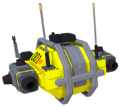 CP-03 construction pod
.png)
Notes
- This represents a transition between the SFC-canon Class D3 and the alpha-canon Type 10. Timo's Guide-canon D6 is no longer represented here and related details above (and in the sidebar) have been altered to match.
- The dimensions are placeholders, to be modified to match final art.