Future Space Stations: Difference between revisions
| Line 33: | Line 33: | ||
2) [[1982]]: The United States and Russia fuse their competing space station programs to begin construction on StarLab One (179 mt). | 2) [[1982]]: The United States and Russia fuse their competing space station programs to begin construction on StarLab One (179 mt). | ||
3) [[1984]]: Deep Space Gateway, the lunar orbital support station, opens. | |||
3) [[1986]]: Construction begins on a second and more sophisticated international space station, Space Station Freedom, in Terran orbit. | 3) [[1986]]: Construction begins on a second and more sophisticated international space station, Space Station Freedom, in Terran orbit. | ||
| Line 44: | Line 46: | ||
6) [[2009]]: New Constantinople, the second L-5 “space city,” is completed and opens its doors. | 6) [[2009]]: New Constantinople, the second L-5 “space city,” is completed and opens its doors. | ||
7) | 7) | ||
<gallery> | <gallery> | ||
File:Skylab.png|1) Skylab | File:Skylab.png|1) Skylab | ||
File:StarLab One.png|2) StarLab One | File:StarLab One.png|2) StarLab One | ||
File:Space Station Freedom.png| | File:Moon station.png|3) Deep Space Gateway | ||
File:European Space Station (ESS).png| | File:Space Station Freedom.png|4) Space Station Freedom | ||
File:Modular space station four.png| | File:European Space Station (ESS).png|5) European Space Station (ESS) | ||
File:SSV (front).png| | File:Modular space station four.png|6) L5 Tsiolkovskygrad | ||
File:SSV (front).png|7) L5 New Constantinople | |||
File:L5 station Asgard.png| Engineering station for warship contruction | File:L5 station Asgard.png| Engineering station for warship contruction | ||
File:Megaplex.png|Megaplex (pre- or early gravity tech) | File:Megaplex.png|Megaplex (pre- or early gravity tech) | ||
Revision as of 06:58, 28 February 2018
- Delta Outpost (1-9-xx): a series of Federation communications arrays and subspace transceivers located on the border of the Klingon Empire; maybe built to communicate with 'concerns' within Klingon space (before alliance) and to spy on other activities.
- Earth Outpost (1-32-xx): stationed along the Romulan Neutral Zone to monitor traffic within and beyond the zone
- Epsilon Outpost (1-11-xx): a series of Federation communications arrays and subspace transceivers located on the border of the Klingon Empire; maybe built to communicate with 'concerns' within Klingon space (before alliance) and to spy on other activities.
- Foxtrot Outposts (1-13): stationed further away from the Romulan Neutral Zone in Sector Foxtrot, in direct support of the Earth Outposts in that sector.
- Jupiter Station: established well-prior to 2153; defended from some threat (domestic?) prior to 2153.
- Memory series
- Memory Prime: construction started by Vulcans prior to 2151; mission is to provide an off-world location for all accumulated knowledge
- Memory Alpha: construction started prior to 2261, with intent to open that year; first in a series of dedicated stations to record specific categories of academic knowledge, with this being collected histories; Memory Prime re-focused on collecting and disseminating all new knowledge to appropriate Memory stations.
- Memory Beta: focus on biology
- Memory Gamma: focus on economies and agriculture
- Memory Delta: focus on astronomy (charting, formations and evolution of interstellar bodies)
- Memory Epsilon: focus on physics
- Memory Zeta: focus on culture
- Quebec Outposts (1-6): stationed further away from the Romulan Neutral Zone in Sector Quebec, in direct support of the Earth Outposts in that sector.
- Relay Station (#): small, manned outposts used to receive communications signals and re-transmit them to other stations in a larger communications network; differing from subspace relays, which are automated and indiscriminately transmit received signals in all directions.
- Romeo Outposts (1-3): stationed further away from the Romulan Neutral Zone in Sector Romeo, in direct support of the Earth Outposts in that sector.
- Sierra Outposts (1-7): stationed further away from the Romulan Neutral Zone in Sector Sierra, in direct support of the Earth Outposts in that sector.
- Tango Outposts (1-4): stationed further away from the Romulan Neutral Zone in Sector Tango, in direct support of the Earth Outposts in that sector.
Earth Space Stations
1) 1973: NASA sends up the Skylab space station to test the realities of long-term life in space (77 mt).
2) 1982: The United States and Russia fuse their competing space station programs to begin construction on StarLab One (179 mt).
3) 1984: Deep Space Gateway, the lunar orbital support station, opens.
3) 1986: Construction begins on a second and more sophisticated international space station, Space Station Freedom, in Terran orbit.
4) 2001: The ESA launches its own space station, in order to better service the unique needs of the Common Market.
- 2003: The first two Earth L-5 space colonies begin construction.
5) 2007: Tsiolkovskygrad, the first L-5 “space city,” is completed and the first 250 residents move in.
6) 2009: New Constantinople, the second L-5 “space city,” is completed and opens its doors.
7)
-
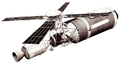 1) Skylab
 -
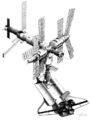 2) StarLab One
 -
 3) Deep Space Gateway
 -
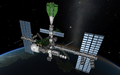 4) Space Station Freedom
 -
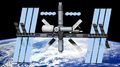 5) European Space Station (ESS)
 -
 6) L5 Tsiolkovskygrad
 -
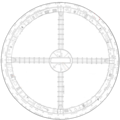 7) L5 New Constantinople
 -
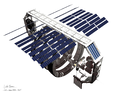 Engineering station for warship contruction
 -
 Megaplex (pre- or early gravity tech)
 -
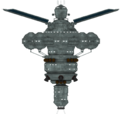 UE 'starbase'


.png)

.png)


.png)