Guide:Big Cat: Difference between revisions
No edit summary |
|||
| Line 96: | Line 96: | ||
==Gallery== | ==Gallery== | ||
<gallery> | <gallery> | ||
File:Big Cat bow view.png| | File:Big Cat bow view.png|''Big Cat'' bow view | ||
File:Big Cat dorsal view.png|''Big Cat'' dorsal view | File:Big Cat dorsal view.png|''Big Cat'' dorsal view | ||
File:Hornet fighter.png|Similar fighter ''Hornet'', with 2 particle cannons | File:Hornet fighter.png|Similar fighter ''Hornet'', with 2 particle cannons | ||
Latest revision as of 12:53, 10 December 2015

| |
| Big Cat | |
|---|---|
| Class Overview | |
| Category | sublight fightercraft |
| Operational | 2182 - 2266 |
| Constructed | 380 |
| Dimensions | |
| Length | 7.5 m |
| Beam | 6.6 m |
| Height | 3.6 m |
| Mass | 50-55 tons (typical) |
| Performance | |
| Max Speed | 0.8 c |
| Endurance | 2 days |
| Complement | |
| Crew | 2-3
|
| Tactical Systems | |
| Beam Weapons |
|
| Other Weapons |
|
| Shields | polarizable armor |
| Canonicity | |
| Design | SFB, ST:ID |
| Name | SFB |
| History | SFB, ST:ID
|

The standard replacement for the fightercraft of the Romulan War was long in coming, for two principal reasons. The first was the great distaste towards risking live pilots like they had been risked aboard the sustainer-engined escort fighters. The second was the optimistic wait for an independent warp propulsion system that could offer more speed and range than the old Vulcan designs. Yet the 2170s came and went without breakthroughs in small-scale warp engines, and Starfleet again began to look at impulse-propelled light combat craft as the answer to its tactical needs.
During the two decades of inaction, those tactical needs had changed little – or rather, no strategic opponent had presented itself, leaving Starfleet unsure of the nature of the threat it should prepare against. Planetary defenses hinged on a combination of resident or visiting warships, vast missile arsenals and a menagerie of medium interceptor craft that still included some space tanks. The latter two aspects were rapidly becoming antiquated, though, and Starfleet ultimately came to consider this as the proper niche of modern fightercraft operations.
High impulse thrust was thus declared essential for timely interception. The ability to carry hard-hitting anti-starship weapons was paramount. For versatility in basing options, transatmospheric capacity was a third major requirement. On this basis, the fightercraft of the latter half of the 22nd century evolved away from the wartime agile needles with warp sustainer bulges and became brute force arrows shooting into space in straight paths to meet a superior enemy in numerical strength. Out of the half a dozen designs produced in the era, the Big Cat is a typical example.
The basic body of the fighter was an arrowhead some six meters long and wide, with impulse pods attached at the trailing edge midspan to port and starboard. For atmospheric agility, there were full-width canards at the bow, their anhedral following the angle of the main hull top surface. Atop the arrowhead rode a boxy pressure compartment housing two to three crew. Unlike in the comparable Vulcan interceptors, the pilot was provided with an angled windshield and lateral portholes for direct visibility, and only the weapons officer(s) relied on a fully synthetic view of the outside.
The craft was capable of planetary takeoff and landing, with tripod landing gear folding out from the bottom, and with gravitics to provide initial lift and maneuvering assistance. The jam-packed hull featured just enough space at centerline to carry the main armament of the fighter, a single GW-range phased particle cannon. Twin ordnance bays flanking the cannon were almost an afterthought in comparison, and anything carried within would have been of little use against starship-sized opponents. A secondary role against ground targets theoretically existed, though; for this role, some later models were fitted with additional exterior hardpoints under the canards, mainly for light projectile weapons and freeflight ordnance.
The Big Cat series did come to feature surprisingly many such models, persisting despite lack of actual confrontations where the fighters could have demonstrated their worth or realistically assessed their shortcomings. Shipboard variants such as the Panther and Jaguar emerged in the 2190s and especially the Advance battle cruisers embarked them for the dual purposes of escorting their unarmed shuttlecraft in assault tasks, and of boosting antiship firepower in impulse battles. The craft were a familiar sight also aboard the later Albions, even though by that time their antiship capabilities had been revealed to be largely theoretical.
The last hurrah of the Big Cat series came with Starfleet’s early experiments on carrier starships in the beginning of the Klingon conflict of the 23rd century. It was believed that fightercraft could still make a difference if deployed in sufficient numbers. Titan and Valkyr vessels had the necessary deck space, and on the other hand the Big Cats had the deck-saving dual qualifications of space superiority and planetary assault capability. While better fighter designs were emerging for both applications and also for their combination, the veteran design persisted and received upgrade after upgrade on phase guns, targeting systems, engines and armor, all the way till the very final Bearcat model completed in 2226. It was not until 2266 that the very last wings operating this model were disbanded.

Gallery
-
 Big Cat bow view
 -
 Big Cat dorsal view
 -
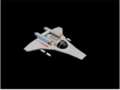 Similar fighter Hornet, with 2 particle cannons
 -
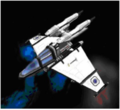 Similar, but smaller, fighter Eagle, with 2 particle cannons
 -
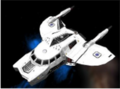 Warthog bomber, on mission
 -
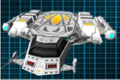 Specs of the Warthog, with 2 particle cannons and 2 bomb bays
 -
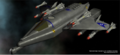 Voodoo heavy fighter, with 2 particle cannons and 8 hardpoints


