Guide:Burke: Difference between revisions
No edit summary |
|||
| Line 178: | Line 178: | ||
* The image and caption regarding the ''USS Vasco de Gama'' indicates a NCC of 1842. It has been changed to 1472, to better represent the range of codes for the ''Aldrin'' sub-class. | * The image and caption regarding the ''USS Vasco de Gama'' indicates a NCC of 1842. It has been changed to 1472, to better represent the range of codes for the ''Aldrin'' sub-class. | ||
* To clarify: | |||
** The ''Burke'' sub-class was built as a 'nearspace' frigate first, followed during the same production run by the ''Aldrin'' 'deep space' frigate, with a dorsal booster. | |||
** Starting in [[2235]], the both sub-classes received a significant upgrade, but the ''Burkes'' also received dorsal torpedo modules, with 2, 3 or 4 launchers; the ''Aldrins'' did not receive the package. | |||
** In [[2244]], both classes were refit to (then) modern standards, with the ''Burkes'' generally retaining the torpedo modules (also upgraded). | |||
==Gallery== | ==Gallery== | ||
Revision as of 20:30, 14 April 2016

| |
| Burke | |
|---|---|
| Class Overview | |
| Category | frigate |
| Operational | 2221-2267 |
| Constructed | 67 total: |
| Dimensions | |
| Length |
|
| Beam | 122.0 m |
| Height | |
| Mass | |
| Performance | |
| Cruise Speed |
|
| Max Speed |
|
| Endurance |
|
| Complement | |
| Officers | 25 |
| Enlisted | 214
|
| Tactical Systems | |
| Beam Weapons | Original
|
| Missile Weapons |
|
| Shields |
|
| Transporters | Original
|
| Auxiliary Craft | None |
| Historical | |
| Ships of Note |
|
| Canonicity | |
| Design | STXI; SFB, ST:Axanar/Tobias Richter |
| Name | SFB, LUG |
| History | SFB, ST:Axanar
|
_dorsal_view3.png)
The successes of the Mann generation of capital combatants had not only increased the Federation’s chances of survival in a war against the Klingons – they had provided Chiokis Corporation with an excellent commercial reputation as an independent spacecraft designer. Yet the Manns and Rangers were a dead end for an ambitious company: saucerlike hulls of refined warp dynamics were the future of starflight. In 2219, Chiokis still remained but a junior partner in such projects, and the contract for the Burke class patrol ship went to Geering. While the nascent Andorian enterprise was asked to modernize the Rangers for a slimmer hull structure, the competing Earth company in turn launched its inaugural saucer hull, taking advantage of the fact that the specifications did not dictate a bulky total conversion powerplant.
Despite the seeming modesty of the patrol ship project, this was a major coup for Geering, and a decisive loss for Chiokis. The Burke class frigate (a bold new definition for the time-honored mission class) would have been the best possible way to make an entry to the market as an independent contractor: a spaceship already conceptualized, visualized and all but designed. This was what the Ranger would look like, once a more compact powerplant could be found for her. Yet without a number of the light cruiser’s mission-specific complications, the new design could be a clean slate for future expansion and eventual greatness. The significance was not lost to Geering’s designing team, which began drafting the shape of a ship far larger than her physical dimensions.
The saucer hull in all its simplicity held the crew accommodation, weapons systems, computing gear, sensors, fuel and impulse propulsion systems, all neatly modularized and sectored. The SAA impulse drive took up the aft centerline, its structures extending somewhat above the level of the widest deck of 122 m diameter. To both sides were main fuel tanks, then crew and support system spaces. On two dorsal positions and a single forward ventral one were the single laser cannon that formed the main armament of the class; six dorsal berths held standard defensive plasma cannon underneath their trapdoors. Even in the modern and ambitious definition of ‘frigate’, there was no mention of torpedo armament. Still, Geering was thinking ahead and introduced dorsal structural hardpoints for possible future installation of weapons modules.

Two stubby pylons underneath would house the PB-21 engines, complete with their built-in power systems. Each also held an integrated navigational deflector, although the saucer bow section was already provided with three auxiliary deflector beam emitters. The performance, or lack thereof, of the engines was no concern of Geering, and the company could deliver the first of the planned fifty hulls on schedule, for trials starting in 2221. Registries were allocated in Ranger fashion, starting out a whole new ‘century’; the 1600s would be a local patrol combatant range for the time being.
Satisfied with the results so far, Starfleet also gave the go-ahead for a Mk II version of improved endurance, designated as the Aldrin sub-class. The main difference was to be found at the aft dorsal hull: a spinal protrusion housed extended fuel tanks, consumables storage, and a workshop and hangarette for repair pods. Adding a year to total patrol time was a largely theoretical exercise, as engine performance was unchanged and did not allow the vessels to deploy particularly far. Minor improvements in sensors, targeting systems and computers nevertheless contributed to Starfleet assigning registries in line with contemporary deep space cruisers, in the 1400 ‘century’, right after the Baton Rouge and the (much delayed and eventually re-registered) Ares.
The Burkes proved sturdy and dependable in most respects. Unfortunately, propulsion was not one of them. Through the latter half of the 2220s, Starfleet struggled to find a suitable replacement for the PB-21, the failure rate of which kept the 43 plus 24 completed Burkes from efficiently contributing to Federation defense. It was only in 2244 that the PB-45 rose as a credible contender, bringing the Burkes to the solid state era and increasing their military potential. At that point, the baton had been passed; it would be Chiokis’ turn to give shape to Starfleet’s future. Select ships received a modern phased beam arsenal with twin emitters, their impulse engines were brought to SAD standard, and a wholly internal warp core was installed. The nearspace units were also equipped with a destroyer-type underbelly sensor dish plus boosted shields. Chiokis crafted a ventral bulge to mount the former; the latter called for the customary downward extension of the saucer rim and removed the last traces of the original Geering shape.
The high endurance vessels remained truer to the origins externally. Eight of them received improved C3I facilities and had a host of new sensors bolted onto the spine. They were dedicated to deep space reconnaissance tasks and in theory were considered Magellan class scout cruisers, as per the lowest-registry conversion (NCC-1462). In this role, they saw sterling service in the Four Years War.

Timing wasn’t on the side of the dependable little ships, however. The Great Awakening brought up the possibility of much more capable frigates in this size range, and directed the attentions of Chiokis elsewhere. Further extension of the Burke hull to house a multilinear dilithium-focus powerplant was considered futile, especially considering the very recent investments that would keep these frigates a useful force until full transition could be made to Loknar and Miranda types. In practice, even these investments were cut, leaving almost a third of the Burke force unmodernized (save for a 2250s phaser upgrade) and stationed near the core worlds. Retirements began with laying off a dozen vessels immediately, then followed apace with Loknar and Miranda commissionings. Hulls from both the modernized blocks persisted until the mid-2260s, and the last such unit was stricken from records as late as in 2267.
_port_stern_view.png)
Despite falling a tad short of longevity, the Burke class was elemental in ushering in the era of the saucer-hulled combatant. The tentative steps taken with Ranger light cruisers would soon be followed by the decisive on-march of Baton Rouge and Proxima cruisers, Detroyat and Saladin destroyers and Ptolemy armed transports, projects directly benefiting from work done on the Burke program. There would be no turning back now; no further lifting-body ships would be procured, and even the results of major modernization programs on such designs would be sent directly to second-rate assignments. Ever since the introduction of the Burke, the archetypal image of Starfleet has been the silhouette of the saucer-hulled starship.
Notes
- The number of Burke sub-class ships was increased by one in the text, to match the sidebar.
- The initial inline image has been changed from Timo's Guide as a nearspave Burke to that of a deep space Aldrin, because an actual image was located that best shows the dorsal booster described in the caption.
- The image and caption regarding the USS Vasco de Gama indicates a NCC of 1842. It has been changed to 1472, to better represent the range of codes for the Aldrin sub-class.
- To clarify:
- The Burke sub-class was built as a 'nearspace' frigate first, followed during the same production run by the Aldrin 'deep space' frigate, with a dorsal booster.
- Starting in 2235, the both sub-classes received a significant upgrade, but the Burkes also received dorsal torpedo modules, with 2, 3 or 4 launchers; the Aldrins did not receive the package.
- In 2244, both classes were refit to (then) modern standards, with the Burkes generally retaining the torpedo modules (also upgraded).
Gallery
-
 Burke / Aldrin in original configuration, port ventral view
 -
 Aldrin sub-class in original configuration, port forward view
 -
 Aldrin sub-class starboard stern view
 -
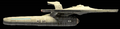 Burke class in 2235 configuration, starboard view, with torpedo module
 -
 Bow view with torpedo module (2235 upgrade)
 -
 Dorsal view with torpedo module (2235 upgrade)
 -
 "Voyage of the Mayflower"
 -
Aldrin sub-class in 2244 refit, bow plan
-
Aldrin in 2244 refit, bow plan
-
Aldrin in 2244 refit, dorsal plan

_port_fwd_view.png)

_stbd_view.png)
_bow_view.png)
_dorsal_view2.png)


