Guide:Yorktown: Difference between revisions
No edit summary |
|||
| Line 100: | Line 100: | ||
File:Yorktown battlecruiser (dorsal stern).png | File:Yorktown battlecruiser (dorsal stern).png | ||
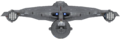
File:Yorktown battlecruiser (dorsal).png | File:Yorktown battlecruiser (dorsal).png | ||
File:Yorktown battlecruiser (stern).png | File:Yorktown battlecruiser (stern).png | ||
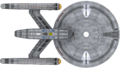
File:Yorktown battlecruiser (ventral).png | File:Yorktown battlecruiser (ventral).png | ||
File:Aiding the good cause by jetfreak 7-d4gq58c.png|"Aiding the Good Cause" | File:Aiding the good cause by jetfreak 7-d4gq58c.png|"Aiding the Good Cause" | ||
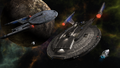
File:Wartime exchange by jetfreak74656-d64evi0.png|"Wartime Exchange" | File:Wartime exchange by jetfreak74656-d64evi0.png|"Wartime Exchange" | ||
Revision as of 07:55, 13 March 2018
.png)
| |
| Yorktown | |
|---|---|
| Class Overview | |
| Category | battle cruiser |
| Operational | 2160 - 2177 |
| Constructed | 1 |
| Dimensions | |
| Length | 236.1 m |
| Beam | 120.1 m |
| Height | 38.0 m |
| Mass | 345,000 tons |
| Performance | |
| Cruise Speed | w 3 |
| Max Speed | w 4.9 |
| Endurance | 4 years |
| Complement | |
| Officers | 82 |
| Enlisted | 270
|
| Tactical Systems | |
| Beam Weapons |
|
| Missile Weapons |
|
| Shields |
|
| Transporters | 2 GP (3-pad); Mk I |
| Auxiliary Craft |
|
| Historical | |
| Ships of Note | USS Yorktown |
| Canonicity | |
| Design | ST:Legacy computer game |
| Name | ST:Legacy computer game |
| History | SFC, own
|
For the purpose of boring through Romulan defenses, the UESF began in 2158 to build three large
battle cruisers, with several more in planning. Based on existing Earth and Andorian technology
taken to extreme proportions, the third-of-a-million-ton ships would carry hundreds of photonic warhead
missiles and torpedoes, be protected by dozens of self-defense fightercraft and layers of
laser, plasma and forcefield defenses, and fly at nearly warp five to the Romulan homeworlds,
untouched by the perimeter defenses of the still expanding Romulan empire.
Starfleet’s initial bid for the role was the Yorktown, an application of Enterprise and Poseidon technologies and hull components on a grander scale. The saucer as such was actually of slightly smaller diameter than those of the predecessor cruisers, and one deck flatter on both dorsal and ventral superstructure. Yet joining it was a massive tubular structure, an entire second hull a hundred meters long, that would shelter the fightercraft contingent in a stern hangar. The bow of the secondary hull would house an annihilation powerplant twice as large as the Enterprise original, and also accommodate the ship’s navigational deflector. The impulse engines of the vessel would be located in the juncture of her warp engine pylons, in a well armored neck structure where all primary power leads would be concentrated for citadel protection.
This would liberate virtually all the room in the primary hull for an unprecedented offensive and defensive armament. A row of six launch tubes on the underside was to spit out a combination of high speed anti-ship photonic torpedoes and the fusion missiles that would vaporize Romulan fortifications and industries. Eight 700-gigajoule particle cannon would complete the bombardment, while four heavy 150 nm lasers and eight rapid-fire plasma cannon kept enemy vessels at bay. Further bombardment cannon would be installed on the lower sides of the secondary hull, along with additional defensive plasma guns.

There was a fatal shortcoming in the balance of offensive and defensive weapons, however. Cruiser engagements in 2158 and 2159 proved that the Romulan forces could mount an impregnable defense against the heaviest Starfleet penetrators if they could amass sufficient numbers of cruisers and destroyers of their own. Home system defenses could be expected to feature this threshold number of vessels at all times, unless a major strategic feint could be effected. Key to success thus lay not in firepower alone, but in the ability to push it past enemy formations without an exchange of fire. High dash speed, equal at least to that of the superfast Christopher light cruisers, would be a strategic necessity.
This the drive system could not provide, not even with the high output, dilithium-focus reactor that kept throwing dangerous tantrums at the warp trials of USS Yorktown. The inaugural battle cruiser was doomed to fight her battles against Rihannsu deep space fleets, in violent cruiser actions, never getting the chance to rain destruction on key enemy bases or production facilities. A challenger with at least one full warp factor over the Yorktown would be needed to carry the torch, hopefully to the powder cellars of the enemy.
Yet the war would soon end, in a very different fashion from the one envisioned. The Yorktown would continue to serve, now under different masters with different goals. She would never achieve fame or receive breakthrough technologies – yet eventually, she would serve as the template for the next great leap in starship construction, inspiring the Horizon class of heavy cruisers.
Gallery
-

-

-

-
-
-
 "Aiding the Good Cause"
 -
 "Wartime Exchange"
.png)
.png)
.png)
.png)
.png)

