Guide:Solar: Difference between revisions
Created page with "{{Sidebar Guide ship |image=250px|Solar cutter |classname= ''Solar'' |category= cutter |years= 2250 - 2280<br> * MK I: * Mk III: * Mk VI..." |
|||
| (31 intermediate revisions by the same user not shown) | |||
| Line 1: | Line 1: | ||
{{Sidebar Guide ship | {{Sidebar Guide ship | ||
|image=[[File: | |image=[[File:Solar (stbd).png|250px|Solar cutter]] | ||
|classname= ''Solar'' | |classname= ''Solar'' | ||
|category= cutter | |category= cutter | ||
|years= [[2250]] - [[2280]]<br> | |years= [[2250]] - [[2280]]<br> | ||
* MK I: | * MK I: [[2250]]-[[2271]] | ||
* Mk III: | * Mk III: [[2262]]-[[2274]] | ||
* Mk VI: | * Mk VI: [[2264]]-[[2280]] | ||
|constructed= 1,619<br> | |constructed= 1,619<br> | ||
* MK I: 588 (built [[2250]]-[[2252]]) | * MK I: 588 (built [[2250]]-[[2252]]) | ||
| Line 35: | Line 35: | ||
<u>Mk I</u> | <u>Mk I</u> | ||
* 1x 600 MW laser emitter (lower bow) | * 1x 600 MW laser emitter (lower bow) | ||
* | * 2x 600 MW laser emitter (lower hull flanks) | ||
<u>Mk III</u> | <u>Mk III</u> | ||
* 2x phaser III (twin bank) (lower bow) | * 2x phaser III (twin bank) (lower bow) | ||
| Line 49: | Line 49: | ||
|labs= | |labs= | ||
|transporters= <br> | |transporters= <br> | ||
<u> | <u>Mk I</u> | ||
* 1x GP (6-pad); Mk III | |||
<u>Mk III-on</u> | |||
* 1x GP (6-pad); Mk III | * 1x GP (6-pad); Mk III | ||
* 1x small cargo; Mk III | * 1x small cargo; Mk III | ||
| Line 59: | Line 61: | ||
}} | }} | ||
For the first decade of the Great Awakening, development of compact solid state warp engines | ==Background: ''Hobbyist's Guide''== | ||
approached the underutilized middle from both ends. Corvettes, escorts and skirmishers got their | For the first decade of the Great Awakening, development of compact solid state warp engines approached the underutilized middle from both ends. Corvettes, escorts, and skirmishers got their interstellar drives at a tad below hundred thousand tons per coil set, while ''[[Guide: Chameleon|Chameleon]]'' and ''[[Guide: Mission|Mission]]'' squeezed warp three cruise performance out of engines massing in at the low four digits. It was PB-40, at 15,000 tons per set, that best met the needs of the civilian market, though. The promise of warp five cruising would be kept with the ''[[Guide: Masterson|Masterson]]'' patrol cutters, ''[[Guide: Graynet|Graynet]]'' corvettes, and ''[[Guide: Guide:Tavares|Tavares]]'' light transports—but only after being put to a test in a craft designed solely for speed. | ||
interstellar drives at a tad below hundred thousand tons per coil set, while Chameleon and Mission | |||
squeezed warp three cruise performance out of engines massing in at the low four digits. It was PB- | |||
40, at 15,000 tons per set, that best met the needs of the civilian market, though. The promise of | |||
warp five cruising would be kept with the Masterson patrol cutters, Graynet corvettes and Tavares | |||
light | |||
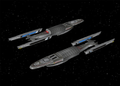
The Solar class of fast revenue cutters by VXT was not intended for | The '''''Solar''''' class of fast revenue cutters by [[VXT]] was not intended for [[Star Fleet]] use, despite its large, military-standard engines and relatively heavy armament. Fleet experts nevertheless watched with keen interest as [[Federation Customs Service]] put the craft through the paces, running the [[Moloch]] A antimatter powerplant at the limits of its performance. The closely-spaced engine pair produced a spindle-shaped warp field for a peak speed of warp 5.7; for maintaining warp five, the reactor had to be surrounded by an array of heat dissipation plates that also helped contain less benign types of radiation. There was little else to the craft, save for an arrowhead crew compartment that clamped onto a shirtsleeves engine monitoring section just forward of the reactor, and a cylindrar pod for the navigational deflector beneath this compartment. | ||
military-standard engines and relatively heavy armament. Fleet experts nevertheless watched with | |||
keen interest as Federation Customs Service put the craft through the paces, running the Moloch A antimatter powerplant at the limits of its performance. The closely spaced engine pair produced a | |||
spindle-shaped warp field for a peak speed of warp 5.7; for maintaining warp five, the reactor had | |||
to be surrounded by an array of heat dissipation plates that also helped contain less benign types of | |||
radiation. There was little else to the craft, save for an arrowhead crew compartment that clamped | |||
onto a shirtsleeves engine monitoring section just forward of the reactor, and a cylindrar pod for the | |||
navigational deflector beneath this compartment. | |||
Faster than the more lavishly equipped Mastersons, the new cutters were ideal for early interception | Faster than the more lavishly-equipped ''Mastersons'', the new cutters were ideal for early interception of vessels in need of pilot services or a quick verification of identity and intent. Search and rescue services were another matter. Even though a ''Solar'' carried a large transporter with twin rows of three pads, there was little room for evacuees, almost nothing in the way of medical facilities, and only a rudimentary sensor array for sorting out survivors from debris. Three laser cannon were included in most of the 588 craft built, their aiming being burdened on the then-standard L-14 central computing unit that had severely limited capacity for such extra duties. Affordable and standardized equipment was nevertheless essential for attaining such procurement numbers, and for equipping virtually every UFP port with a ''Solar'' or two. | ||
of vessels in need of pilot services or a quick verification of identity and intent. Search and rescue | |||
services were another matter. Even though a Solar carried a large transporter with twin rows of | |||
three pads, there was little room for evacuees, almost nothing in the way of medical facilities, and | |||
only a rudimentary sensor array for sorting out survivors from debris. Three laser cannon were | |||
included in most of the 588 craft built, their aiming being burdened on the then-standard L-14 | |||
central computing unit that had severely limited capacity for such extra duties. Affordable and | |||
standardized equipment was nevertheless essential for attaining such procurement numbers, and for | |||
equipping virtually every UFP port with a Solar or two. | |||
The Mk II version for civilian markets was not a sales success, as it offered less than the similarly | The Mk II version for civilian markets was not a sales success, as it offered less than the similarly-engined ''Tavares'' in virtually every respect, for only a slightly lower price. A mere technology demonstrator wouldn’t sell—unless it demonstrated something more impressive. In [[2262]], the Mk III government and Mk IV civilian refits of the respective originals remedied some of the equipment shortcomings, providing the craft with cargo transporters and phaser armament. More importantly, they introduced the sleek PB-60 engine, which gave warp seven dash speed for the same power costs and weighed only marginally more. | ||
engined Tavares in virtually every respect, for only slightly lower price. A mere technology | |||
demonstrator wouldn’t | |||
III government and Mk IV civilian refits of the respective originals remedied some of the | |||
equipment shortcomings, providing the craft with cargo transporters and phaser armament. More | |||
importantly, they introduced the sleek PB-60 engine, which gave warp seven dash speed for the | |||
same power costs and weighed only | |||
The Mk III was also offered for | The Mk III was also offered for Star Fleet, and 24 units were adopted as training craft. Several shortcomings in habitability and spaceframe durability were identified and the manufacturer was prompted to design remedies. A reinforced structure and a beefed-up armament increased the mass of the special, all-newbuild Mk VI variant by two thousand tons, while crew facilities were rearranged to accommodate three instructors. The option of using the crew compartment as a separable lander was seldom used by other operators, yet Star Fleet took the opportunity to carry out various rendezvous and docking training maneuvers with the lander. Introduction of the fully landing-capable ''[[Guide: Epsilon|Epsilon]]'' cutter soon outdated these units, though, and Star Fleet sold all 24 of its Mk VI acquisitions forward. | ||
shortcomings in habitability and spaceframe durability were identified | |||
prompted to design remedies. A reinforced structure and a beefed-up armament increased the mass | |||
of the special, all-newbuild Mk VI variant by two thousand tons, while crew facilities were | |||
rearranged to accommodate three instructors. The option of using the crew compartment as a | |||
separable lander was seldom used by other operators, yet | |||
various rendezvous and docking training maneuvers with the lander. Introduction of the fully | |||
landing-capable Epsilon cutter soon outdated these units, though, and | |||
VI acquisitions forward. | |||
Production of Mk VI ultimately reached 621 craft, which largely replaced the earlier models but did | Production of Mk VI ultimately reached 621 craft, which largely replaced the earlier models but did not spread high speed cutter services to new starports; that was left to the ''Epsilon'' class. As fast craft had fast replacement cycles, almost all the original ''Solars'' were gone by [[2270]], and the Mk VI batch was retired by [[2280]]. Despite its lack of longevity and modest contribution to Star Fleet, the class retains a prominent place in small craft history for launching not just one but two groundbreaking warp engines. | ||
not spread high speed cutter services to new starports; that was left to the Epsilon class. As fast craft | |||
had fast replacement cycles, almost all the original Solars were gone by 2270, and the Mk VI batch | |||
was retired by 2280. Despite its lack of longevity and modest contribution to | |||
retains a prominent place in small craft history for launching not just one but two groundbreaking | |||
warp engines. | |||
==Gallery== | ==Gallery== | ||
<gallery> | <gallery> | ||
File:Solar (stbd).png | |||
File:Solar (bow).png | |||
File:Solar (dorsal).png | |||
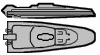
File:Solar (lander feature).png|Lander feature | |||
File:Solar (2-view).png | |||
</gallery> | </gallery> | ||
==Notes== | ==Notes== | ||
* | * The side bar says there is only one laser emitter on the lower hull, though it uses the plurality of "flanks". In the text, three laser emitters are indicated overall, so I'm adding one to the lower hull. | ||
* The Mk I was never in [[Star Fleet]] service; just with the [[FCS]]. | |||
* Twenty-four of the Mk III were procured by [[Star Fleet]], for training purposes. I've decided they were procured (upon completion) all in [[2263]]. | |||
* Mks II, IV, & V were all civilian models. | |||
* It is not clear, but it looks like the Mk VI version added the ability to have a separable lander of the crew compartment. Instead of this being a feature of the class, I've decided it will be introduced specifically with the Mk VI. | |||
* Twenty-four of the Mk VI were also procured by [[Star Fleet]] for training purposes, though not retained for too long. Star Fleet received the first off of the lines in [[2264]], because of their request, replacing each of the Mk IIIs. However, they were themselves quickly replaced by the ''[[Guide:Epsilon|Epsilons]]'' Mk I & Mk II in [[2265]] and [[2266]] respectively. | |||
* The statement regarding the FSC's Mk VI "largely replac[ing] the earlier models" suggests some of the Mk Is and Mk IIIs remained active. I've decided that the 178 Mk Is not refitted to Mk III standard were replaced first by the Mk VIs, no later than the end of [[2271]]. Then most (but not all) of the Mk IIIs were replaced by the Mk VIs, and all gone from service by [[2274]]. By [[2280]], all FCS ''Solars'' were out of the service. | |||
* [[Guide: Epsilon]] has pertinent information regarding the ''Solars'', especially regarding the PB-40 nacelles. | |||
* The registry range for the 24 Mk IIIs and 24 Mk VIs will need to wait until we get up to this ship. However, they should be NCC-Kxxx. | |||
==Alt Sources== | |||
* [https://www.ststcsolda.space/federation/solar/solar.html STSTCSOLDA] | |||
<br> | <br><br> | ||
---- | ---- | ||
* [[Guide: Timo's Guide to Star Fleet|Back to the Table of Contents]] | * [[Guide: Timo's Guide to Star Fleet|Back to the Table of Contents]] | ||
Latest revision as of 14:49, 10 August 2024
.png)
| |
| Solar | |
|---|---|
| Class Overview | |
| Category | cutter |
| Operational | 2250 - 2280 |
| Constructed | 1,619 |
| Dimensions | |
| Length | 90.0 m |
| Beam |
|
| Height | 12.1 m |
| Mass |
|
| Performance | |
| Cruise Speed | w 5 |
| Max Speed |
|
| Endurance | 15 months |
| Complement | |
| Crew | 23
|
| Patients | 6 |
| Cargo | 250 mt |
| Tactical Systems | |
| Beam Weapons | Mk I
Mk III
Mk VI
|
| Shields |
|
| Transporters | Mk I
Mk III-on
|
| Canonicity | |
| Design | FASA |
| Name | FASA |
| History | FASA
|
Background: Hobbyist's Guide
For the first decade of the Great Awakening, development of compact solid state warp engines approached the underutilized middle from both ends. Corvettes, escorts, and skirmishers got their interstellar drives at a tad below hundred thousand tons per coil set, while Chameleon and Mission squeezed warp three cruise performance out of engines massing in at the low four digits. It was PB-40, at 15,000 tons per set, that best met the needs of the civilian market, though. The promise of warp five cruising would be kept with the Masterson patrol cutters, Graynet corvettes, and Tavares light transports—but only after being put to a test in a craft designed solely for speed.
The Solar class of fast revenue cutters by VXT was not intended for Star Fleet use, despite its large, military-standard engines and relatively heavy armament. Fleet experts nevertheless watched with keen interest as Federation Customs Service put the craft through the paces, running the Moloch A antimatter powerplant at the limits of its performance. The closely-spaced engine pair produced a spindle-shaped warp field for a peak speed of warp 5.7; for maintaining warp five, the reactor had to be surrounded by an array of heat dissipation plates that also helped contain less benign types of radiation. There was little else to the craft, save for an arrowhead crew compartment that clamped onto a shirtsleeves engine monitoring section just forward of the reactor, and a cylindrar pod for the navigational deflector beneath this compartment.
Faster than the more lavishly-equipped Mastersons, the new cutters were ideal for early interception of vessels in need of pilot services or a quick verification of identity and intent. Search and rescue services were another matter. Even though a Solar carried a large transporter with twin rows of three pads, there was little room for evacuees, almost nothing in the way of medical facilities, and only a rudimentary sensor array for sorting out survivors from debris. Three laser cannon were included in most of the 588 craft built, their aiming being burdened on the then-standard L-14 central computing unit that had severely limited capacity for such extra duties. Affordable and standardized equipment was nevertheless essential for attaining such procurement numbers, and for equipping virtually every UFP port with a Solar or two.
The Mk II version for civilian markets was not a sales success, as it offered less than the similarly-engined Tavares in virtually every respect, for only a slightly lower price. A mere technology demonstrator wouldn’t sell—unless it demonstrated something more impressive. In 2262, the Mk III government and Mk IV civilian refits of the respective originals remedied some of the equipment shortcomings, providing the craft with cargo transporters and phaser armament. More importantly, they introduced the sleek PB-60 engine, which gave warp seven dash speed for the same power costs and weighed only marginally more.
The Mk III was also offered for Star Fleet, and 24 units were adopted as training craft. Several shortcomings in habitability and spaceframe durability were identified and the manufacturer was prompted to design remedies. A reinforced structure and a beefed-up armament increased the mass of the special, all-newbuild Mk VI variant by two thousand tons, while crew facilities were rearranged to accommodate three instructors. The option of using the crew compartment as a separable lander was seldom used by other operators, yet Star Fleet took the opportunity to carry out various rendezvous and docking training maneuvers with the lander. Introduction of the fully landing-capable Epsilon cutter soon outdated these units, though, and Star Fleet sold all 24 of its Mk VI acquisitions forward.
Production of Mk VI ultimately reached 621 craft, which largely replaced the earlier models but did not spread high speed cutter services to new starports; that was left to the Epsilon class. As fast craft had fast replacement cycles, almost all the original Solars were gone by 2270, and the Mk VI batch was retired by 2280. Despite its lack of longevity and modest contribution to Star Fleet, the class retains a prominent place in small craft history for launching not just one but two groundbreaking warp engines.
Gallery
-

-

-

-
 Lander feature
 -
.png)
.png)
.png)
.png)
.png)
Notes
- The side bar says there is only one laser emitter on the lower hull, though it uses the plurality of "flanks". In the text, three laser emitters are indicated overall, so I'm adding one to the lower hull.
- The Mk I was never in Star Fleet service; just with the FCS.
- Twenty-four of the Mk III were procured by Star Fleet, for training purposes. I've decided they were procured (upon completion) all in 2263.
- Mks II, IV, & V were all civilian models.
- It is not clear, but it looks like the Mk VI version added the ability to have a separable lander of the crew compartment. Instead of this being a feature of the class, I've decided it will be introduced specifically with the Mk VI.
- Twenty-four of the Mk VI were also procured by Star Fleet for training purposes, though not retained for too long. Star Fleet received the first off of the lines in 2264, because of their request, replacing each of the Mk IIIs. However, they were themselves quickly replaced by the Epsilons Mk I & Mk II in 2265 and 2266 respectively.
- The statement regarding the FSC's Mk VI "largely replac[ing] the earlier models" suggests some of the Mk Is and Mk IIIs remained active. I've decided that the 178 Mk Is not refitted to Mk III standard were replaced first by the Mk VIs, no later than the end of 2271. Then most (but not all) of the Mk IIIs were replaced by the Mk VIs, and all gone from service by 2274. By 2280, all FCS Solars were out of the service.
- Guide: Epsilon has pertinent information regarding the Solars, especially regarding the PB-40 nacelles.
- The registry range for the 24 Mk IIIs and 24 Mk VIs will need to wait until we get up to this ship. However, they should be NCC-Kxxx.
Alt Sources