Guide:Class A6: Difference between revisions
created |
|||
| (10 intermediate revisions by the same user not shown) | |||
| Line 1: | Line 1: | ||
{{Sidebar Guide ship | {{Sidebar Guide ship | ||
|image=[[File:|250px|]] | |image=[[File:Sonora (stbd).png|250px|]] | ||
|classname= Class | |classname= Class A6 / LSA(P)-44 "Sauk" or "Shook" | ||
|category= light atmospheric shuttle | |category= light atmospheric shuttle | ||
|years= [[ | |years= [[2196]]-[[2249]] | ||
|constructed= | |constructed= 1,295 | ||
|length= | |length= 8.8 m | ||
|beam= 4. | |beam= 4.5 m | ||
|height= 2. | |height= 2.1 m | ||
|mass= 1 | |mass= 2.1 tons | ||
|cruisespeed= sublight | |cruisespeed= sublight | ||
|maxspeed= sublight | |maxspeed= sublight | ||
|endurance= | |endurance= 8 days | ||
|officers= | |officers= | ||
|enlisted= | |enlisted= | ||
|troops= | |troops= | ||
|passengers= | |passengers= 4-5 | ||
|patients= | |patients= | ||
|crew= | |crew= 1 | ||
|cargo= | |cargo= | ||
|beamweapons= <br> | |beamweapons= <br> | ||
* 2x laser emitters ( | * 2x laser emitters (10 mw) (wingtips) | ||
|missileweapons= <br> | |missileweapons= <br> | ||
* | * 4 missile hardpoints | ||
|otherweapons= | |otherweapons= | ||
|shields= | |shields= <br> | ||
* navigational deflector (ventral bow) | |||
|labs= | |labs= | ||
|transporters= | |transporters= | ||
|auxcraft= | |auxcraft= | ||
|historicalships= | |historicalships= | ||
|design= Matt Jeffries ( | |design= Matt Jeffries (for Phase II) | ||
|name= own | |name= own | ||
|history= own | |history= own | ||
}} | }} | ||
[[ | The sleek '''Class A6''' light atmospheric shuttle was the direct descendant of the lifting-body, lifting wing | ||
personnel and utility craft of the [[22nd century]], and in many ways the culmination of that | |||
technology. The mechanisms and software that kept the aerodynamically highly unstable and thus | |||
highly maneuverable craft under control were on the verge of transcendence. As the A6 (also called | |||
''Starswift'' by the manufacturer, and LSA(P)-44 in the systematic [[Starfleet]] listing) completed its test | |||
flight series in early [[2196]], engineers were already tackling the problem they curtly defined as | |||
“flying a brick through an aerobatic routine”. | |||
Indeed, the limitations of the aerodynamic form were well recognized on the issues of utilizable | |||
the | volume, accessibility and footprint. It would have been difficult to accuse the ''Starswift'' of low | ||
utility value, though. In its basic configuration, the tiny craft could carry six people between an | |||
orbiting starship and a planet of 1-2 [[Earth]] gravities. Trititanium-aluminum alloy was used for the | |||
tubular pressure hull, which seated the pilot in the front, four passengers or palletized cargo in the | |||
middle, and a sensor operator/passenger in a rear seat. Wide gullwing doors opened on both sides | |||
for excellent access, while the pilot had superb view from behind a bulbous cockpit window. | |||
Antigravs were provided for landing, while main propulsion was by a microfusion pile powering | |||
either jets of atmospheric gases or rockets feeding from an onboard tank. The pile took up most of | |||
the aft hull, along with the cylindrar fuel/propellant tank. RCS nozzles were located on wingtip | |||
pods, although main attitude control was by antigravs. | |||
[[File:No Photo Available.jpg|left|400px|thumb|Four color schemes belie the presence of four starships, as liaison craft line up on the tarmac of [[Starbase 11]]. In the early | |||
[[23rd century]], regulations still called for shuttlecraft rather than transporters when a captain’s party was to attend a | |||
planetside function. The actual risks of personnel transport were mostly history at the time of this line-up in [[2237]], but | |||
tradition lingered well past the retirement of the A6.]] | |||
the | |||
The | The wings extended from the rear hull to provide atmospheric lift, with winglet control surfaces at | ||
the tips. The wing leading edges also housed engine coolers. For defensive needs, rapid-fire laser | |||
units were mounted on the wingtips. Main sensors were located under bow and stern in special | |||
cutouts; the forward cutout also featured a low-power deflector, the aft one a palletized jammer | |||
suite for self-protection. For combat missions, four missiles could be mounted underwing. | |||
Type 6 shuttles were officially designated the ''Sauk'' class, following the contemporary theme of | |||
North American tribal names, but the harrowing flight characteristics readily explained the more | |||
the craft | usually used name ‘Shook’. The craft were deployed aboard light and heavy cruisers to replace | ||
antiquated [[Guide:Class A3|A3]] and [[Guide:Class B4|B4]] (‘''Little Sioux''’ and ‘Big Sioux’) atmospheric craft. Due to their limited | |||
spaceborne performance, they were almost exclusively used as alternatives to transporters when | |||
of | deploying landing parties on planets featuring transporter-disrupting phenomena. Typically, a | ||
[[Guide:Horizon/Advance|Horizon]] class cruiser would carry two of these craft in addition to Class B and C craft, although a dozen | |||
could easily be accommodated aboard – more if the wings were removed for stowage, a nontrivial | |||
operation calling for at least an hour of reassembly. | |||
The rapid development of multi-purpose shuttles soon led to the abandoning of this special type, | |||
and also the whole classification system. Most units had been withdrawn by early [[2249]]. Some | |||
the | examples of these robust shuttles still serve as space-certified hovercars in many worlds, though, | ||
and are sought-after collector items. | |||
==Notes== | |||
* I've removed the mention of Type III phasers, as these were not introduced until 8 years after the A6 was removed from service. | |||
* The A4 reference was changed to B4, to reflect the heavy nature indicated by 'Big Sioux.' | |||
==Gallery== | ==Gallery== | ||
<gallery> | <gallery> | ||
File:A6 (starboard).png | |||
File:Shook (bow).png | |||
File:A6 (bow stern).png| Bow & stern cutaway | |||
File:Shook (dorsal).png| Dorsal view | |||
File:A6 (dorsal).png | |||
File:A6 (starboard bow).png| Starboard view | |||
File:A6 (ventral).png| Ventral view | |||
File:ScoutBP.jpg| | |||
File:ClassA6-geardown.png|Gear down | |||
</gallery> | </gallery> | ||
Latest revision as of 09:27, 29 October 2025
.png)
| |
| Class A6 / LSA(P)-44 "Sauk" or "Shook" | |
|---|---|
| Class Overview | |
| Category | light atmospheric shuttle |
| Operational | 2196-2249 |
| Constructed | 1,295 |
| Dimensions | |
| Length | 8.8 m |
| Beam | 4.5 m |
| Height | 2.1 m |
| Mass | 2.1 tons |
| Performance | |
| Cruise Speed | sublight |
| Max Speed | sublight |
| Endurance | 8 days |
| Complement | |
| Crew | 1 |
| Passengers | 4-5
|
| Tactical Systems | |
| Beam Weapons |
|
| Missile Weapons |
|
| Shields |
|
| Canonicity | |
| Design | Matt Jeffries (for Phase II) |
| Name | own |
| History | own
|
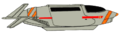
The sleek Class A6 light atmospheric shuttle was the direct descendant of the lifting-body, lifting wing
personnel and utility craft of the 22nd century, and in many ways the culmination of that
technology. The mechanisms and software that kept the aerodynamically highly unstable and thus
highly maneuverable craft under control were on the verge of transcendence. As the A6 (also called
Starswift by the manufacturer, and LSA(P)-44 in the systematic Starfleet listing) completed its test
flight series in early 2196, engineers were already tackling the problem they curtly defined as
“flying a brick through an aerobatic routine”.
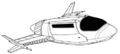
Indeed, the limitations of the aerodynamic form were well recognized on the issues of utilizable volume, accessibility and footprint. It would have been difficult to accuse the Starswift of low utility value, though. In its basic configuration, the tiny craft could carry six people between an orbiting starship and a planet of 1-2 Earth gravities. Trititanium-aluminum alloy was used for the tubular pressure hull, which seated the pilot in the front, four passengers or palletized cargo in the middle, and a sensor operator/passenger in a rear seat. Wide gullwing doors opened on both sides for excellent access, while the pilot had superb view from behind a bulbous cockpit window.
Antigravs were provided for landing, while main propulsion was by a microfusion pile powering either jets of atmospheric gases or rockets feeding from an onboard tank. The pile took up most of the aft hull, along with the cylindrar fuel/propellant tank. RCS nozzles were located on wingtip pods, although main attitude control was by antigravs.

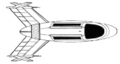
The wings extended from the rear hull to provide atmospheric lift, with winglet control surfaces at the tips. The wing leading edges also housed engine coolers. For defensive needs, rapid-fire laser units were mounted on the wingtips. Main sensors were located under bow and stern in special cutouts; the forward cutout also featured a low-power deflector, the aft one a palletized jammer suite for self-protection. For combat missions, four missiles could be mounted underwing.
Type 6 shuttles were officially designated the Sauk class, following the contemporary theme of North American tribal names, but the harrowing flight characteristics readily explained the more usually used name ‘Shook’. The craft were deployed aboard light and heavy cruisers to replace antiquated A3 and B4 (‘Little Sioux’ and ‘Big Sioux’) atmospheric craft. Due to their limited spaceborne performance, they were almost exclusively used as alternatives to transporters when deploying landing parties on planets featuring transporter-disrupting phenomena. Typically, a Horizon class cruiser would carry two of these craft in addition to Class B and C craft, although a dozen could easily be accommodated aboard – more if the wings were removed for stowage, a nontrivial operation calling for at least an hour of reassembly.
The rapid development of multi-purpose shuttles soon led to the abandoning of this special type, and also the whole classification system. Most units had been withdrawn by early 2249. Some examples of these robust shuttles still serve as space-certified hovercars in many worlds, though, and are sought-after collector items.
Notes
- I've removed the mention of Type III phasers, as these were not introduced until 8 years after the A6 was removed from service.
- The A4 reference was changed to B4, to reflect the heavy nature indicated by 'Big Sioux.'
Gallery
-
-

-
 Bow & stern cutaway
 -
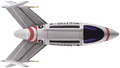 Dorsal view
 -
-
 Starboard view
 -
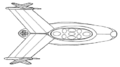 Ventral view
 -
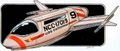
-
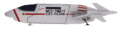 Gear down
.png)
.png)
.png)
.png)
.png)
.png)
.png)

