Guide:Class G2: Difference between revisions
created |
No edit summary |
||
| (6 intermediate revisions by the same user not shown) | |||
| Line 1: | Line 1: | ||
{{Sidebar Guide ship | {{Sidebar Guide ship | ||
|image=[[File: | |image=[[File:G2 (stbd).png|250px|Class G2 / HSI(U)-2 "Greyhound" heavy warp shuttle]] | ||
|classname= Class G2 | |classname= Class G2 / HSI(U)-2 "Greyhound" | ||
|category= heavy warp shuttle | |category= heavy warp shuttle | ||
|years= [[2215]]-[[2278]] | |years= [[2215]]-[[2278]] | ||
|constructed= 276 total:<br> | |constructed= 276 total:<br> | ||
* Mk I: | * Mk I: 142 | ||
* Mk II: | * Mk II: 22 | ||
* Mk III: | * Mk III: 63 | ||
* Mk IV: | * Mk IV: 49 | ||
|length= 13.6 m | |length= 13.6 m | ||
|beam= 7. | |beam= 7.7 m | ||
|height= <br> | |height= <br> | ||
* 6.9 m (landing gear retracted) | * 6.9 m (landing gear retracted) | ||
| Line 39: | Line 39: | ||
|history= FASA, own | |history= FASA, own | ||
}} | }} | ||
The three practical shortcomings of the pathfinding Comet warp shuttle were obvious to | |||
The three practical shortcomings of the pathfinding [[Guide:Class G1|Comet]] warp shuttle were obvious to [[Star Fleet]] | |||
from the very beginning. The solution readily presented itself as well: the cost, horizontal footprint | from the very beginning. The solution readily presented itself as well: the cost, horizontal footprint | ||
and mass of the craft would be halved by omission of one warp nacelle. Whether such a craft would | and mass of the craft would be halved by omission of one warp nacelle. Whether such a craft would | ||
| Line 46: | Line 47: | ||
beginning. | beginning. | ||
Conceptual studies by VXT confirmed what common sense already suggested: a centerline | Conceptual studies by [[VXT]] confirmed what common sense already suggested: a centerline | ||
mounting would leave the craft without utilizable payload volume. Furthermore, installing the ion | mounting would leave the craft without utilizable payload volume. Furthermore, installing the ion | ||
cascade powerplant ahead or astern of the warp coils would result in a vehicle of impractical length. | cascade powerplant ahead or astern of the warp coils would result in a vehicle of impractical length. | ||
As the warp propulsion aspect of the Comet design was deemed more important than the ability to | As the warp propulsion aspect of the Comet design was deemed more important than the ability to | ||
operate from aboard starships, | operate from aboard starships, Star Fleet soon agreed that it would be best to concentrate on creating | ||
a compact and affordable warp transport for surface and starbase applications, and to leave the | |||
a compact and | |||
revolution of warp-capable starship auxiliaries for the next generation of craft. The single-nacelled | revolution of warp-capable starship auxiliaries for the next generation of craft. The single-nacelled | ||
Greyhound was thus adopted as the Class G2 warp shuttle in a form that was inherently | "Greyhound" was thus adopted as the '''Class G2''' warp shuttle in a form that was inherently | ||
incompatible with most starship hangar decks. | incompatible with most starship hangar decks. | ||
| Line 75: | Line 75: | ||
acceptable. | acceptable. | ||
For some fifteen years, the G2 enjoyed primary warp liaison vessel status and also saw planetary | For some [[2230|fifteen years]], the G2 enjoyed primary warp liaison vessel status and also saw planetary | ||
assault service, evolving into four variants: the original Mk I received improved passenger interiors | assault service, evolving into four variants: the original Mk I received improved passenger interiors | ||
to become Mk II, lost these but gained armoring to become the Mk III assault type, and had the | to become Mk II, lost these but gained armoring to become the Mk III assault type, and had the | ||
holds reconfigured for maximum cargo capacity in Mk IV. It was only in the 2230s that advancing | holds reconfigured for maximum cargo capacity in Mk IV. It was only in the [[2230s]] that advancing | ||
technology provided the means for further compacting of ion power drives and allowed the | technology provided the means for further compacting of ion power drives and allowed the | ||
production of boxy high volume craft such as the ones adopted as Class F2 and G3 utility shuttles. | production of boxy high volume craft such as the ones adopted as Class F2 and G3 utility shuttles. | ||
The former offered no propulsive advantages over the Greyhound but had vastly improved | The former offered no propulsive advantages over the Greyhound but had vastly improved | ||
utility as a starship auxiliary, while the latter outperformed the single-naceller so significantly | |||
in every respect that it swiftly took over the starbase and surface assignments. | in every respect that it swiftly took over the starbase and surface assignments. | ||
The Greyhounds persisted much like the Comets, serving in secondary roles till the late seventies. | The Greyhounds persisted much like the Comets, serving in secondary roles till the [[2270s|late seventies]]. | ||
The complexity and cost of the pathfinding technology precluded long post- | The complexity and cost of the pathfinding technology precluded long post-Star Fleet careers, | ||
though. Only the Mk IV saw small goods delivery service in UPS colors until superseded by | though. Only the Mk IV saw small goods delivery service in UPS colors until superseded by | ||
commercial dilithium-powered designs. | commercial dilithium-powered designs. | ||
| Line 92: | Line 92: | ||
==Gallery== | ==Gallery== | ||
<gallery> | <gallery> | ||
File:G2 (bow).png|Bow view | |||
</gallery> | </gallery> | ||
==Notes== | ==Notes== | ||
* | * The sidebar height was changed from 7.3 to 7.7 meters, to match the text. | ||
* Production dates need to be set for the Mks II through IV. | |||
<br> | |||
---- | ---- | ||
* [[Guide: Timo's Guide to | * [[Guide: Timo's Guide to Star Fleet|Back to the Table of Contents]] | ||
* [[Guide: Shuttlecraft|Back to Shuttlecraft]] | * [[Guide: Shuttlecraft|Back to Shuttlecraft]] | ||
* [[Guide: Of Ship Statistics|Appendix A: Of Ship Statistics]] | * [[Guide: Of Ship Statistics|Appendix A: Of Ship Statistics]] | ||
* [[Guide: Glossary|Appendix B: Glossary]] | * [[Guide: Glossary|Appendix B: Glossary]] | ||
* [[Guide: | * [[Guide: Star Fleet Organization - General Outline|Appendix C: Star Fleet Organization - General Outline]] | ||
* [[Guide: Abbreviations From Outside|Appendix D: Abbreviations From Outside]] | * [[Guide: Abbreviations From Outside|Appendix D: Abbreviations From Outside]] | ||
[[Category:Guide|{{PAGENAME}}]] | [[Category:Guide|{{PAGENAME}}]] | ||
Latest revision as of 11:38, 18 November 2022
.png)
| |
| Class G2 / HSI(U)-2 "Greyhound" | |
|---|---|
| Class Overview | |
| Category | heavy warp shuttle |
| Operational | 2215-2278 |
| Constructed | 276 total:
|
| Dimensions | |
| Length | 13.6 m |
| Beam | 7.7 m |
| Height |
|
| Mass | 63.4 tons |
| Performance | |
| Cruise Speed | w 1 |
| Max Speed | w 1.5 |
| Endurance | 2 weeks |
| Complement | |
| Crew | 2 |
| Passengers | 12
|
| Tactical Systems | |
| Shields |
|
| Canonicity | |
| Design | FASA |
| Name | FASA |
| History | FASA, own
|
The three practical shortcomings of the pathfinding Comet warp shuttle were obvious to Star Fleet from the very beginning. The solution readily presented itself as well: the cost, horizontal footprint and mass of the craft would be halved by omission of one warp nacelle. Whether such a craft would retain sufficient performance to work as a starship auxiliary was never truly in question. Yet whether one could be designed to conform to operational demands was debatable from the very beginning.
Conceptual studies by VXT confirmed what common sense already suggested: a centerline mounting would leave the craft without utilizable payload volume. Furthermore, installing the ion cascade powerplant ahead or astern of the warp coils would result in a vehicle of impractical length. As the warp propulsion aspect of the Comet design was deemed more important than the ability to operate from aboard starships, Star Fleet soon agreed that it would be best to concentrate on creating a compact and affordable warp transport for surface and starbase applications, and to leave the revolution of warp-capable starship auxiliaries for the next generation of craft. The single-nacelled "Greyhound" was thus adopted as the Class G2 warp shuttle in a form that was inherently incompatible with most starship hangar decks.
Mounting the warp coils above the hull solved the footprint problem, maximized payload volume, and trivialized the issue of ingress and egress. The Greyhound was configured with the DB-20 riding on a dorsal pylon that also housed the impulse propulsion system, and with the CID powerplant at the pylon stem. The control cabin was mounted ahead of the reactor, giving the single pilot an excellent view forward and down, and the single aft-facing engineer an equally direct access to the power systems. The payload of 10 tons of water-equivalent cargo or 12 passengers was carried in the wide lower part of the craft, entering through a forward door beneath the cockpit. The forward leg of the tripod landing gear doubled as the ingress ramp when deployed; a trio of lift engines was arranged in the reverse pattern, with two in front straddling the forward leg and one between the aft pair of legs.
The stack reached a total height of 7.7 meters, making operations from aboard even the largest starship hangars cumbersome. Also, the high mounting of the warp coils and the reactor presented some stability problems at landing. On the other hand, the horizontal footprint of 12.8 m times 7.3 meters was quite reasonable for a craft of such performance. Warp 1.5 could be achieved without field gradient hazards to the crew or the cargo, and impulse performance was found perfectly acceptable.
For some fifteen years, the G2 enjoyed primary warp liaison vessel status and also saw planetary assault service, evolving into four variants: the original Mk I received improved passenger interiors to become Mk II, lost these but gained armoring to become the Mk III assault type, and had the holds reconfigured for maximum cargo capacity in Mk IV. It was only in the 2230s that advancing technology provided the means for further compacting of ion power drives and allowed the production of boxy high volume craft such as the ones adopted as Class F2 and G3 utility shuttles. The former offered no propulsive advantages over the Greyhound but had vastly improved utility as a starship auxiliary, while the latter outperformed the single-naceller so significantly in every respect that it swiftly took over the starbase and surface assignments.
The Greyhounds persisted much like the Comets, serving in secondary roles till the late seventies. The complexity and cost of the pathfinding technology precluded long post-Star Fleet careers, though. Only the Mk IV saw small goods delivery service in UPS colors until superseded by commercial dilithium-powered designs.
Gallery
-
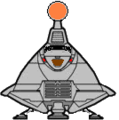 Bow view
.png)
Notes
- The sidebar height was changed from 7.3 to 7.7 meters, to match the text.
- Production dates need to be set for the Mks II through IV.