Guide:Class B1 (pod)
.png)
| |
| Class B1 (or IP-27) | |
|---|---|
| Class Overview | |
| Category | work pod |
| Operational | 2129 - 2168 |
| Constructed | 380 |
| Performance | |
| Max Speed | Maneuvering thrusters only |
| Endurance | 2 days |
| Complement | |
| Crew | 2 |
| Passengers | 2 |
| Cargo |
|
| Canonicity | |
| Design | ENT |
| Name | own |
| History | own
|
For their crew-attended manipulation needs, Earth orbital dockyards in the 20th century made use of
relatively clumsy conversions of small surface-to-orbit spacecraft, essentially just cutting further
portholes into these ballistic pods and bolting on some manipulator arms and spotlights. A range of
dedicated designs finally emerged in the early 21st century, lacking bulky reentry heatshields and
parachutes but incorporating more versatile tools, lighting rigs and situational awareness systems.
There were few modifications to their basic structure for the next hundred years, and the first
noteworthy improvement was the IP-27 Class B pod designed in 2129 for carrying aboard
interstellar starships.
The small pod was primarily configured as a spatial personnel transfer and inspection craft, with an ergonomically sized rear docking hatch, comfortable seating for one to four people, plus locker space for small cargo. Yet out of the operational necessity of deep space assignments, the IP-27 also featured a pair of laterally stowed manipulators and a bow attachment point for repair and inspection tools, thus doubling as a work pod for her mothership. Two crew would operate the capsule in this role, although two more could be carried as passengers. Both pilots had seats oriented with floor-normal artificial gravity; the conical shape of the cabin allowed for forward and lateral vision through four viewports and dorsal inspection through a wide overhead port. There were illumination fixtures both above and below the craft, the latter at the end of an extensible and steerable arm. Simple radar provided proximity awareness.
While more capable “space forklifts” continued operations on Earth’s various orbital outposts, it soon became obvious that the compacting and integrating work performed on the multipurpose IP-27 was providing the best bang for the buck. Other manufacturers soon began offering comparably small pods, sometimes with modular engine packages for heavier manipulation tasks. Production of the IP-27 was terminated in 2142, and the last units were replaced by 2168. Most were quite worn down; some had even served in exotic combat assignments during the Romulan War, disabling buoys and satellites, infiltrating floating outposts and sometimes breaching enemy hulls at the desperate last stages of engagements where neither side would consider surrender or retreat. Postwar repairs of Earth’s tattered and torn space assets kept repair pod manufacturers in steady business and ensured swift replacement of the IP-27.
Gallery
-

-
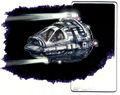 A fully equipped pod
 -
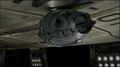 An IP-27 gets up close and personal with an Enterprise class vessel


Alt Sources
- Starship Handbook (Combined) (as Inspection Pod)