Guide:Djartanna
.png)
| |
| Djartanna | |
|---|---|
| Class Overview | |
| Category | Light Destroyer |
| Operational | 2139 - 2189 |
| Constructed | 316 total:
|
| Dimensions | |
| Length |
|
| Beam |
|
| Height |
|
| Mass |
|
| Performance | |
| Cruise Speed |
|
| Max Speed |
|
| Endurance |
|
| Complement | |
| Officers | 6 |
| Enlisted | 45
|
| Tactical Systems | |
| Beam Weapons | Original
Romulan War refit
|
| Missile Weapons | Original
Romulan War refit
|
| Shields | |
| Auxiliary Craft |
|
| Historical | |
| Ships of Note |
|
| Canonicity | |
| Design | FASA |
| Name | FASA |
| History | FASA
|
Background: The Hobbyist's Guide
Coping with the expansion of colonized space was largely a theoretical exercise for the UESF of the early 22nd century. Out of the roughly 5,000 warp vessels built by Earth so far, some fifty were battleworthy interstellar combatants within range of colonial holdings, "range" being generously defined as a response time of less than a year. A further hundred could be deployed for battle across "short ranges", yet even the major off-Sol colonies at Alpha Centauri lay outside these parameters. Rather than attempt to increase the strength or range of the interstellar response fleet, the UESF found it theoretically more attractive to build large numbers of local action warp interceptors. As some two hundred of such destroyer-type vessels would be needed to protect Earth, Mars, and Earth Colony One alone, though, practical execution was beyond Earthly means.
Yet these were not the only means available for the Terran colonists of the Alpha Centauri system. There had already been extensive technology exchange between the first settlers and native inhabitants, and the industrial potential of the Centaurians had surprised the Terrans over and over again. In the 2120s, joint ventures moved beyond basic colonial matters such as the construction of shelters, local transportation, or water purifier plants. The first tentative deals were now signed between Earth and Centauri defense corporations to provide the system patrols with the necessary spaceships. Signatures by military authorities followed slightly thereafter.
Interstellar cooperation did not come easily, what with millennia of differing engineering traditions, economic systems, or even units of measurement separating the two cultures. But Centauri Overseers were just as interested as UESF Command in providing a credible defense against alien cultures, especially when the Vulcans were taking an "actively passive" stance on the matter. A destroyer design with Earth-provided warp drive was created in a joint program between 2136 and 2139, and fielded in large enough numbers to provide defense for both Human and Centaurian home systems and their respective primary colonies.
The basic hull shape of the Djartanna destroyers was, in theory, a lifting body. Yet when attached to the two rather gargantuan S40 nacelles with integrated ramscoops, the Djartanna was largely consigned to vacuum and to relatively pedestrian maneuverability and impulse performance as well. The main hull thus was to enter atmospheres in emergencies only, after a separation maneuver. As completed for the Djartanna (DD-88 in UE Starfleet registry, although such pennant paint was only applied after fifteen years of operations), the forward hull was jam-packed with combat systems, most of Earth origin. Atop was the bridge, topped by a sensor dome. Beneath the bow lay the main plasma cannon, in a turret mount that provided about half the firepower of the older, larger Emmette destroyers that had been able to bring two such cannon to bear on any enemy. Secondary 1 GW cannon were carried on both dorsal and ventral surfaces and hull polarizer rotors mounted in between. There was a secondary impulse engine in the hull as well, with two tiny fusion reactors, each with twin nozzles of which the outboard one was fully vectoring—a layout to be repeated in the Enterprise class cruisers a few decades later. Between the external shrouds of the engines was an aft-facing docking bay for a fuel lighter, with a small airlock to the starboard side.
A T-shaped support pylon connected the primary hull to the warp engines, so that a diminutive powerplant block was left in between the S40 nacelles. These open-frame units could drive the vessel close to warp two for short jumps. Primary sublight propulsion came from a single-nozzle impulse engine at the stern of the power block, feeding directly from primary loop plasma. In the final models of the destroyer, a single plasma recharger was added under the power block for increased warp and impulse performance.
The RCS packages and gyroscopes were all packed in the power block as well, there being no more room in the main pressure section. From Vigilance subclass onwards, two further RCS units were added at the stems of the horizontal pylons supporting the warp engines and several collision avoidance radars installed around the hull. Another late addition was a series of glass bead dispensers for fooling enemy lasers and for quickly mining regions of space with shrapnel dangerous to small vessels. These replaced the ventral berth for a Rutan "Firefly" spatial pod, forcing the Djartannas so equipped to rely on external means of crew transfer. While the arcane defense system did not do much good against large spaceships, it was still very effective against light and unshielded Romulan fightercraft. The polarizable hull surface armor of the destroyers in turn was immune to such threats and allowed the UESF to ditch several outdated concepts on space combat maneuvering dating back from the previous century and a half.

As many as 316 of the small ships were built in all, in sixteen batches on five orbital dockyards in the Alpha Centauri A and Sol systems. Each batch featured incremental structural improvements on the basic design, but the main reason for continued production was the ever-growing need for local defenses. Some fifty units deployed permanently at each major Human system—at roughly 50% availability—was barely enough for credible deterrence against space piracy. Numbers compensated for lack of performance: the masses of destroyers were frequently paraded in front of visiting alien dignitaries for psychological effect, yet much less often deployed for actual defensive duties. True power projection was handled by the few available high warp cruisers. As those units were almost constantly on faraway assignments, the face of the Starfleet usually presented to the public was that of the idled rows of destroyers. The communications media were eager to report the Mendor as the first "alien"-built ship to be officially incorporated into the UESF, even though off-Earth commercial designs had been in more or less regular use for half a century already.
Most of the destroyers operated nominally under shared command, but in practice within either UESF or Centauri Guardian Forces. Optimized for local action and not for the long interstellar deployment runs necessary for battle in the main fronts of the Romulan War, the destroyers held a defensive posture throughout that conflict. In 2158, when Romulan forces were feared to reach Earth, frantic measures were taken to step up local defenses and numerous outdated Djartannas were summoned to act as shields for the homeworld. They had served in this role with notorious indistinction during the Klingon and Xindi incursions, being far too slow to react or actually intercept anybody, and were eager to redeem their reputation now, patching up defensive holes through sheer numbers (and, for some vessels, with the help of a major upgunning). Several engagements with Romulan advance forces ended in Romulan retreat, but Starfleet now had to assume the enemy had accurate knowledge of the inner worlds and their defenses.
The initial successor to the Djartanna design was the upscaled Cavalry destroyer, with just a single warp engine but otherwise a similar layout. Yet both these light destroyer types were gradually replaced with far larger, somewhat more efficient designs that were better suited to the fast-moving offensives of the final war years. In 2162, the last Djartannas were idled as grossly outdated, and Marshall heavy destroyers were assigned to take their place in humble defense duties—a good indicator of the rapid pace of weapons development during the conflict. No Djartannas ever entered UFP Star Fleet service, but several dozen continued in the UESF arsenal until the late 2180s.
Few other warships of a single type have been built for Earth or the Federation in such large numbers. The current Federation industrial infrastructure would be quite capable of fielding hundreds of ships a year in the modern destroyer size range (or dozens of ships per year and per star system in the Djartanna size range) yet the military dogma do not include such massed use of manned spacecraft, nor the maintaining of large reserves of military vessels. Whereas the technology of the Romulan War era dictated that ships be available in quantity in every starbase, outpost, and strategic target, current warp technology allows for the warships to be normally deployed on exploration missions far away from the potential war theaters. It remains to be seen if this arrangement survives the continuing expansion of Star Fleet-patrolled space and the increasing of distances. It is possible that Star Fleet in the future will be forced to adopt the garrison strategy favored by most of the ancient empires, despite its obvious drawbacks.
Gallery
-
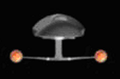 Bow
Bow -
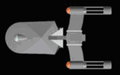 Dorsal
 -
 Dorsal port angle
 -
 Stern
Stern -
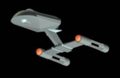 Ventral port angle
 -
 A Djartanna entering orbit
.png)
.png)
.png)
.png)
.png)

Notes
- The spelling has been changed from "Centauran" to "Centaurian".
- The prefix "USS" has been changed to "UESS" for ships of the United Earth Starfleet.
- The article is very clear the Djartanna did not serve in the UFP Star Fleet.