Guide:Guardian/Majestic
- see also Guide: Guardian (USAF)
.png)
| |
| Guardian / Majestic | |
|---|---|
| Class Overview | |
| Category | heavy escort |
| Operational | Guardian: 2229-2258 |
| Constructed | 106 total:
|
| Dimensions | |
| Length | 149.0 m |
| Beam | 76.2 m |
| Height | 38.0 m |
| Mass | 190,000 tons |
| Performance | |
| Cruise Speed | w 4 |
| Max Speed | w 4.7 |
| Endurance | 8 months |
| Complement | |
| Officers | 10 |
| Enlisted | 48
|
| Tactical Systems | |
| Beam Weapons | Guardian:
Majestic:
|
| Shields |
|
| Transporters | n/a |
| Auxiliary Craft |
|
| Historical | |
| Ships of Note |
|
| Canonicity | |
| Design | SOTL 2006/Aristomenis Tsirbas, STO |
| Name | LUG |
| History | LUG
|
As soon as supercruise capability was introduced to the elite units of the logistics fleet, the need
arose to defend these units on their way to fleet support assignments. Detaching to escort duty the
very starships the tenders and transports were supposed to assist would have been
counterproductive indeed. Operating the support units only within the context of an entire fleet in
motion would not be practical, either; strategic mobility definitely called for the option of shipping
supplies back and forth between bases and detachments, even when the latter were operating at
regions of high risk.
The first experiments with supercruising convoy involved Kovaris destroyers propelled by the capable PB-25 engines. When these turned out to be in too short a supply, designing of dedicated escorts based on the PB-23 of the logistics force began in earnest. Results could be presented by 2229, just in time to match the escalation of threat from Klingon long range raiders. The 2212 ransacking of even the unescorted Klingon Flying Fortress was elemental in prompting Star Fleet to proceed with making use of said results, despite the fact that the supercruising escort Guardian (NCC-E300) was not quite meeting the specifications.
There was nothing wrong with the drive system or its ability to sustain supercruise. A pair of PB-23 engines, bolted to a cigar hull a hundred meters long, was producing the required warp field under power from a reactor identical to the system concurrently installed on Independence fast transports. The single Scarbak KKR impulse engine below aft hull was also performing admirably, despite some reliability problems. The shortcomings resulted from the combination of these systems into a fighting unit, intended to provide armed escort in deep space for up to a year – affordably enough that a hundred convoys per year could be shepherded to destinations of high risk. The performance was there all right, but came at an unacceptable unit cost and consumed onboard resources so hungrily that maximum mission duration had to be set at eight months.

The Guardian was not the solution to Star Fleet’s escort woes yet, then. Yet it was a valiant start. The saucerlike extension of the main hull to port and starboard presaged future combatant designs, and housed a formidable weapon system of eight 1.6 GW lasers, later hidden under smooth gunports. Cowled at the saucer/cigar joint were various sensors and scanners enabling independent operations. A large sensor and deflector dish at the very bow facilitated warp four navigation, and combat shields were at what might be described as high corvette level. Sized nearly like destroyers but stocked with fewer weapon systems, more modest shield generators and no transporters, the escorts offered almost comfortable accommodation for the 58 crew. There was also a shuttlebay and hangar for two light liaison craft, providing welcome interfacing with the other ships in the convoy.
Sixty-two of the bold combatants were produced in a great rush before Star Fleet made up its mind about the deep space escorts it really needed. The Guardian was a tad too large and expensive for her role – yet frustratingly too light to accommodate the superior PB-35 engine when it became available. An all-new escort with an even bigger saucer hull had to be devised to make use of the engine. The single-nacelled Remora class greatly outperformed both the Guardian and its up-gunned Majestic variant in almost every respect. Only a minor advantage in endurance kept a few of these vessels operational past the 2250s, at which point the Hellespont three-engine escort completed the generation change and consigned the two-nacellers to an early retirement. In practice, this meant disarming and export to friendly powers, all of which were now cleared for the early generation of supercruise propulsion.
There exists a surprising afterword to the story of the Guardians, however. The overall design was eagerly adopted by several of the cultures that had bought the surplus hulls. Production of comparable designs ensued at Andess and Lactra in the seventies, and when the Bilanans joined the Federation in the early 24th century, they soon had a modernized variant in production. This type originally remained in local use only. However, the Dominion War saw its adoption, with minor modifications, as the Dervish class patrol escort. This vessel, described in a later entry, has been found thoroughly satisfactory and is projected to spawn a range of related, more advanced patrol combatant designs.
Gallery
-
 Guardian (bow)
 -
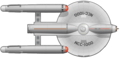 Dorsal view
 -
 Stern view
 -
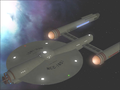 A Guardian on patrol
.png)
.png)
.png)

Notes
- This design is known as the Bonaventure class in non-Timo and non-game canon (specifically in beta and possibly in Star Trek Online canons).
- Emphasis is added to the vulnerability of solitary transports by the strengthening the concept of the Flying Fortress being a Klingon vessel. The year 2212 was also added, as original wording could suggest the ransacking occurred around the time of the Guardian's unveiling.
- The link for the 24th century actually points to 2317, due to the randomly determined entry point of Bilana III influenced by the last paragraph.