Guide:TAU

| |
| TAU series | |
|---|---|
| Class Overview | |
| Category | NASA extrasolar exploration vessel |
| Operational | 2036 - 2069 |
| Constructed | 5 |
| Dimensions | |
| Length |
|
| Beam |
|
| Height |
|
| Mass |
|
| Performance | |
| Max Speed | 0.3c |
| Endurance | 6 years (w/cryosleep) |
| Complement | |
| Crew | 15-18
|
| Tactical Systems | |
| Shields | electromagnetic shield (max 12 mt) |
| Auxiliary Craft |
|
| Canonicity | |
| Design | Kris Trigwell |
| Name | own |
| History | (own, adapting TNG and SFC)
|
In the first decade of the 21st century, various new countries on Earth entered the space race.
Technology leaps implemented by the genetically-augmented scientists enabled most industrialized
nations to mount elaborate space programs. Between 2000 and 2009 alone, a total of 212
interplanetary and 51 interstellar probes were launched, and six major manned orbital platforms
were assembled – typical actions by a fledging space power, although the time scale is slightly
shorter than the galactic average. Manned missions to Mars, the asteroids and the Jovian and
Saturnian moons were performed using combined NTR and ion drives and cryosleep techniques. A
tentative colony was founded on the Moon but later abandoned and destroyed; today, the basalt bed
of Lake Armstrong covers the site of the ruins. All the time, the various nations were preparing for
the next giant step for mankind: the first manned interstellar mission.
The first crewed probeships to attempt flight outside the star system of Sol were built in the late 2030s. The program was mainly run by the de facto only surviving economical superpower, the United States (through NASA), although an international crew was selected for the missions to appease vocal critics of the US in the New United Nations. Still, France, Texas, China and India were skeptical, to say the least, of the motivations behind the technology alliance that created the craft.
Like most early 21st century craft, the so-called TAU ships (Thousand Astronomical Units, the grandiose but ultimately unrealistic intended range of the craft) were put together around Amjet engines copied from Singh empire vessels. Crew facilities and other equipment were developed and built around the world in an international cooperation effort of previously unseen scale. This cooperation was not without incidents, as evidenced by sabotage of component shipments by both Texan and Greenpeace submarines and the daring theft of five experimental EM shield generators by suspected Russian operatives. The completed vessels, built in Earth orbit, took the shape of multi-modular ‘trains’, with a large booster stage attached to the stern. The booster was used to throw the craft out of the solar system, after which gas-core fission engines, coupled with Singh-style hypervelocity exhaust systems, provided continuous 0.8 g acceleration, theoretically up to as much as 0.5 c. Ahead of the booster and the fission stage lay support system compartments, sporting communications antennas and long radiator surfaces. Foremost were a centrifugal habitat compartment and a command pod, with maintenance pods and, in some cases, landing craft attached.
Five manned TAU vessels of slightly varying configurations were sent to probe the space beyond the heliopause. Their missions varied, from the testing of future interstellar flight hardware or military spacecraft systems like EM shields to experiments on long-term life support and cryosleep. With some flights reaching as far as 350 AU from the sun, long-base interferometry measurements were conducted in hopes of locating extrasolar planetary systems and perhaps even civilizations.
Unfortunately, shielding on the craft proved woefully inadequate. Contact with the main computer of the Daedalus was lost five months into the mission, soon after the ship had passed the orbit of Pluto. After a month of frantic efforts at re-establishing communications, brief telemetry contact with the monitoring systems revealed a series of onboard fires and subsystem failures. Soon thereafter, the ship vanished in the inner Oort cloud, and was presumed destroyed. A massive charge buildup on her hull was deemed the likely cause after a detailed telemetry analysis. TAU Two, the Betelgeuze, incorporated extensive protective measures and was configured to carry two crewmembers awake at all times, to provide a better response to such completely unexpected contingencies as the Daedalus catastrophe had been. The Betelgeuze completed a six-year mission into interstellar space and finally proved the concept of cryosleep as a long-term life support method.

TAU Three, the Charybdis, was lost as her still rather poorly understood Singh-derived drive systems apparently jammed open and propelled the ship out of communications range. Two of the following missions attempted to locate the vessel, without any success. It was later found that the ship had been rescued/abducted by unknown extraterrestrials who had apparently transported her to Theta 116 system; the remains of the sole survivor of the crew, mission commander Lt. Col. Stephen Richey, USAF, were in 2365 found on Theta 116-VIII by the away team of USS Enterprise (NCC-1701- D). A similar fate must have befallen several space probes and manned missions in the early 21st century, but the identity of the abductors still remains a mystery. Vulcan survey files from the early 21st century appear devoid of clues in this respect. The abductions seem to have ended after the invention of warp drive on Earth.
The two disasters could have been expected to end all efforts at interstellar travel for a good while. Instead, interest in such missions increased constantly. A fierce econo-technological competition between the US compact and a new Eurasian alliance called the Econ drove both researchers and manufacturers to double their efforts in constructing an interstellar exploration vessel, at virtually any cost. During the 2030s, Earth spaceflight rapidly progressed beyond the level reached by the genetically engineered supermen, and it very much seemed as if interstellar flight would indeed become reality within the next twenty years. Unfortunately, the two competing superpowers had other goals as well – among them elimination of the competitor and supremacy of mankind’s own solar system. Numerous combat spacecraft, both cislunar and interplanetary, were fielded and weapons of mass destruction based on Earth orbit. By the 2040s, it was difficult to predict which of the wishes of the superpowers would be met first.
SFC Note: The Guide reports only 5 ships were launched, though the data column indicates 8. As it doesn't make sense that 3 vessels of that time would be built and not utilized, the data column is being adjusted and it is presumed the last vessel, the Jacob, was restricted to inside the solar system, possibly making up to three TAU missions to the Oort cloud.
SFC Note: The symbol 'θ' has been replaced by 'Theta' for sake of simplicity and to match official canon.
Missions
Vessels of the TAU series were named after mythological characters.
- Daedalus - TAU One (2036): presumed lost
- Betelgeuze - TAU Two (2037-2043): successful heliopause mission
- Charybdis - TAU Three (2037-2038): lost; remnants found orbiting [[Theta 116 VIII]
- Plebas - TAU Four (2037-?): heliopause mission; mission conclusion unrecorded
- Jacob - TAU Five, Six, Seven, Eight (2038-?): Charybdis search mission; follow-on Oort cloud missions; mission conclusions unrecorded
Gallery
-
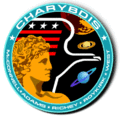 Charybdis mission patch
