| STARSHIP CLASS
|
|
| DY-50
|
| Transport (Experimental)
|
| Affiliation
|
People's Republic of China
|
| Completed
|
2 projected
|
| Active
|
0
|
| Projected Lifespan
|
5 years
|
| Dimensions
|
| Mass
|
2,200 mt
|
| Length
|
102.2 m
|
| Beam
|
48.8 m
|
| Height
|
30.9 m
|
| Characteristics
|
| Crew
|
2
|
| Combat Ratings
|
| Size
|
3
|
| Impulse
|
0.005c
|
| Damage
|
n/a
|
| Threshold
|
n/a
|
| Background
|
| Costs (RPs)
|
173 / 34.6
|
| Guide entry
|
DY sublight series
|
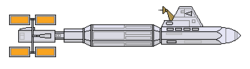
The DY-50 craft were Earth's first modern interplanetary spacecraft, though neither were actually operated (nor designed) to transit even to Luna. Instead, the People's Republic of China (PRC) built the vessels as flight-worthy feasibility studies and successfully proved their viability, leading directly to the DY-100 series. They were not capable of mounting the DY series cargo modules, but instead carried any assigned cargo internal to the spine, with two pairs of clamshell doors on the dorsal and ventral sides providing access.
Ships
| Name |
NCC |
Builder |
Commissioned |
Decommissioned |
Status
|
| pre-Shuguang |
DY-50 |
Wenchang Shipyard, PRC |
(1989) |
n/a |
under development
|
| pre-Shenzhou |
DY-51 |
Wenchang Shipyard, PRC |
(1989) |
n/a |
under development
|
Flight Configuration
Mass: 2,200 mt
- Size: 3
- Length: 107.6 m
- Beam: 39.5 m
- Height: 26.1 m
- Maximum SU: 614
- Utilized SU: 575
- SU Mass: 4 mt (3.58 mt specifically)
Hull (24 SU)
- Outer Hull/Primary Structure: 12 SU (Type: OH 42.96; cost: 3.6 RP)
- Inner Hull/Secondary Structure: 12 SU (Type: IH 42.96; cost: 3.6 RP)
- Resistance: 2 (free)
Personnel Systems (444 SU)
- Crew: 2 (limited as a test vehicle)
- Passengers: n/a
- Crew Quarters: 1 SU
- 2 Zero-G hammocks
- Basic Life Support: 12 SU (Type: 42.96; cost: 3.6 RP)
- Reserve Life Support: 6 SU (Type: 21.48; cost: 1.8 RP)
- Emergency Life Support: n/a
- Gravity: n/a
- Consumables: 1 year (6 SU)
- Food Processor System: Food Stores (2 SU)
- Industrial Fabrication Units: n/a
- Medical Systems: Rating 1 (5 SU) (Type: 17.9; cost: 1.5RP)
- Recreation Facilities: Rating 1 (6 SU) (Type: 21.48; cost: 1.8 RP)
- Personnel Transport: Jeffries Tubes only (3 SU) (Type: 10.74; cost: 0.9 RP)
- Fire Suppression: 3 SU (Type: 10.74; cost: 0.9 RP)
- Cargo: 1,432 mt (400 SU)
- Escape Pods: 1 (1 SU) (Type: 3.58; cost: 0.3 RP)
Propulsion Systems (35 SU)
- Warp Propulsion System: n/a
- Impulse Propulsion System: Chemical Propulsion (30 SU)
- Reaction Control System:
- Primary RCS: 3 SU
- Auxiliary RCS: 2 SU (1.5 SU specifically)
Power Systems (29 SU)
- Battery Power Systems: 9 SU
- Emergency Power: Back-up battery system (5 SU)
- Electroplasma System: Pre-warp (15 SU)
Operations Systems (41 SU)
- Bridge Systems: 20th c. version (6 SU)
- Auxiliary Control Room: n/a
- Computers: 2 cores (silicon) (2 SU, 1.5 SU specifically, 0.75 each)
- Optical Data Networks: 9 SU
- Navigational Deflector: n/a
- Sensor Systems:
- Long-Range Sensors: Pre-warp, Class 1 (3 SU)
- Lateral Sensors: Class 0 (7 SU)
- Navigational Sensors: Class 0 (7 SU)
- Flight Control Systems:
- Autopilot: Flight Control 1, Coordination 1 (4 SU)
- Navigational Computers: Class 1 (1 SU)
- Back-up: free
- Attitude Control: 1 (0.75 SU specifically)
- Communication Systems: Type I (1 SU)
- Security Systems: n/a
- Science Systems: n/a
Tactical Systems
- Beam Weapons: n/a
- Missile Weapons: n/a
- Hull Plating: n/a
Auxiliary Spacecraft Systems (2 SU)
- Shuttlebays: 1 capsule connection (2 SU)
Notes
- While a vessel of this size should technically require 12-14 crew, it was never intended to operate as a freight transport and since would not be commissioned as a working vehicle, it was only designed to accommodate two crew. Additionally, while the DY-50's size would suggest an operational lifespan of 10 years, as a test model, neither ship was intended to be operated longer than five. That, along with the high-stress testing inflicted on the class resulted in much more expensive maintenance costs.
- The DY-50, as a test model, did not have a functioning shuttlebay, though there was a mock-up area designated as one. Instead, during the period of testing for the vessels, crew swaps would occur via the ground-based capsule system at the dedicated connection. The DY-50 never actually operated with the crew capsule attached, though the escape capsule was always available.
- While the DY-50 craft never operated as true freight transports and were only equipped with a rudimentary cargo door, they were rated to carry 400 mt of payload (expandable to 439 mt, if orbitally refit), over 16 times more than the previous re-usable vessel, the NASA Space Shuttle of 8 years earlier. (Technically, the space shuttle and the DY-50 were not re-usable in the same manner, as the DY-50 could not return to a ground position.)
- The DY-50 was very similar to the production DY-100 class, with only minor differences regarding overall length and height, which came about from results of launching and test-operating the DY-50. The biggest difference comes from the lack of any ability to attach cargo pods nor an efficient manner to transfer the limited cargo the class was capable of carrying to an intermediary craft.
