Guide:Baker: Difference between revisions
No edit summary |
|||
| Line 1: | Line 1: | ||
{{Sidebar Guide ship | |||
|image=[[Image:No Photo Available.jpg|250px|Baker light exploratory cruiser / destroyer]] | |||
|classname= ''Baker'' | |||
|category= light exploratory cruiser / destroyer | |||
|years= [[2268]] - [[2328]] | |||
* Flight I light exploratory cruiser: ([[xxxx]] - [[xxxx]]) | |||
* Flight III destroyer: ([[xxxx]] - [[xxxx]]) | |||
* Flight IV destroyer: ([[xxxx]] - [[xxxx]]) | |||
|constructed= 40 total: | |||
* Flt I: | |||
* Flt III: | |||
* Flt IV: | |||
|length= <br> | |||
* Flt I: 171.9 m | |||
* Flt III, IV: 212.6 m | |||
|beam= 96.0 m | |||
|height= <br> | |||
* Flt I: 48.7 m | |||
* Flts III, IV: 56.8 m | |||
|mass= <br> | |||
* Flt I: 413,000 mt | |||
* Flt III: 622,900 mt | |||
* Flts IV: 624,600 mt | |||
|cruisespeed= <br> | |||
* Flt I: w 6.0 | |||
* Flts III, IV: w 7.0 | |||
|towspeed= | |||
|maxspeed= <br> | |||
* Flt I: w 8.0 | |||
* Flt III, IV: w 9.0 | |||
|endurance= <br> | |||
* Flt I: 3 years | |||
* Flts III, IV: 2 years | |||
|officers= 36 | |||
|enlisted= <br> | |||
* Flt I: 199 | |||
* Flts III, IV: 237 | |||
|troops= | |||
|passengers= 30 researchers (Flt I) | |||
|patients= | |||
|crew= | |||
|cargo= | |||
|beamweapons= <br> | |||
<u>Flt I</u> | |||
* 4x phaser VI emitters (twin banks) (dorsal/ventral bow) | |||
<u>Flt III, Flt IV</u> | |||
* 4x phaser VI emitters (twin banks) (fwd dorsal quarters) | |||
* 2x phaser VI emitters (twin bank) (ventral) | |||
|missileweapons= <br> | |||
<u>Flt III</u> | |||
* 2x fwd light torpedo launchers (ventral bow) | |||
<u>Flt IV</u> | |||
* 2x fwd medium torpedo launchers (ventral bow) | |||
|otherweapons= | |||
|shields= <br> | |||
* 2-layer forcefields | |||
* nav deflector (secondary hull bow) (Flt I only) | |||
* 2x aux nav deflectors (dorsal superstructure) | |||
|labs= <br> | |||
Flt I: 4x (varying configs) | |||
Flts III, IV: none | |||
|transporters= <br> | |||
* 4x general purpose (6-pad); Mk III | |||
* 2x emergency evac (22-pad); Mk III | |||
* 1x cargo; Mk III | |||
|auxcraft= <br> | |||
<u>Flt I</u> | |||
* 1x medium (or) 2x light shuttles (or) 1x special environment craft | |||
<u>Flt III, Flt IV</u> | |||
* 2x light shuttles | |||
|historicalships= <br> | |||
* ''USS Baker'' (NCC-1296) | |||
|design= FASA, Brad R. Torgersen, ''TOS'' comic: "Action of the Tiger" | |||
|name= FASA | |||
|history= FASA, ''TOS'' comic: "Action of the Tiger" | |||
}} | |||
==Background: ''Hobbyist's Guide''== | |||
When the Bader exploratory cruiser construction program was aborted for lack of military scouting | |||
potential in the late 2260s, Starfleet lost an economical way of boosting its sagging exploration capabilities. Restarting of the program during the Organian peace would not have restored the | |||
economy of the concept, as the costs in reproducing the tooling alone would have outweighed the | |||
advantages of reusing the existing design. Rather, Starfleet had to seek savings in classic cutbacks, | |||
this quite literally meaning a reduction in the dimensions of the exploratory cruiser to be constructed | |||
in Bader’s stead. | |||
Starfleet’s first purpose-built exploratory light cruiser (or light exploratory cruiser, as the | |||
designation soon would be formalized) was to utilize relatively few preexisting elements. The | |||
command superstructure on the saucer hull was more or less standard stock, save for two | |||
navigational deflector dishes taking the place of bow quarters on Decks 2 and 3. However, the | |||
saucer itself was constructed to only 96 m diameter, featuring just basic accommodation and support | |||
functions, plus two twin banks of bow phasers with excellent fields of fire. | |||
A boxy hull extension astern served a dual role. The lower decks were dedicated to engineering, | |||
housing the main powerplant and antimatter stores. The upper half was home to four laboratories, | |||
lateral sensor berths, and a relatively capacious shuttle hangar with hinged dorsal doors. The number | |||
of transporter units was increased as well, with two six-pad systems in the saucer and two more plus | |||
a cargo unit in the aft extension. | |||
For a rare once, a separate IMFR assembly was carried, paired with the nozzle systems of the FID-2 | |||
impulse engine. Two PB-45 warp engines, despite showing their age, gave cruiser performance in | |||
all respects. The lion’s share of mission gear was to be carried between them, on a ventral grapple in | |||
Bader style, and normally consisted of a flattened cylinder with sensor arrays at both ends and | |||
equipment bays in the middle. If need be, the lithe explorer could instead carry a hangar pod for a | |||
fuller arsenal of survey craft, or heavy single-sensor modules of varying types, thus undertaking | |||
special missions the comparable if propulsively inferior Keith and T’Pari units were unsuited for. | |||
[[Image:No Photo Available.jpg|left|300px|thumb|USS Baker resting between sorties at Starbase 6. The mission module is about to be floated away; its forward sensor dish is well in evidence, yet the bracings of the starbase observation window obscure the lateral clusters of instrumentation, roll-out subspace antenna surfaces, and the doors to the survey equipment hangar at the spine of the module.]] | |||
The 2268 launch of the inaugural vessel appeared to justify all the doctrinal and engineering | |||
shortcuts applied on this stopgap type. Delivery was on schedule, on budget, and met the technological specifications of the time. Nine further units soon followed USS Baker, NCC-1290, to | |||
mapping missions in border regions now theoretically safe from Klingon harassment. | |||
The illusion of peace wasn’t quite shattered yet by a 2270 act of aggression against USS Bakker | |||
(NCC-1296). A criminal endeavor at Starbase 6 saw the temporarily idled research vessel used as a | |||
getaway vehicle. The audacious theft might have resembled various Klingon Imperial Intelligence | |||
coups of the recent past, but was quickly established to have been the work of petty criminals | |||
instead. Swift law enforcement action by Klingon cruisers deprived Starfleet of the petite explorer, | |||
but the act had no lasting diplomatic consequences either way. | |||
[[Image:No Photo Available.jpg|left|300px|thumb|A later view of the Bakker, better showing the angled pylons taking the full load of the PB-45 engines. The interchangeable | |||
nature of the mission pod is also evident here.]] | |||
Forces driving for re-escalation existed independently of such events. A refitting craze gripped | |||
Starfleet at the introduction of linear excitation warp propulsion technology, and suddenly every | |||
existing platform was seen as a potential basis for a superfast, multipurpose combatant. The | |||
remaining flock of light exploratory cruisers was in 2270 deemed to be behind the times on all three | |||
aspects of the designation: more substantial armament, protection and propulsion was called for; | |||
exploration had to give way to defensive duties; and the proper moniker for a vessel of this size | |||
would from now on be destroyer. USS Knutson (NCC-1298) got the misfortune of trailblazing the | |||
conversion. She received the Setchuen LN-40 warp engine, one of the less successful attempts at a | |||
PB-45 successor, and had her aft hull stretched to accommodate the associated powerplant. An | |||
accordingly increased number of lateral sensor berths was to compensate for all the survey assets | |||
lost with cutting off the ventral mission pod. | |||
The actual mission gear Starfleet hoped to fit aboard was unrelated to survey duty. Paired torpedo | |||
launchers were to turn the Knutson into the twin-engined counterpart to the projected Charger | |||
single-nacelle light destroyers. The better endurance and accommodations of the Knutson were lost | |||
in the conversion process, as the torpedo system took up a lot of room at the lower bow, and the | |||
outer hull equipment cavities and consumables tanks were reappropriated for extra shield conduitry | |||
and a double-wall structure of somewhat dubious protective worth. | |||
[[Image:No Photo Available.jpg|left|300px|thumb|The major changes in Baker appearance – the new warp engines on their aft-slanted pylons, the lengthwise extension of | |||
the aft hull, the cosmetic modifications on the saucer – actually mattered less to her mission capabilities than the internal | |||
gutting performed to accommodate the twin torpedo launchers. The bulging, duonetically transparent berths on the aft hull | |||
upper flanks at least were retained for possible (but never realized) remounting of scientific sensors.]] | |||
The Knutson experiment was followed with series production of a slightly different model, with a | |||
more potent Mk 9 ‘Common Claw’ torpedo launcher rather than the Mk 14 of the Chargers. The | |||
class ship spearheaded the modification, a telltale sign of the unhurried schedule of the refitting | |||
project: there were more capable destroyer types under consideration already, and the Bakers rode | |||
largely on inertia now. Two full flotillas were completed by first refitting the eight remaining survey | |||
designs and then adding seventeen newbuilds; the first flotilla was completed by 2276, the second | |||
by 2282. Setchuen sized its casting of LN-40 coils to fit this procurement program, and then | |||
discontinued the type. | |||
In frontline use, the Bakers initially added to the confusing multitude of single-flotilla destroyer | |||
designs. Their range of applicability was greater than that of the Chargers, and few were tasked | |||
with escort duty. Instead, border starbases enjoyed the rotation of offensive half-flotillas of Bakers, | |||
led by modern scouts of appropriate warp performance when available. No dedicated flotilla leader | |||
design was created out of Baker; and indeed the type would have been somewhat undersized for | |||
housing flotilla command gear. Rather, the manageable dimensions encouraged mass production, | |||
rdand the Baker eventually became the only late 23 century destroyer type to be procured to the | |||
strength of three full combat flotillas. | |||
At the turn of the century, the class was still at full fighting strength, despite the alarmingly | |||
dwindling supply of LN-40 spares - the Khitomer-imposed retirement of Makin and Kolm-An | |||
assault transports had alleviated that problem somewhat, even though their LN-40A wasn’t | |||
completely compatible with the earlier model. In contrast, the single-nacelled destroyers of the | |||
Klingon conflict were disappearing from around the Bakers, class by class. Moreover, their | |||
replacements represented obvious Baker thinking, only now through a priori deliberation: the | |||
Polaris heavy destroyers were twin-engined light cruisers by design, and destroyers only by relative | |||
performance, while the humbler spaceframes of the Hardin destroyers packed firepower hitherto undreamed of. With such a splendid heritage, the Baker class could well be declared the winner of | |||
the messy and confused destroyer race, despite the lack of decisive combat engagements or stories | |||
of outstanding heroism. | |||
==Gallery== | ==Gallery== | ||
<gallery> | <gallery> | ||
| Line 6: | Line 180: | ||
</gallery> | </gallery> | ||
==Notes== | |||
* | |||
==Alt Sources== | ==Alt Sources== | ||
* [https://www.ststcsolda.space/federation/baker/baker.html STSTCSOLDA] | * [https://www.ststcsolda.space/federation/baker/baker.html STSTCSOLDA] | ||
* [https://vintagestarships.wordpress.com/2017/01/12/2267-baker/ Vintage Starships: "2267 – Baker"]: includes 3D viewer | * [https://vintagestarships.wordpress.com/2017/01/12/2267-baker/ Vintage Starships: "2267 – Baker"]: includes 3D viewer | ||
---- | |||
* [[Guide: Timo's Guide to Star Fleet|Back to the Table of Contents]] | |||
* [[Guide: 2240-2270 - The Final Frontier|Back to "The Final Frontier"]] | |||
* [[Guide: Of Ship Statistics|Appendix A: Of Ship Statistics]] | |||
* [[Guide: Glossary|Appendix B: Glossary]] | |||
* [[Guide: Star Fleet Organization - General Outline|Appendix C: Star Fleet Organization - General Outline]] | |||
* [[Guide: Abbreviations From Outside|Appendix D: Abbreviations From Outside]] | |||
[[Category: Guide]] | [[Category:Guide|{{PAGENAME}}]] | ||
Revision as of 11:36, 22 September 2025

| |
| Baker | |
|---|---|
| Class Overview | |
| Category | light exploratory cruiser / destroyer |
| Operational | 2268 - 2328 |
| Constructed | 40 total:
|
| Dimensions | |
| Length |
|
| Beam | 96.0 m |
| Height |
|
| Mass |
|
| Performance | |
| Cruise Speed |
|
| Max Speed |
|
| Endurance |
|
| Complement | |
| Officers | 36 |
| Enlisted |
|
| Passengers | 30 researchers (Flt I)
|
| Tactical Systems | |
| Beam Weapons | Flt I
Flt III, Flt IV
|
| Missile Weapons | Flt III
Flt IV
|
| Shields |
|
| Laboratories | Flt I: 4x (varying configs) Flts III, IV: none |
| Transporters |
|
| Auxiliary Craft | Flt I
Flt III, Flt IV
|
| Historical | |
| Ships of Note |
|
| Canonicity | |
| Design | FASA, Brad R. Torgersen, TOS comic: "Action of the Tiger" |
| Name | FASA |
| History | FASA, TOS comic: "Action of the Tiger"
|
Background: Hobbyist's Guide
When the Bader exploratory cruiser construction program was aborted for lack of military scouting potential in the late 2260s, Starfleet lost an economical way of boosting its sagging exploration capabilities. Restarting of the program during the Organian peace would not have restored the economy of the concept, as the costs in reproducing the tooling alone would have outweighed the advantages of reusing the existing design. Rather, Starfleet had to seek savings in classic cutbacks, this quite literally meaning a reduction in the dimensions of the exploratory cruiser to be constructed in Bader’s stead.
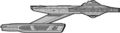
Starfleet’s first purpose-built exploratory light cruiser (or light exploratory cruiser, as the designation soon would be formalized) was to utilize relatively few preexisting elements. The command superstructure on the saucer hull was more or less standard stock, save for two navigational deflector dishes taking the place of bow quarters on Decks 2 and 3. However, the saucer itself was constructed to only 96 m diameter, featuring just basic accommodation and support functions, plus two twin banks of bow phasers with excellent fields of fire.
A boxy hull extension astern served a dual role. The lower decks were dedicated to engineering, housing the main powerplant and antimatter stores. The upper half was home to four laboratories, lateral sensor berths, and a relatively capacious shuttle hangar with hinged dorsal doors. The number of transporter units was increased as well, with two six-pad systems in the saucer and two more plus a cargo unit in the aft extension.
For a rare once, a separate IMFR assembly was carried, paired with the nozzle systems of the FID-2 impulse engine. Two PB-45 warp engines, despite showing their age, gave cruiser performance in all respects. The lion’s share of mission gear was to be carried between them, on a ventral grapple in Bader style, and normally consisted of a flattened cylinder with sensor arrays at both ends and equipment bays in the middle. If need be, the lithe explorer could instead carry a hangar pod for a fuller arsenal of survey craft, or heavy single-sensor modules of varying types, thus undertaking special missions the comparable if propulsively inferior Keith and T’Pari units were unsuited for.
The 2268 launch of the inaugural vessel appeared to justify all the doctrinal and engineering shortcuts applied on this stopgap type. Delivery was on schedule, on budget, and met the technological specifications of the time. Nine further units soon followed USS Baker, NCC-1290, to mapping missions in border regions now theoretically safe from Klingon harassment.
The illusion of peace wasn’t quite shattered yet by a 2270 act of aggression against USS Bakker (NCC-1296). A criminal endeavor at Starbase 6 saw the temporarily idled research vessel used as a getaway vehicle. The audacious theft might have resembled various Klingon Imperial Intelligence coups of the recent past, but was quickly established to have been the work of petty criminals instead. Swift law enforcement action by Klingon cruisers deprived Starfleet of the petite explorer, but the act had no lasting diplomatic consequences either way.
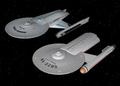
Forces driving for re-escalation existed independently of such events. A refitting craze gripped Starfleet at the introduction of linear excitation warp propulsion technology, and suddenly every existing platform was seen as a potential basis for a superfast, multipurpose combatant. The remaining flock of light exploratory cruisers was in 2270 deemed to be behind the times on all three aspects of the designation: more substantial armament, protection and propulsion was called for; exploration had to give way to defensive duties; and the proper moniker for a vessel of this size would from now on be destroyer. USS Knutson (NCC-1298) got the misfortune of trailblazing the conversion. She received the Setchuen LN-40 warp engine, one of the less successful attempts at a PB-45 successor, and had her aft hull stretched to accommodate the associated powerplant. An accordingly increased number of lateral sensor berths was to compensate for all the survey assets lost with cutting off the ventral mission pod.
The actual mission gear Starfleet hoped to fit aboard was unrelated to survey duty. Paired torpedo launchers were to turn the Knutson into the twin-engined counterpart to the projected Charger single-nacelle light destroyers. The better endurance and accommodations of the Knutson were lost in the conversion process, as the torpedo system took up a lot of room at the lower bow, and the outer hull equipment cavities and consumables tanks were reappropriated for extra shield conduitry and a double-wall structure of somewhat dubious protective worth.
The Knutson experiment was followed with series production of a slightly different model, with a more potent Mk 9 ‘Common Claw’ torpedo launcher rather than the Mk 14 of the Chargers. The class ship spearheaded the modification, a telltale sign of the unhurried schedule of the refitting project: there were more capable destroyer types under consideration already, and the Bakers rode largely on inertia now. Two full flotillas were completed by first refitting the eight remaining survey designs and then adding seventeen newbuilds; the first flotilla was completed by 2276, the second by 2282. Setchuen sized its casting of LN-40 coils to fit this procurement program, and then discontinued the type.
In frontline use, the Bakers initially added to the confusing multitude of single-flotilla destroyer designs. Their range of applicability was greater than that of the Chargers, and few were tasked with escort duty. Instead, border starbases enjoyed the rotation of offensive half-flotillas of Bakers, led by modern scouts of appropriate warp performance when available. No dedicated flotilla leader design was created out of Baker; and indeed the type would have been somewhat undersized for housing flotilla command gear. Rather, the manageable dimensions encouraged mass production, rdand the Baker eventually became the only late 23 century destroyer type to be procured to the strength of three full combat flotillas.
At the turn of the century, the class was still at full fighting strength, despite the alarmingly dwindling supply of LN-40 spares - the Khitomer-imposed retirement of Makin and Kolm-An assault transports had alleviated that problem somewhat, even though their LN-40A wasn’t completely compatible with the earlier model. In contrast, the single-nacelled destroyers of the Klingon conflict were disappearing from around the Bakers, class by class. Moreover, their replacements represented obvious Baker thinking, only now through a priori deliberation: the Polaris heavy destroyers were twin-engined light cruisers by design, and destroyers only by relative performance, while the humbler spaceframes of the Hardin destroyers packed firepower hitherto undreamed of. With such a splendid heritage, the Baker class could well be declared the winner of the messy and confused destroyer race, despite the lack of decisive combat engagements or stories of outstanding heroism.
Gallery
-
-
 class evolution

.png)
Notes
Alt Sources
- STSTCSOLDA
- Vintage Starships: "2267 – Baker": includes 3D viewer