Guide:Chandley: Difference between revisions
No edit summary |
No edit summary |
||
| Line 1: | Line 1: | ||
{{Sidebar Guide ship | {{Sidebar Guide ship | ||
|image=[[ | |image=[[File:Chandley (orig)(stbd).png|250px|InsertAltTextHere]] | ||
|classname= | |classname= Chandley | ||
|category= | |category= strike frigate | ||
|years= | |years= [[2266]] - [[2283]] | ||
|constructed= | * Flight I: [[2266]] - | ||
|length= | * Flight II: | ||
|beam= | * Flight III: | ||
|height= | |constructed= 14 total | ||
|mass= | * Flt I: 8 ([[xxxx]] - [[xxxx]]) | ||
|cruisespeed= | * Flt II: 2 (refitted from Flt I [[xxxx]] - [[xxxx]]) | ||
|towspeed= | * Flt III: 6 ([[xxxx]] - [[xxxx]]) | ||
|maxspeed= | |length= 314.9 m | ||
|endurance= | |beam= 262.0 m | ||
|officers= | |height= 90.1 m | ||
|enlisted= | |mass= <br> | ||
|troops= | * Flt I: 673,300 mt | ||
* Flt II: 673,600 mt | |||
* Flt III: 676,700 mt | |||
|cruisespeed= w 6.0 | |||
|towspeed= | |||
|maxspeed= w 8.1 | |||
|endurance= 5 years | |||
|officers= 31 | |||
|enlisted= <br> | |||
* Flt I: 332 | |||
* Flt II: 339 | |||
* Flt III: | |||
|troops= 250 | |||
|passengers= | |passengers= | ||
|patients= | |patients= | ||
|crew= | |crew= | ||
|cargo= | |cargo= | ||
|beamweapons= | |beamweapons= 6x phaser VII emitters (twin banks) (primary hull) | ||
|missileweapons= | |missileweapons= <br> | ||
* 2x fwd medium torpedo tubes (w/ 40 photon torpedoes) (ventral primary hull) | |||
* 2x aft medium torpedo tubes (w/ 40 photon torpedoes) (ventral primary hull) | |||
|otherweapons= | |otherweapons= | ||
|shields= | |shields= <br> | ||
* 3-layer forcefields | |||
* navigational deflectors (hull extensions) | |||
* 3x secondary navigational deflectors (fwd primary hull) | |||
|labs= | |labs= | ||
|transporters= | |transporters= <br> | ||
|auxcraft= | * 8x GP (6-pad); Mk III | ||
|historicalships= | * 8x emergency evacuation/assault (20-pad); Mk III | ||
|design= | * 4x cargo; Mk III | ||
|name= | |auxcraft= <br> | ||
|history= | * 10x assault shuttles | ||
* 2x work pods | |||
|historicalships= <br> | |||
* USS Chandley | |||
* USS Hanson (NCC-2309) | |||
* USS Monson (NCC-2302) | |||
|design= FASA | |||
|name= FASA, Kevin Dilmore & Dayton Ward: ''Foundations'' | |||
|history= FASA, Kevin Dilmore & Dayton Ward: ''Foundations'', Timo | |||
}} | }} | ||
The art of planetary assault has never been close to the hearts of Starfleet strategists. Prior to the | |||
Klingon advances in the 2220s, there had been very little incentive for the Fleet to fight its way from | |||
orbit to planetary surfaces. Major invasions in the Romulan, Tarn and Khsatriyan campaigns had been | |||
preceded by orbital bombardment and establishing of space superiority, and the troops landed only | |||
when opposition had ceased. No such thing as a ‘minor invasion’ had been attempted, not after the | |||
disaster at Verillia IV. The way of the Klingon warrior was different: combat was seen as one integral | |||
whole, extending from planetary surfaces to deepest space. There was no battle too large or too small | |||
for the use of class M terrain to tactical advantage. Starfleet had no flexible response to such a threat; | |||
to call in assault transports and shuttlecarriers when the crew of a battle cruiser pillaged a settlement | |||
would be inexcusable waste of resources, and far from a timely response. | |||
[[Image:No Photo Available.jpg|left|300px|thumb| | The Coventry frigates were the closest thing to a rapid reaction assault force Starfleet had. Yet they | ||
embarked just two platoons of troops during normal operations, while a Klingon cruiser was assumed | |||
to carry ten or more, using cryosleep techniques to accommodate the force for extended periods of | |||
time. When the Klingons again appeared to be close to pulling their act together in the 2260s, Starfleet | |||
acutely needed ships with greater troop capacity. Speed was of essence in more ways than one. The | |||
faster the ships were produced, the greater their deterrence value in the political situation. The faster | |||
they reached their battlefields, the less chance the Klingon invaders had of digging in or escaping with | |||
loot. And the faster they deployed their troops while in orbit, the more likely they would be to rout the | |||
surprisingly conservatively, even sluggishly moving Klingon ground forces. On the latter point, the | |||
technology of the day provided a new approach: with dilithium energizing and duotronic control, | |||
whole companies plus their light vehicles could be deployed by transporter. In 2262, a request for proposals was sent out for a Transporter Strike Frigate capable of rapidly disembarking eight platoons | |||
of troops via transporter, maintaining a cruise speed of warp six, and carrying phaser and torpedo | |||
armament superior to that of the Coventry class. | |||
The early sixties were a far cry from the desperate times of the 2220s. The major shipbuilding and | |||
refitting programs of the forties and fifties had either been completed or funded to completion, and | |||
both the budgets and the dockyards thus had slots for ‘silver bullet’ acquisition programs. By 2264, | |||
funds had been secured, plans finalized, and the first four keels laid for the hypermodern Transporter | |||
Strike Frigates. Chandley Works Ltd was granted the use of Star Fleet Division’s yards at Mars and | |||
Titan for this special project, which involved spaceframes far bigger than anything Chandley had | |||
produced in the preceding two centuries of operations. What the company excelled in was precision | |||
duonetic field engineering, and this was needed for making the troop transporters work seamlessly | |||
with shields and warp fields in combat conditions. | |||
Chandley nevertheless chose to play it safe. Pylons of unprecedented length were used in order to | |||
efficiently separate the warp coils from the transporter emitters, giving the vessel a height of 90 meters | |||
and a beam of 262 meters. The spaceframe proper was by no means small, either. To accommodate the | |||
two light companies’ worth of troops and equipment, two boxy structures four decks high were added | |||
to the stern quarters of a Loknar -type Class 1 saucer, flush with the saucertop and thus comprising | |||
Decks 6-9. Each held separate accommodation, mess areas and training facilities for each of the four | |||
platoons; holds for the units’ vehicles and equipment; four troop transporters, each with 20 pads, plus | |||
two six-pad GP transporters; and an aft-facing shuttlebay, with a combined standard complement of | |||
eight assault shuttles for the deployment of four of the platoons (without their vehicles) in conditions | |||
prohibiting transporter operations. | |||
Astern between the shuttlebays was an expanded SBK impulse deck almost three times as powerful as | |||
the Loknar unit, and necessarily stronger than the Coventry or Surya engines as well – total idle mass | |||
was already 20,000 tons past the Coventry mark. Vast arch-like structures over the lateral extensions | |||
provided mounting for the transporter emitters, one per each assault transporter for maximum | |||
efficiency. Below was a transverse keel housing the main powerplant, primary plasma leads, and a | |||
decisive armament of two Mk 3 torpedo launchers per side, one facing forward, one aft. The armament | |||
was completed by three twin phaser VII banks on the main hull. Control was by a Fasfax III unit, yet | |||
without the FSTR/TAC fire control package of contemporary cruisers. Instead, the TDC-M expert | |||
program managed the concerted use of the assault transporters and shields, a task well beyond human | |||
response times. | |||
Warp propulsion was ultimately rather conservative and featured many off-the-shelf solutions. The | |||
Loknar Mk II plasma loop, Achernar-standard powerplant and PB-47 engines were all well within | |||
their performance envelopes. Cruising at warp 6 and a dash speed of warp 8 kept stress levels in the | |||
spindly pylons (and at the Chief Engineer’s workstation) within acceptable limits, and allowed joint | |||
operations with all modern fleet combatants. | |||
The four inaugural vessels were launched in 2266, and USS Chandley (registered NCC-2300, and | |||
officially named after the 21st century naval hero, not the company!) commissioned in early December | |||
of that year. Four more vessels were completed to the standard within the next two years by Vickers at | |||
Mars, another four by Star Fleet Division at Titan. Yet these vessels were launched to a world much | |||
changed: the Organian truce had terminated Starfleet Marine operations against the former arch- | |||
enemy, seemingly leaving little for strike frigates to do. However, a daring counter-raid by USS | |||
Hanson (NCC-2309) against raiders from two ostensibly renegade Gorn cruisers in 2269 proved the worth of the frigates in ship-to-ship combat. Encouraged by the success, Starfleet ordered six more | |||
Chandleys, now optimized for engaging enemy vessels in space. The Mk III standard was not | |||
considered a separate subclass, yet carried the more potent Keindoffer-Klaatsen Mk 4 long range | |||
torpedo system, the advanced FSTR/TAC interface, and uprated impulse engines. Production was | |||
expanded to involve Andorian yards in addition to the Sol production facilities. | |||
[[Image:No Photo Available.jpg|left|300px|thumb|A strike frigate of Mk III standard in a rare multi-ship operation alongside a through-deck cruiser and two heavy frigates during the Xindi Incursion. Typical of the poor coverage of the conflict, the image fails to reveal the exact identities of the vessels in question. The Chandley displays prominent hull art, an extreme rarity elsewhere in the Fleet, yet the alligator motif (symbolizing the two-realm nature of the vessels) was popular in the strike frigate community and applied on at least three Chandleys in the early 2270s.]] | |||
A more modest Mk II upgrade to two of the existing eight ships merely increased the size of Marine | |||
equipment storage bays at the expense of hangar spaces, and was clearly aimed at a direction | |||
opposite from that taken by the Mk III modifications. Boarding warfare nevertheless became the | |||
main role for the Chandleys for the next decade. They saw little action in the brief Xindi conflict, | |||
yet regularly engaged in anti-piracy operations. Towards the end of the seventies, they also began | |||
participating in intelligence operations against Klingon forces, raiding lone vessels in disputed | |||
space. The grisly fate of the boarding party from USS Monson (NCC-2302) in 2269 still fresh in | |||
mind, Starfleet initially took no risks, performing extensive scans to reveal booby traps and scuttling | |||
mechanisms and to allow them to be disabled. Confidence grew with mounting experience, | |||
however. By the early eighties, the Chandleys were raiding Klingon ships with deadly speed and | |||
efficiency. | |||
As the noninterference of the Organians became more and more obvious, Starfleet again began | |||
pondering the use of the successful Chandleys in planetary assault. An engine, shield and torpedo | |||
system refit was deemed necessary for anti-ship and assault duty alike. The project is described later in | |||
a separate entry. Meanwhile, several of the vessels were moved to inactive reserves, to preserve their | |||
delicate spaceframes for what certain circles in Starfleet Command already ominously referred to as | |||
"real action". | |||
All the Chandley types suffered casualties evenly: one unit of each was lost between 2269 and 2276 – | |||
USS Baudin in the campaign of Kastela, USS Tromp to the Tholians during the ill-fated ‘fact-finding’ | |||
expedition of 2271, and USS Williams at the evacuation of Niri. The class ship survived without a | |||
scratch through arduous years of patrol first on the Romulan Neutral Zone, then on the Organian treaty | |||
borders. She was in 2275 assigned as an engineering testbed for evaluating Kelvan warp propulsion | |||
and structural integrity techniques. Due to the extensive modifications she received in the role, the | |||
Chandley was a prime candidate for spearheading the refitting program initiated in 2277. | |||
The last unmodified Mk I units were stricken in 2288, and the final Mk II and III ones in 2294. None | |||
had seen active service after 2283, however. The concept of transporter assault had been largely | |||
outdated by increased shield action in the battlefields, and opposed boardings had become the province | |||
of corvette-category starships. The peculiar spaceframes had no applications outside the original | |||
mission parameters, and would have required extensive overhauls in any case. While the strike frigates | |||
were significant contributors in the major achievements of the late 23rd century, namely the eradication | |||
of piracy and the pacifying of the Klingon front, they must be viewed as a passing fad in comparison | |||
with the other designs and technologies introduced during those legendary years. | |||
==Gallery== | ==Gallery== | ||
Revision as of 18:07, 16 September 2025
(stbd).png)
| |
| Chandley | |
|---|---|
| Class Overview | |
| Category | strike frigate |
| Operational | 2266 - 2283
|
| Constructed | 14 total |
| Dimensions | |
| Length | 314.9 m |
| Beam | 262.0 m |
| Height | 90.1 m |
| Mass |
|
| Performance | |
| Cruise Speed | w 6.0 |
| Max Speed | w 8.1 |
| Endurance | 5 years |
| Complement | |
| Officers | 31 |
| Enlisted |
|
| Troops | 250
|
| Tactical Systems | |
| Beam Weapons | 6x phaser VII emitters (twin banks) (primary hull) |
| Missile Weapons |
|
| Shields |
|
| Transporters |
|
| Auxiliary Craft |
|
| Historical | |
| Ships of Note |
|
| Canonicity | |
| Design | FASA |
| Name | FASA, Kevin Dilmore & Dayton Ward: Foundations |
| History | FASA, Kevin Dilmore & Dayton Ward: Foundations, Timo
|
The art of planetary assault has never been close to the hearts of Starfleet strategists. Prior to the
Klingon advances in the 2220s, there had been very little incentive for the Fleet to fight its way from
orbit to planetary surfaces. Major invasions in the Romulan, Tarn and Khsatriyan campaigns had been
preceded by orbital bombardment and establishing of space superiority, and the troops landed only
when opposition had ceased. No such thing as a ‘minor invasion’ had been attempted, not after the
disaster at Verillia IV. The way of the Klingon warrior was different: combat was seen as one integral
whole, extending from planetary surfaces to deepest space. There was no battle too large or too small
for the use of class M terrain to tactical advantage. Starfleet had no flexible response to such a threat;
to call in assault transports and shuttlecarriers when the crew of a battle cruiser pillaged a settlement
would be inexcusable waste of resources, and far from a timely response.
The Coventry frigates were the closest thing to a rapid reaction assault force Starfleet had. Yet they embarked just two platoons of troops during normal operations, while a Klingon cruiser was assumed to carry ten or more, using cryosleep techniques to accommodate the force for extended periods of time. When the Klingons again appeared to be close to pulling their act together in the 2260s, Starfleet acutely needed ships with greater troop capacity. Speed was of essence in more ways than one. The faster the ships were produced, the greater their deterrence value in the political situation. The faster they reached their battlefields, the less chance the Klingon invaders had of digging in or escaping with loot. And the faster they deployed their troops while in orbit, the more likely they would be to rout the surprisingly conservatively, even sluggishly moving Klingon ground forces. On the latter point, the technology of the day provided a new approach: with dilithium energizing and duotronic control, whole companies plus their light vehicles could be deployed by transporter. In 2262, a request for proposals was sent out for a Transporter Strike Frigate capable of rapidly disembarking eight platoons of troops via transporter, maintaining a cruise speed of warp six, and carrying phaser and torpedo armament superior to that of the Coventry class.
The early sixties were a far cry from the desperate times of the 2220s. The major shipbuilding and refitting programs of the forties and fifties had either been completed or funded to completion, and both the budgets and the dockyards thus had slots for ‘silver bullet’ acquisition programs. By 2264, funds had been secured, plans finalized, and the first four keels laid for the hypermodern Transporter Strike Frigates. Chandley Works Ltd was granted the use of Star Fleet Division’s yards at Mars and Titan for this special project, which involved spaceframes far bigger than anything Chandley had produced in the preceding two centuries of operations. What the company excelled in was precision duonetic field engineering, and this was needed for making the troop transporters work seamlessly with shields and warp fields in combat conditions.
Chandley nevertheless chose to play it safe. Pylons of unprecedented length were used in order to efficiently separate the warp coils from the transporter emitters, giving the vessel a height of 90 meters and a beam of 262 meters. The spaceframe proper was by no means small, either. To accommodate the two light companies’ worth of troops and equipment, two boxy structures four decks high were added to the stern quarters of a Loknar -type Class 1 saucer, flush with the saucertop and thus comprising Decks 6-9. Each held separate accommodation, mess areas and training facilities for each of the four platoons; holds for the units’ vehicles and equipment; four troop transporters, each with 20 pads, plus two six-pad GP transporters; and an aft-facing shuttlebay, with a combined standard complement of eight assault shuttles for the deployment of four of the platoons (without their vehicles) in conditions prohibiting transporter operations.
Astern between the shuttlebays was an expanded SBK impulse deck almost three times as powerful as the Loknar unit, and necessarily stronger than the Coventry or Surya engines as well – total idle mass was already 20,000 tons past the Coventry mark. Vast arch-like structures over the lateral extensions provided mounting for the transporter emitters, one per each assault transporter for maximum efficiency. Below was a transverse keel housing the main powerplant, primary plasma leads, and a decisive armament of two Mk 3 torpedo launchers per side, one facing forward, one aft. The armament was completed by three twin phaser VII banks on the main hull. Control was by a Fasfax III unit, yet without the FSTR/TAC fire control package of contemporary cruisers. Instead, the TDC-M expert program managed the concerted use of the assault transporters and shields, a task well beyond human response times.
Warp propulsion was ultimately rather conservative and featured many off-the-shelf solutions. The Loknar Mk II plasma loop, Achernar-standard powerplant and PB-47 engines were all well within their performance envelopes. Cruising at warp 6 and a dash speed of warp 8 kept stress levels in the spindly pylons (and at the Chief Engineer’s workstation) within acceptable limits, and allowed joint operations with all modern fleet combatants.
The four inaugural vessels were launched in 2266, and USS Chandley (registered NCC-2300, and officially named after the 21st century naval hero, not the company!) commissioned in early December of that year. Four more vessels were completed to the standard within the next two years by Vickers at Mars, another four by Star Fleet Division at Titan. Yet these vessels were launched to a world much changed: the Organian truce had terminated Starfleet Marine operations against the former arch- enemy, seemingly leaving little for strike frigates to do. However, a daring counter-raid by USS Hanson (NCC-2309) against raiders from two ostensibly renegade Gorn cruisers in 2269 proved the worth of the frigates in ship-to-ship combat. Encouraged by the success, Starfleet ordered six more Chandleys, now optimized for engaging enemy vessels in space. The Mk III standard was not considered a separate subclass, yet carried the more potent Keindoffer-Klaatsen Mk 4 long range torpedo system, the advanced FSTR/TAC interface, and uprated impulse engines. Production was expanded to involve Andorian yards in addition to the Sol production facilities.

A more modest Mk II upgrade to two of the existing eight ships merely increased the size of Marine equipment storage bays at the expense of hangar spaces, and was clearly aimed at a direction opposite from that taken by the Mk III modifications. Boarding warfare nevertheless became the main role for the Chandleys for the next decade. They saw little action in the brief Xindi conflict, yet regularly engaged in anti-piracy operations. Towards the end of the seventies, they also began participating in intelligence operations against Klingon forces, raiding lone vessels in disputed space. The grisly fate of the boarding party from USS Monson (NCC-2302) in 2269 still fresh in mind, Starfleet initially took no risks, performing extensive scans to reveal booby traps and scuttling mechanisms and to allow them to be disabled. Confidence grew with mounting experience, however. By the early eighties, the Chandleys were raiding Klingon ships with deadly speed and efficiency.
As the noninterference of the Organians became more and more obvious, Starfleet again began pondering the use of the successful Chandleys in planetary assault. An engine, shield and torpedo system refit was deemed necessary for anti-ship and assault duty alike. The project is described later in a separate entry. Meanwhile, several of the vessels were moved to inactive reserves, to preserve their delicate spaceframes for what certain circles in Starfleet Command already ominously referred to as "real action".
All the Chandley types suffered casualties evenly: one unit of each was lost between 2269 and 2276 – USS Baudin in the campaign of Kastela, USS Tromp to the Tholians during the ill-fated ‘fact-finding’ expedition of 2271, and USS Williams at the evacuation of Niri. The class ship survived without a scratch through arduous years of patrol first on the Romulan Neutral Zone, then on the Organian treaty borders. She was in 2275 assigned as an engineering testbed for evaluating Kelvan warp propulsion and structural integrity techniques. Due to the extensive modifications she received in the role, the Chandley was a prime candidate for spearheading the refitting program initiated in 2277.
The last unmodified Mk I units were stricken in 2288, and the final Mk II and III ones in 2294. None had seen active service after 2283, however. The concept of transporter assault had been largely outdated by increased shield action in the battlefields, and opposed boardings had become the province of corvette-category starships. The peculiar spaceframes had no applications outside the original mission parameters, and would have required extensive overhauls in any case. While the strike frigates were significant contributors in the major achievements of the late 23rd century, namely the eradication of piracy and the pacifying of the Klingon front, they must be viewed as a passing fad in comparison with the other designs and technologies introduced during those legendary years.
Gallery
-

-

-

-
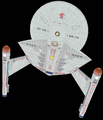
-
 Port view
 -
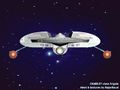 Bow view
 -
 Dorsal beam view
 -
 Ventral bow view
 -
 Dorsal aft view
 -
 Dorsal view
 -
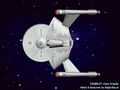 Ventral view
 -
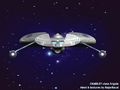 Aft view
.png)
.png)
.png)
.jpg)
.jpg)
.jpg)
.jpg)
.jpg)
.jpg)
.jpg)
.jpg)