Guide:Columbus series: Difference between revisions
No edit summary |
|||
| Line 83: | Line 83: | ||
* The symbols 'α' and 'ε' have been replaced by 'Alpha' and 'Epsilon' (respectively) for sake of simplicity and to match official canon. | * The symbols 'α' and 'ε' have been replaced by 'Alpha' and 'Epsilon' (respectively) for sake of simplicity and to match official canon. | ||
* The three successful missions to [[Alpha Centauri A]], [[Epsilon Indi]] and [[Arcturus]] would have actually arrived in [[2050]], [[2060]] and [[2061]] respectively, well before First Contact ([[2063]]). However, in this SFC RPG, the sublight speeds have been adjusted to account for their arrivals well after the Vulcans' arrival on [[Earth]]. * The operational period has been extended from Timo's [[2075]] to the year [[2104]], reflecting the calculated arrival time of the ''Hector'' at [[Arcturus]]. | * The three successful missions to [[Alpha Centauri A]], [[Epsilon Indi]] and [[Arcturus]] would have actually arrived in [[2050]], [[2060]] and [[2061]] respectively, well before First Contact ([[2063]]). However, in this SFC RPG, the sublight speeds have been adjusted to account for their arrivals well after the Vulcans' arrival on [[Earth]]. | ||
* The operational period has been extended from Timo's [[2075]] to the year [[2104]], reflecting the calculated arrival time of the ''Hector'' at [[Arcturus]]. | |||
* The original ''Guide'' had these ships no longer operational by [[2075]]. However, at the best mission estimates, the Epsilon Indi mission could not return before the end of the century. | * The original ''Guide'' had these ships no longer operational by [[2075]]. However, at the best mission estimates, the Epsilon Indi mission could not return before the end of the century. | ||
Revision as of 19:51, 11 December 2022
| Columbus interstellar sublight explorer | |
| Columbus series | |
|---|---|
| Class Overview | |
| Category | ISA/NASA interstellar sublight explorer |
| Operational | 2040 - 2104 |
| Constructed | 5 |
| Dimensions | |
| Length | 120.0m |
| Beam |
|
| Height |
|
| Mass |
|
| Performance | |
| Max Speed | 0.23c |
| Endurance | 13 years (w/cryosleep) |
| Complement | |
| Officers | 4 |
| Enlisted | 36
|
| Tactical Systems | |
| Beam Weapons | 4x Sorac 0.36 Class laser emitters (UNSS Columbus only, 2046) |
| Missile Weapons | 1x nuclear missile launcher (25 Mk III nuclear missiles) (UNSS Columbus only, 2046) |
| Shields |
|
| Laboratories | 1 GP/planetary sciences |
| Auxiliary Craft |
|
| Canonicity | |
| Design | SFC, Timo |
| Name | SFC |
| History | SFC, Timo
|

Background: Hobbyist's Guide
Despite the setbacks suffered by the TAU explorers, international competition had driven the US-led alliance to undertake a more complex program of interstellar sublight flight. While fission-powered vessels already plied the skies in some quantity, fusion propulsion remained a dream – a pipe dream, some insisted, after the hyperexpensive Galileo laser-fusion/NTR project ended in utter financial and technological disaster. In 2035, the multi-nationally manned prototype AFP-1 experimented on e-beam pulsed fusion detonation drive but met with a disaster of a more concrete kind, with 14 lives lost.
Yet scientists and engineers everywhere agreed that fission systems of known types could never attain the power/mass ratio required for successful interstellar flight, not even with the non-Newtonian trickery of Singh-type reaction drives. And the threshold of unacceptable casualties kept climbing with each personnel-hour spent in space: by the 2040s, some 600 people had already perished off-Earth. The AFP-1 accident barely made the news, even though secrecy and paranoia around the project was somewhat less intense than the global norm of the day. In this callous atmosphere, it was hardly surprising that the first successful interstellar fusion-based propulsion system would be one forgoing innovation and relying on a combination of previously failed solutions.
In 2040, the state of the art enabled the construction of a 0.85 c maximum speed, 2.3 c total Δ-v spaceship, using methane as the primary propellant and deuterium as the fusion fuel. Main acceleration propellant was stored in four jettisonable wedgelike tanks, surrounding a cylindrar core stage roughly 40 m in diameter, with an instrumentation and habitat compartment riding atop the core. The fusion reactor would initially work much like the fission powerplants of typical Singh drives, providing both hot exhaust gases and MHD-tapped energy for an exhaust accelerator, which would in turn drive the methane propellant. After the acceleration phase, fusion would be spiked with antimatter for pulsed detonation drive. The huge combined thrust chamber and exhaust accelerator was rightfully called “the most expensive compromise in the history of mankind”, featuring the worst of both worlds – but working.
Fusion fuel and some propellant for deceleration were stored in the core stage, in two large spherical tanks, but in situ propellant production was to be used to fill the tanks up to capacity again. And what would this situ be? Nothing less than the atmosphere of a planet circling an alien sun. The primary goal of the craft was to propel mankind to its first interstellar journey. Secondary goals were set as well, since the core stages were capable interplanetary or extrasolar explorers on their own right; in fact, on acceleration mode, they were just greatly expanded versions of the boosters routinely used for manned missions launched to Mars and the asteroid belt. Still, all the five vessels of Columbus class were furnished with cryosleep systems that could sustain life across interstellar instead of mere interplanetary distances. The significant improvements in propulsion technology had already made interplanetary cryosleep virtually unnecessary, and the test run of UNSS Columbus to Saturn and back was performed with the test crew of thirty fully awake.
In 2045, all five spaceframes included in the program were ready. Equipment was mounted for interstellar exploration, including a versatile atmospheric shuttle with a fission drive of its own, a battery of wide-spectrum telescopes, a laboratory adaptable for various planetary studies and a series of small lander probes for planetary surveys. Interferometry telescopy and probe flybys had already confirmed the existence of at least seven planets in the Alpha Centauri system, assured the scientists that return propellant could be manufactured there, and hinted at the presence of carbon-based life on the third and fourth planets of Alpha Centauri A. Four other systems visited by Earth probes were also chosen, and five ships fueled for launch.
A serious accident during the fueling of UNSS Columbus in late September 2045, led to eight fatalities and damaged the spacecraft. Her mission to Alpha Centauri had to be given to UNSS Icarus and the journey of that ship to 40 Eridani delayed indefinitely. UNSS Nautilus was thus the first ship to boost out of Earth orbit, on January 21st, 2046, on her way to Tau Ceti. Other ships launched within six months of the Nautilus, each carrying 40 men and women in cryosleep. But tragedy struck on May 5th: the Nautilus, traveling at almost 0.4 c, hit an interplanetary object too large for the meteoroid protection system to handle. Apparently, not only was the ionic activity in the inner Oort cloud badly underestimated, so was the density of macrometeoroids and cometary fragments. What little communications with the Nautilus could be maintained through the exhaust plume were now disrupted as the vessel entered uncontrollable oscillatory movement. Hundreds of successive meteoroid impacts and dangerous charge buildup were recorded before total communications loss. The onboard computer could not handle the situation, and Earth controllers could only watch through space telescopes as the ship tore herself apart in a matter of days.
There were heated demands of recalling the other three vessels, but such complex instructions could not be sent to the ships – the crews would have to have been awakened prematurely, which would have been an extremely dangerous procedure. Resignedly, the various governments wrote off the intrepid explorers as total losses, shut down telemetry networks when the ionization storms cut communications with the rest of the fleet, and down-scaled their interstellar programs.
Evidently, mankind was not destined to reach the stars quite yet, and there was much to do on Earth in the meantime. For one, there was again a war in the brewing. The repaired Columbus was appropriated by the United States and equipped with four laser cannon and a rack for 25 fusion missiles for inner system offensive use, but destroyed in 2053 by an Econ kinetic-kill missile in Earth orbit before she had the chance to fire a single shot.
Yet after demanding, decades-long journeys (lasting physically only years from the viewpoint of the relativistic-speed ships, and biologically mere days or weeks for the crews in hibernation), the Icarus, Hector and Prometheus did get through to Alpha Centauri A, Arcturus and Epsilon Indi, respectively. The crews awoke, extended their sensor gear, and were hit by radio-frequency broadcasts, low enough in power not to be discernible outside the systems’ ionization bubbles but still undoubtedly marks of advanced civilizations. Excitedly, the crews set to work to prepare for first contact with extraterrestrial cultures, not knowing that this had already taken place on Earth several years ago.
The rest, as the approximately 1,800 human-visited inhabited worlds now stand witness, was history. Before this history could be written, however, there were two more chapters to be added to the human spaceflight chronicles: the midpoint of the 21st century would mark the birth of a unified combat fleet for Earth, and the launch of a bold experiment that would take this fleet to the stars.
Missions
Vessels of the Columbus series were named after the famous Italian explorer, the ship that circumnavigated Earth in 1892-1894 (Nautilus) and the rest from mythological characters. The following dates and events are SFC-canon:
- UNSS Columbus (2040-2053): destroyed in Earth orbit
- UNSS Nautilus (2046): Tau Ceti mission; destroyed in Sol's Oort cloud in the days after 05 May.
- UNSS Hector (2046-2104): G03-0516 mission; departed for Arcturus on 16 February 2046, arriving 09 February 2104; upon arrival, they discover not only an advanced (and friendly) alien civilization of Arcturians, but also the presence of Humans that had arrived earlier via warp drive. The ship is eventually mothballed in the Arcturian system, with the crew delivered home via a warp ship.
- UNSS Prometheus (2046-2080): A-12-0106 mission; departed for Epsilon Indi on 17 March 2046, arriving 11 May 2080; upon arrival, they discover not only an advanced (and friendly) alien civilization of Draylaxians, but also the presence of Humans that had arrived earlier via warp drive. The ship is eventually mothballed in the system, with the crew delivered home via a warp ship.
- UNSS Icarus (2046-2085): K-0104-15 mission; departed for Alpha Centauri on 02 April 2046, arriving 12 May 2065; visited with inhabitants of Alpha Centauri III and IV for 13 months, radioing back to Earth about their first contact (unawares of the events of 05 April 2063); departed the Alpha Centauri system on 20 June 2066; arrived back at Earth on 30 July 2085, to a new reality at home.
Gallery
-
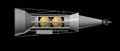 Side view
 -
 Bow view
 -
 Stern view
 -
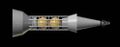 Dorsal/Ventral view
 -
 3/4th perspective (I)
 -
 3/4th perspective (II)

.jpg)
.jpg)
.jpg)
.jpg)
.jpg)
.png)
Notes
- The symbols 'α' and 'ε' have been replaced by 'Alpha' and 'Epsilon' (respectively) for sake of simplicity and to match official canon.
- The three successful missions to Alpha Centauri A, Epsilon Indi and Arcturus would have actually arrived in 2050, 2060 and 2061 respectively, well before First Contact (2063). However, in this SFC RPG, the sublight speeds have been adjusted to account for their arrivals well after the Vulcans' arrival on Earth.
- The operational period has been extended from Timo's 2075 to the year 2104, reflecting the calculated arrival time of the Hector at Arcturus.
- The original Guide had these ships no longer operational by 2075. However, at the best mission estimates, the Epsilon Indi mission could not return before the end of the century.
prior to 2076 and the Arcturus mission before 2078. For story-telling purposes, the series will be considered operational thru 2086, to account for the return of the UNSS Hector, the decade after the Bonaventure's return.
- The probe explorations of Alpha Centauri A now indicate possible life on the 3rd and 4th planets, instead of 7th, to reflect other sources.
- In order to not have the Columbus series craft as too fast (arriving at destinations pre-First Contact), all max speeds have been drastically reduced, (except for the DY-50).
- Review page 61 of Mandel's FSC Terran Orientation (Modified Okuda Timeline) for examples of the explorer and militarized versions of the Columbus.