Guide:Aventeur: Difference between revisions
No edit summary |
No edit summary |
||
| Line 28: | Line 28: | ||
|history= | |history= | ||
}} | }} | ||
In the post-Eugenics War period, following the loss of production capability of ''DY'' series spacecraft due to the fall of the Great Khanate, several concerted efforts were made to re-establish and further humanity's presence in the solar system. The first of these, the ''[[Guide: | In the post-Eugenics War period, following the loss of production capability of ''DY'' series spacecraft due to the fall of the Great Khanate, several concerted efforts were made to re-establish and further humanity's presence in the solar system. The first of these, the ''[[Guide: Aphrodite|Aphrodite]]'' mission spacecraft series, were first launched in [[2001]] and saw considerable construction over the next 14 years, exploring all the way inward to land on [[Venus]] and outwards to the asteroid belt, to start critical efforts to bring back needed resources for further space-borne construction. | ||
But Venus and [[Mars]] were not awe-inspiring. Humanity, albeit the enhanced variety, had already set foot on both of those planets and the world's leaders knew that something grand must be announced and launched to encourage hope and growth. The Grand Tour series of missions were designed. When possible, aligning planets would dictate the mission, but the ion drives that came from the Eugenics Wars did not require such precision, so all of the outer planets could be visited, when properly planned, including the grandest of the dwarf planets, Pluto. | But Venus and [[Mars]] were not awe-inspiring. Humanity, albeit the enhanced variety, had already set foot on both of those planets and the world's leaders knew that something grand must be announced and launched to encourage hope and growth. The Grand Tour series of missions were designed. When possible, aligning planets would dictate the mission, but the ion drives that came from the Eugenics Wars did not require such precision, so all of the outer planets could be visited, when properly planned, including the grandest of the dwarf planets, Pluto. | ||
Revision as of 09:36, 31 October 2020

| |
| Aventeur | |
|---|---|
| Class Overview | |
| Category | NASA/ESA (later ISA) mission spacecraft |
| Operational | 2008-2039 |
| Constructed | 6 |
| Dimensions | |
| Length | 126.0m |
| Beam | 28.5m (plus antennas) |
| Height | 28.5m (plus antennas) |
| Mass | 2,810 tons |
| Performance | |
| Max Speed | 0.02c |
| Endurance |
|
| Complement | |
| Crew | 3 |
| Passengers | 12 (cryosleep)
|
| Tactical Systems | |
| Shields | normally none |
| Laboratories | 2x planetary sciences |
| Auxiliary Craft | 2 exoatmospheric landers, 2 work pods |
In the post-Eugenics War period, following the loss of production capability of DY series spacecraft due to the fall of the Great Khanate, several concerted efforts were made to re-establish and further humanity's presence in the solar system. The first of these, the Aphrodite mission spacecraft series, were first launched in 2001 and saw considerable construction over the next 14 years, exploring all the way inward to land on Venus and outwards to the asteroid belt, to start critical efforts to bring back needed resources for further space-borne construction.
But Venus and Mars were not awe-inspiring. Humanity, albeit the enhanced variety, had already set foot on both of those planets and the world's leaders knew that something grand must be announced and launched to encourage hope and growth. The Grand Tour series of missions were designed. When possible, aligning planets would dictate the mission, but the ion drives that came from the Eugenics Wars did not require such precision, so all of the outer planets could be visited, when properly planned, including the grandest of the dwarf planets, Pluto.
The spacecraft designed to do this, the Aventeur series, was the first of the non-DYs to be developed for truly long-term and deep space intrasolar travel. Aventeur I, the Lewis and Clark, was the most inspiring of these missions. Led by Commander Shaun Geoffrey Christopher, the ship would see its crew suspended into deep cryosleep shortly after launch, only to be awakened as they approached Jupiter. After six months of study of the Jovian system, they would return to suspension until they were awakened in the Saturnian system, again to spend six months exploring the rings and moons. The plan called for a 2009 launch, a mid-point arrival at Jupiter in 2014 and then arrival at Saturn in 2020, before finally returning home to Earth in 2039.
The mission was an outstanding success, but the news shared with certain scientific circles was figuratively Earth-shaking: evidence of mining -obviously by extraterrestrials- was clearly documented on the Saturnian moons of Dione and Enceladus.
Five more vessels were constructed following the 2009 launch of Lewis and Clark, but one never launched and the Aventeur V mission, the Frémont, was even recalled, once it was obvious that emergent propulsion technology would see later vessels arriving at any planetoid in the system before she could ever make Neptune.
Missions
Vessels of the Aventeur series were named after explorers of the North American continent.
- USNS Lewis and Clark - Aventeur I (2008-2039): Jupiter & Saturn
- USNS Ponce de León - Aventeur II (2012-2026): Uranus
- USNS Mackenzie - Aventeur III (2016-2028): Neptune
- USNS Powell - Aventeur IV (2019-2037): Saturn & Pluto
- USNS Frémont - Aventeur V (2022-2029): Jupiter & Neptune (recalled in 2026)
- USNS Long - Aventeur VI (2025): Saturn & Uranus (canceled)
Gallery
-
-
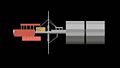
 Lewis and Clark approaches Saturn
 -
 Establishing orbital insertion


Notes
- In order to not have the Columbus series craft as too fast (arriving at destinations pre-First Contact), all max speeds have been drastically reduced, (except for the DY-50).