Guide:Christopher: Difference between revisions
created |
No edit summary |
||
| Line 85: | Line 85: | ||
|history= FASA, LUG, SFC | |history= FASA, LUG, SFC | ||
}} | }} | ||
Apart from the Armstrong class, the only new cruiser-sized design to emerge during the Romulan War was the Christopher class light cruiser, a totally new class featuring no Triton or Enterprise components. Built for speed and endurance, the ship was optimized from the beginning for extremely mobile warfare, and would act as the spearhead of a new tactical approach. The cruisers would no longer prey on the frustratingly elusive Romulan carrier groups, but would perform deep strikes against fixed installations, moving the war to the Romulan turf for the first time. A key requirement to this approach was the increase in scoutship quality and quantity, which had already given UESF its first major victory in 2159. But only with the new long range cruisers could such strikes be mounted with any certainty of success. | |||
Every lesson learned from Marshall and Cavalry destroyers was applied here, from the omission of particle beam weaponry to the use of heavy frontal armor and provision of room for up-to-date subspace/graviton shield generators. In fact, USS Warren E. Christopher (NCL-2000) should basically be considered a heavy destroyer instead of a true cruiser. Quickly joined by no less than 17 sisters, the ship nevertheless soon proved her worth as an independent, high endurance fighting platform worthy of the cruiser designation. | |||
The primary hull of the Christopher was a two-part structure reminiscent of an alligator head: a rounded upper section housed three decks of command, control and communications functions and habitat space, while the smaller lower ‘jaw’ housed twin missile tubes with magazines for at most fourteen heavy 900 mm fusion or photonic missiles each. A pair of 95,000 ton PA-4 warp engines on sturdy pylons sprouting from a boxy secondary hull represented traditional thinking and gave the ship a rather conventional cruiser silhouette. Tried and proven construction techniques could be used, for it was not the hull that was significant in the new cruiser. Nor was the integrated weapons system unconventional: in addition to a single warp torpedo tube and two tubes for sublight missiles, there were two gigawatt-class, warp-accelerated main lasers to provide primary firepower, with four smaller lasers for close-in protection. | |||
What made a difference was the combination of a high endurance powerplant, a superb inertial navigation system and a separate major computer dedicated completely to the task of long-duration warp navigation. While two Cavalries or one Marshall might pump out equal missile, torpedo or laser firepower, the destroyers could not compete in the range of combat operations. At a cruise speed of full warp three, some ten lightyears could be spanned in a single combat sortie – twenty, if the ships were stripped of some weaponry, crew and equipment, and given extra fuel. | |||
Due to their superior speed and range, the Christophers seldom operated in concert with other ship types, although complex ambushes were at times performed jointly with modern destroyers. USS Chester W. Nimitz and USS Raymond Spruance took the place of their fallen namesakes of Messier class, while others received names honoring various lost destroyers. The names proved good omens, for not a single Christopher was lost while idle on Earthbase orbit or flying into a Romulan ambush. Eight cruisers nevertheless perished in attack sorties, in battles that may have been uneven but in which the initiative at last was on the Earth side. | |||
[[Image:.jpg|left|300px|thumb|As two Cavalry destroyers launch their missiles at more distant targets, light cruiser Anaconda (NCL-2008) plunges directly into a swarm of enemy missile boats at Nimbus in 2160. While the Christophers were never designed to fight against small craft the way the older cruisers were forced to do, the Anaconda more than held her own in the engagement; superior UESF fire control was beginning to turn the tables against the Romulans and making their small craft less of a threat to Earth fighting vessels.]] | |||
The greatest hour of the Christopher class came in 2160, when a flotilla of seven specially configured light cruisers, stripped of the torpedo launcher, some consumables and most crew and carrying a mixture of heavy anti-ship and anti-surface missiles and a maximal fuel load, penetrated Romulan defenses with a daring uninterrupted warp run of 52 days. Despite the immense problems of coordination due to complete sensor and communications silence while in warp drive, the cruisers arrived at the Cheron system in perfect formation with only minor systems damage to one vessel. Local defenses responded with deadly force, and the UESF flotilla lost two cruisers in quick succession. Still, the surviving cruisers fired their missiles with precision at the frontline command center spotted four months earlier by a Doppler scout. | |||
Near-simultaneously, six other strikes of this type were carried out against other Romulan installations located in the recent months, featuring mixed fleets of Christophers and Enterprises. Two were never heard of again, but the remaining four all scored devastating hits on their targets. Yet none was more important than the battle at Cheron: unbeknownst to the crews, the ships had managed to destroy the hub of the entire Romulan subspace communications network in sectors 23 through 28. The utter confusion into which the Romulan command structure had been thrown would have meant easy victory for Earth. The only way for the Romulans to protect their frontline bases would have been to permanently deploy their fleets inside the respective systems. Instead of risking total loss of both bases and ships, the Romulans decided to throw the game. A request for truce was sent out in October 12, 2160. | |||
* * * | |||
Surviving Christopher units continued operations beyond the onset of peace. Since local space was quite saturated with war surplus vessels, and since the victorious Federation had few challengers, there was little interest in developing an antimatter-powered successor design. Yet the deep space capabilities of the Christophers were not as useful in peacetime duty as one might assume, as there was no room or power to be spared for research gear. No permanent laboratory spaces were ever installed aboard the vessels, nor did the sensor suites receive the advanced short range planetary survey instruments of the Enterprises. The light cruisers mainly attained fame in early pirate hunts, and served admirably in enforcing Federation law and order across the former dominions of the UFP signature members. | |||
When the time for retirement came in 2182, four Christopher vessels including the original class ship were still active. All were sold forward to existing and hoped-for allies in the coreward direction. | |||
==Notes== | ==Notes== | ||
Revision as of 21:34, 11 January 2014
| InsertAltTextHere | |
| Armstrong/Helena | |
|---|---|
| Class Overview | |
| Category | Cruiser/Light Cruiser |
| Operational | 2158 - 2203 |
| Constructed | 22 total
|
| Dimensions | |
| Length |
|
| Beam |
|
| Height |
|
| Mass |
|
| Performance | |
| Cruise Speed | w 3 |
| Max Speed |
|
| Endurance |
|
| Complement | |
| Officers |
|
| Enlisted |
|
| Troops |
|
| Tactical Systems | |
| Beam Weapons | Armstrong original
Armstrong (2159-60 refit)
Helena original
Helena (2159-60 refit)
|
| Missile Weapons | Armstrong original
Armstrong (2159-60 refit)
Helena original
Helena (2159-60 refit)
|
| Shields |
|
| Laboratories |
|
| Transporters |
|
| Auxiliary Craft |
|
| Historical | |
| Ships of Note | * USS Glenn (NCA-242/NCC-08)
|
| Canonicity | |
| Design | FASA Romulan War Sourcebook |
| Name | LUG, SFC |
| History | FASA, LUG, SFC
|
Apart from the Armstrong class, the only new cruiser-sized design to emerge during the Romulan War was the Christopher class light cruiser, a totally new class featuring no Triton or Enterprise components. Built for speed and endurance, the ship was optimized from the beginning for extremely mobile warfare, and would act as the spearhead of a new tactical approach. The cruisers would no longer prey on the frustratingly elusive Romulan carrier groups, but would perform deep strikes against fixed installations, moving the war to the Romulan turf for the first time. A key requirement to this approach was the increase in scoutship quality and quantity, which had already given UESF its first major victory in 2159. But only with the new long range cruisers could such strikes be mounted with any certainty of success.
Every lesson learned from Marshall and Cavalry destroyers was applied here, from the omission of particle beam weaponry to the use of heavy frontal armor and provision of room for up-to-date subspace/graviton shield generators. In fact, USS Warren E. Christopher (NCL-2000) should basically be considered a heavy destroyer instead of a true cruiser. Quickly joined by no less than 17 sisters, the ship nevertheless soon proved her worth as an independent, high endurance fighting platform worthy of the cruiser designation.
The primary hull of the Christopher was a two-part structure reminiscent of an alligator head: a rounded upper section housed three decks of command, control and communications functions and habitat space, while the smaller lower ‘jaw’ housed twin missile tubes with magazines for at most fourteen heavy 900 mm fusion or photonic missiles each. A pair of 95,000 ton PA-4 warp engines on sturdy pylons sprouting from a boxy secondary hull represented traditional thinking and gave the ship a rather conventional cruiser silhouette. Tried and proven construction techniques could be used, for it was not the hull that was significant in the new cruiser. Nor was the integrated weapons system unconventional: in addition to a single warp torpedo tube and two tubes for sublight missiles, there were two gigawatt-class, warp-accelerated main lasers to provide primary firepower, with four smaller lasers for close-in protection.
What made a difference was the combination of a high endurance powerplant, a superb inertial navigation system and a separate major computer dedicated completely to the task of long-duration warp navigation. While two Cavalries or one Marshall might pump out equal missile, torpedo or laser firepower, the destroyers could not compete in the range of combat operations. At a cruise speed of full warp three, some ten lightyears could be spanned in a single combat sortie – twenty, if the ships were stripped of some weaponry, crew and equipment, and given extra fuel.
Due to their superior speed and range, the Christophers seldom operated in concert with other ship types, although complex ambushes were at times performed jointly with modern destroyers. USS Chester W. Nimitz and USS Raymond Spruance took the place of their fallen namesakes of Messier class, while others received names honoring various lost destroyers. The names proved good omens, for not a single Christopher was lost while idle on Earthbase orbit or flying into a Romulan ambush. Eight cruisers nevertheless perished in attack sorties, in battles that may have been uneven but in which the initiative at last was on the Earth side.

The greatest hour of the Christopher class came in 2160, when a flotilla of seven specially configured light cruisers, stripped of the torpedo launcher, some consumables and most crew and carrying a mixture of heavy anti-ship and anti-surface missiles and a maximal fuel load, penetrated Romulan defenses with a daring uninterrupted warp run of 52 days. Despite the immense problems of coordination due to complete sensor and communications silence while in warp drive, the cruisers arrived at the Cheron system in perfect formation with only minor systems damage to one vessel. Local defenses responded with deadly force, and the UESF flotilla lost two cruisers in quick succession. Still, the surviving cruisers fired their missiles with precision at the frontline command center spotted four months earlier by a Doppler scout.
Near-simultaneously, six other strikes of this type were carried out against other Romulan installations located in the recent months, featuring mixed fleets of Christophers and Enterprises. Two were never heard of again, but the remaining four all scored devastating hits on their targets. Yet none was more important than the battle at Cheron: unbeknownst to the crews, the ships had managed to destroy the hub of the entire Romulan subspace communications network in sectors 23 through 28. The utter confusion into which the Romulan command structure had been thrown would have meant easy victory for Earth. The only way for the Romulans to protect their frontline bases would have been to permanently deploy their fleets inside the respective systems. Instead of risking total loss of both bases and ships, the Romulans decided to throw the game. A request for truce was sent out in October 12, 2160.
- * *
Surviving Christopher units continued operations beyond the onset of peace. Since local space was quite saturated with war surplus vessels, and since the victorious Federation had few challengers, there was little interest in developing an antimatter-powered successor design. Yet the deep space capabilities of the Christophers were not as useful in peacetime duty as one might assume, as there was no room or power to be spared for research gear. No permanent laboratory spaces were ever installed aboard the vessels, nor did the sensor suites receive the advanced short range planetary survey instruments of the Enterprises. The light cruisers mainly attained fame in early pirate hunts, and served admirably in enforcing Federation law and order across the former dominions of the UFP signature members.
When the time for retirement came in 2182, four Christopher vessels including the original class ship were still active. All were sold forward to existing and hoped-for allies in the coreward direction.
Notes
- The sidebar diverges from the text, in that photonic/photon torpedoes had not yet been developed by 2159. Instead all tubes are for spatial torpedoes, with the numbers reduced during the war to accommodate better defensive capabilities.
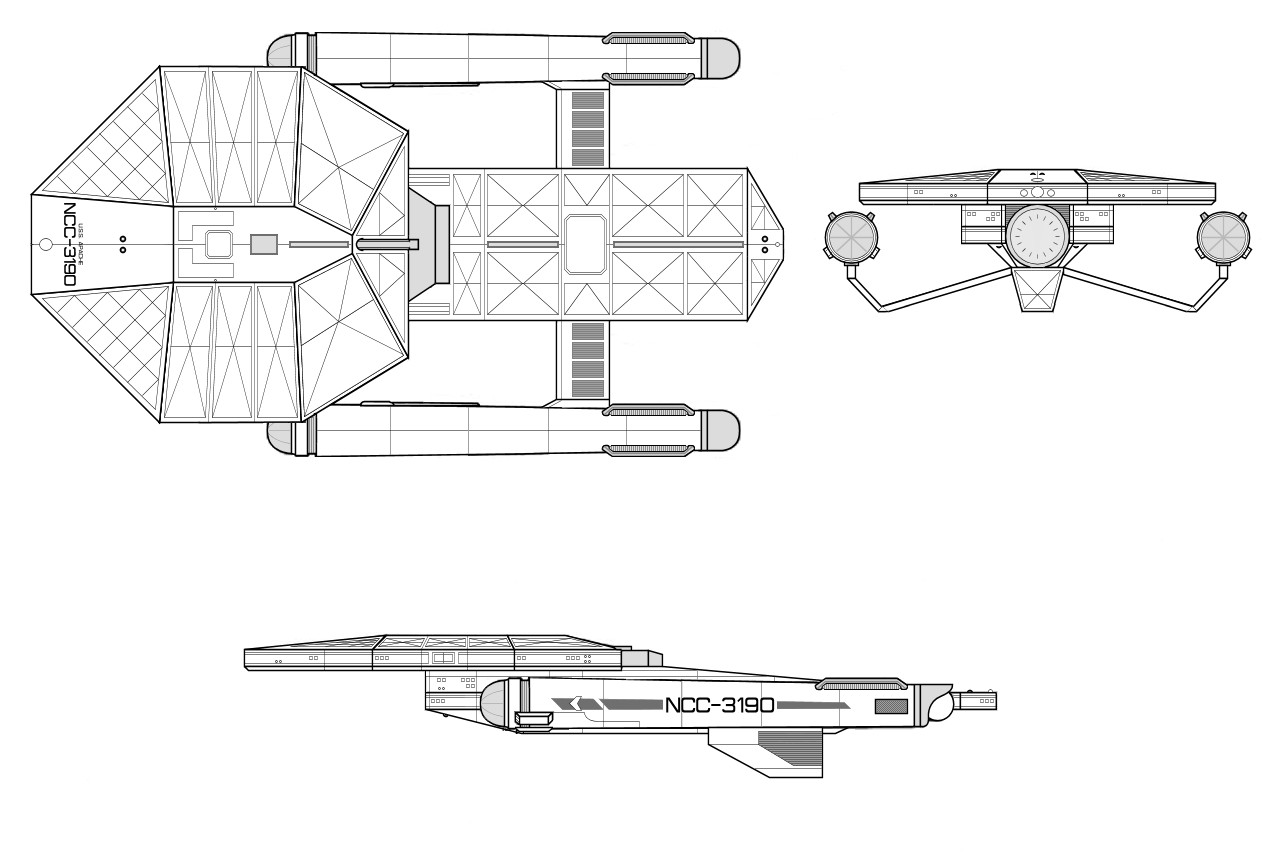
- Check out the Vance Schematic site [maybe this one?] for a good stand-in for this class. Also the FASA Romulan War Sourcebook, though I suspect any images will not match text.
- Some commissioned ship names attributed to the Armstrong/Helena classes are:
- Guide:
- Armstrong-class
- Armstrong (NCA-242/NCC-08)
- Tereshkova (NCA-243/NCC-09)
- Kerry
- McCandless
- Glenn
- Titov
- Helena-class
- Helena
- Emden
- Lorelei (NCA-254/NCC-14)
- Aurora
- Parakeet (NCA-256/NCC-15)
- Mistral
- Rio Negro
- Algerie
- Recommended RPG Ships:
- Armstrong-class
- Armstrong (NCA-242/NCC-08)
- Tereshkova (NCA-243/NCC-09)
- Kerry
- McCandless
- Glenn
- Titov
- Aldrin
- Collins
- Shepherd
- Gagarin
- Lovell
- Leonov
- Helena-class
- Helena
- Emden
- Lorelei (NCA-254/NCC-14)
- Aurora
- Parakeet (NCA-256/NCC-15)
- Mistral
- Rio Negro
- Algerie
- Monitor
- Santisma Trinidad