Guide:T'Pari: Difference between revisions
No edit summary |
No edit summary |
||
| Line 5: | Line 5: | ||
|years= [[2250]]-[[2291]]<br> | |years= [[2250]]-[[2291]]<br> | ||
* ''T'Pari'' surveyor | * ''T'Pari'' surveyor | ||
* ''Thuringia'' surveyor | |||
* ''K’Kmarak'' surveyor | * ''K’Kmarak'' surveyor | ||
|constructed= Total: 30 <br> | |constructed= Total: 30 <br> | ||
* ''T'Pari'': 30 | * ''T'Pari'': 30 | ||
* ''K’Kmarak'': 16 (converted '' | * ''Thuringia'': 20 (modified ''T'Pari'' [[2262]]-[[2264]]) | ||
* ''K’Kmarak'': 16 (converted ''''Thuringia'''' [[2272]]) | |||
|length= 189.0 m | |length= 189.0 m | ||
|beam= 68.4m | |beam= 68.4m | ||
| Line 14: | Line 16: | ||
|mass= <br> | |mass= <br> | ||
* ''T'Pari'': 154,200 mt | * ''T'Pari'': 154,200 mt | ||
* ''Thuringia'': 155,050 mt | |||
* ''K’Kmarak'': 158,000 mt | * ''K’Kmarak'': 158,000 mt | ||
|cruisespeed= w 5 | |cruisespeed= w 5 | ||
| Line 65: | Line 68: | ||
|history= LUG, FASA | |history= LUG, FASA | ||
}} | }} | ||
[[Image:No Photo Available.jpg|left|200px|thumb|The only operational casualty of the T’Pari class, USS T’Pool (NAR-24307) was crippled by an unexpected coronal mass ejection during a standard nova survey in 2272. After the crew was evacuated aboard USS Agincourt (NCC-4314), the survey vessel was set adrift with marker beacons activated. Yet attempts at locating the T’Pool again were unsuccessful.]] | [[Image:No Photo Available.jpg|left|200px|thumb|The only operational casualty of the ''T’Pari'' class, ''USS T’Pool'' (NAR-24307) was crippled by an unexpected coronal mass ejection during a standard nova survey in [[2272]]. After the crew was evacuated aboard ''USS Agincourt'' (NCC-4314), the survey vessel was set adrift with marker beacons activated. Yet attempts at locating the ''T’Pool'' again were unsuccessful.]] | ||
The T’Pari surveyors built in the 2250s exemplify the trusting spirits of the time, prompted by the | The '''''T’Pari''''' surveyors built in the [[2250s]] exemplify the trusting spirits of the time, prompted by the | ||
lifting of the Klingon menace and the opening of the frontier for exploration once more. These | lifting of the Klingon menace and the opening of the frontier for exploration once more. These | ||
vessels were constructed by Vulcan yet for | vessels were constructed by Vulcan yet for [[Star Fleet]] use; even though they received NSP or NAR | ||
registries and served alongside numerous auxiliary cruisers, they were purpose-built designs that | registries and served alongside numerous auxiliary cruisers, they were purpose-built designs that | ||
featured a proper balance of equipment and facilities for multi-year survey work in accordance with | featured a proper balance of equipment and facilities for multi-year survey work in accordance with | ||
Exploration Command mission parameters. On the other hand, they carried virtually no weaponry | [[Research and Exploration|Exploration Command]] mission parameters. On the other hand, they carried virtually no weaponry | ||
and were very lightly shielded. | and were very lightly shielded. | ||
Key to T’Pari performance was a voluminous hull, necessary even when operating crews typically | Key to ''T’Pari'' performance was a voluminous hull, necessary even when operating crews typically | ||
came from Vulcan. Using Procyon corvette structural members as a starting point only, the design | came from [[Vulcan]]. Using ''[[Guide:Procyon|Procyon]]'' corvette structural members as a starting point only, the design | ||
expanded from a bow half-saucer into an elongated shape somewhat resembling the heavy frigate | expanded from a bow half-saucer into an elongated shape somewhat resembling the heavy frigate | ||
hulls. At the aft quarters were bays for medium exploration shuttlecraft, indispensable for the | hulls. At the aft quarters were bays for medium exploration shuttlecraft, indispensable for the | ||
| Line 82: | Line 85: | ||
various type, as well as extensive laboratories for their analysis. Holds between the hangars stored | various type, as well as extensive laboratories for their analysis. Holds between the hangars stored | ||
survey gear and ground vehicles, which could be moved down to the target planet via the heavy | survey gear and ground vehicles, which could be moved down to the target planet via the heavy | ||
Class B shuttlecraft, or via a large combined cargo and personnel transporter just ahead of the holds. | [[Guide:Shuttlecraft|Class B shuttlecraft]], or via a large combined cargo and personnel transporter just ahead of the holds. | ||
For lighter surface forays, two independently working GP transporters were provided, along with | For lighter surface forays, two independently working GP transporters were provided, along with | ||
staging rooms and an immediately adjacent decontamination area and sickbay. | staging rooms and an immediately adjacent decontamination area and sickbay. | ||
| Line 100: | Line 103: | ||
hull, accommodating a horizontal twin-chambered linear reactor. Primary plasma was fed to an | hull, accommodating a horizontal twin-chambered linear reactor. Primary plasma was fed to an | ||
impulse engine at the tapering aft end of the keel, as well as up along an angled pylon into a single | impulse engine at the tapering aft end of the keel, as well as up along an angled pylon into a single | ||
PB-35E engine, in an arrangement very much resembling the Remora escort propulsive system. | PB-35E engine, in an arrangement very much resembling the ''[[Guide:Remora|Remora]]'' escort propulsive system. | ||
Similar warp 6 maximum performance was provided, this time without the help of additional | Similar warp 6 maximum performance was provided, this time without the help of additional | ||
scooping coils. Endurance and persistence at survey target depended more on the secondary power | scooping coils. Endurance and persistence at survey target depended more on the secondary power | ||
| Line 107: | Line 110: | ||
could be stored within the keel. | could be stored within the keel. | ||
An initial flight of ten T’Paris was launched under Vulcan authority towards the rimward | An initial flight of ten ''T’Paris'' was launched under Vulcan authority towards the rimward | ||
exploration zones in the late 2250s, preceding and preparing the even deeper surveys soon to be | exploration zones in the late [[2250s]], preceding and preparing the even deeper surveys soon to be | ||
launched; VSS T’Plana-Hath would extend her mission all the way to the Galactic Barrier, | launched; ''VSS T’Plana-Hath'' would extend her mission all the way to the Galactic Barrier, | ||
performing detailed studies from a safe distance for several year-long stretches in a row. Out of the | performing detailed studies from a safe distance for several year-long stretches in a row. Out of the | ||
following twenty vessels, eight were given | following twenty vessels, eight were given Star Fleet registries and operated in support of specific | ||
Exploration Command programs. These vessels were upgraded in 2262-64, theoretically now | Exploration Command programs. These vessels were upgraded in [[2262]]-[[2264|64]], theoretically now | ||
carrying the subclass name Thuringia although few actual modifications were made to the ships | carrying the subclass name '''''Thuringia''''' although few actual modifications were made to the ships | ||
proper. The increase of some 850 tons of mass came in the form of an expanded FTL sensor suite, | proper. The increase of some 850 tons of mass came in the form of an expanded FTL sensor suite, | ||
required to support modern charting operations. The mission profile of the upgraded ships did tend | required to support modern charting operations. The mission profile of the upgraded ships did tend | ||
| Line 150: | Line 153: | ||
* Timo provides operational numbers that line up with both Vulcan Science Ships (VSS) and [[Star Fleet]] vessels. The Vulcan ones ''might'' be removed following the data-mining stage. | * Timo provides operational numbers that line up with both Vulcan Science Ships (VSS) and [[Star Fleet]] vessels. The Vulcan ones ''might'' be removed following the data-mining stage. | ||
* There will have to be some un-teasing of data: The ''T'Pari'' were the Vulcan science ships, the (original) Star Fleet would be barely modified and should have their own sub-class name; in fact, the article itself should be re-named to fit that Star Fleet subclass name, with the ''T'Pari'' only referenced as the original design source. The ''Thuringia'' subclass ([[2262]]-[[2264]]) would actually be the totality of the (unnamed) Star Fleet vessels (as none were lost prior to [[2272]]) and should be "unnamed subclass Flight II". Finally, the ''K’Kmaraks'' would be the Flight III, as they were upgraded (in totality) between late [[2271]] and early [[2278]]. | |||
<br> | <br> | ||
Revision as of 10:46, 29 January 2020
.png)
| |
| T'Pari | |
|---|---|
| Class Overview | |
| Category | surveyor |
| Operational | 2250-2291
|
| Constructed | Total: 30 |
| Dimensions | |
| Length | 189.0 m |
| Beam | 68.4m |
| Height | 34.5 m |
| Mass |
|
| Performance | |
| Cruise Speed | w 5 |
| Max Speed | w 6 |
| Endurance |
|
| Complement | |
| Officers | 22 |
| Enlisted |
|
| Crew | 30 research staff |
| Passengers | 8 specialist (as assigned)
|
| Tactical Systems | |
| Beam Weapons | T'Pari
K’Kmarak
|
| Shields |
|
| Laboratories |
|
| Transporters | T'Pari
K’Kmarak
|
| Auxiliary Craft |
|
| Historical | |
| Ships of Note |
|
| Canonicity | |
| Design | FASA, dimensions corrected |
| Name | LUG, FASA |
| History | LUG, FASA
|

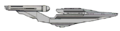
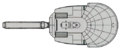
The T’Pari surveyors built in the 2250s exemplify the trusting spirits of the time, prompted by the lifting of the Klingon menace and the opening of the frontier for exploration once more. These vessels were constructed by Vulcan yet for Star Fleet use; even though they received NSP or NAR registries and served alongside numerous auxiliary cruisers, they were purpose-built designs that featured a proper balance of equipment and facilities for multi-year survey work in accordance with Exploration Command mission parameters. On the other hand, they carried virtually no weaponry and were very lightly shielded.
Key to T’Pari performance was a voluminous hull, necessary even when operating crews typically came from Vulcan. Using Procyon corvette structural members as a starting point only, the design expanded from a bow half-saucer into an elongated shape somewhat resembling the heavy frigate hulls. At the aft quarters were bays for medium exploration shuttlecraft, indispensable for the mission profile. Forward of the service hangars were processing rooms for planetary samples of various type, as well as extensive laboratories for their analysis. Holds between the hangars stored survey gear and ground vehicles, which could be moved down to the target planet via the heavy Class B shuttlecraft, or via a large combined cargo and personnel transporter just ahead of the holds. For lighter surface forays, two independently working GP transporters were provided, along with staging rooms and an immediately adjacent decontamination area and sickbay.
Further ahead at ship centerline was a general purpose laboratory complex, adjoining the main computer room and a briefing room, and linking to the athwartships research facilities as well. Superstructures amidships held both the necessary command facilities and versatile astrophysics instrumentation. The whole bow hemisaucer volume was thus available for crew and officer accommodation, offering relative comfort for the basic operating and research crew of up to 120 for great lengths of time. A number of specialists could be accommodated for shorter periods. Guest quarters could also be configured for atypical environmental parameters, to facilitate exchange of information with the broadest range of exotic lifeforms encountered.
Navigation and propulsion systems were detached from the mission hull in a manner typical of civilian vessels. Only the navigational deflector emitters were embedded in primary hull structures ahead of the shuttle hangars and laboratories. An engineering keel extended down from the mission hull, accommodating a horizontal twin-chambered linear reactor. Primary plasma was fed to an impulse engine at the tapering aft end of the keel, as well as up along an angled pylon into a single PB-35E engine, in an arrangement very much resembling the Remora escort propulsive system. Similar warp 6 maximum performance was provided, this time without the help of additional scooping coils. Endurance and persistence at survey target depended more on the secondary power systems, again benefiting from PA experience with tapping the main reactor at low power levels for extended periods of time. Battery backups were naturally available, and significant fuel reserves could be stored within the keel.
An initial flight of ten T’Paris was launched under Vulcan authority towards the rimward exploration zones in the late 2250s, preceding and preparing the even deeper surveys soon to be launched; VSS T’Plana-Hath would extend her mission all the way to the Galactic Barrier, performing detailed studies from a safe distance for several year-long stretches in a row. Out of the following twenty vessels, eight were given Star Fleet registries and operated in support of specific Exploration Command programs. These vessels were upgraded in 2262-64, theoretically now carrying the subclass name Thuringia although few actual modifications were made to the ships proper. The increase of some 850 tons of mass came in the form of an expanded FTL sensor suite, required to support modern charting operations. The mission profile of the upgraded ships did tend more towards astrophysics, even if the ships were fully equipped for planetary surveys as well. No major changes to propulsion or power generation were warranted during the decade of successful operations, and general overhaul periods between three-year cruises seldom exceeded three months. No shortcomings in other fields made themselves evident, either, and all vessels returned safely when the surprise recall orders were issued in 2268.
Shut off from deep space by policy changes, the T’Paris still made themselves useful in local survey work during the transitionary period of the early seventies. Curiously enough, they never were considered to be in need of a linear-engine refit. Instead, a shield generator upgrade and weapon system repositioning saw the vessels decommissioned between late 2271 and early 2278, after which the resulting subclass of improved defensive potency was released for operations. While the subclass name K’Kmarak might have been theoretical only, the vessels in fact achieved considerable public fame under this name. Charting of rimward space was resumed, with now fully Vulcan crews continuing the work of the T’Plana-Hath. The surveyors made numerous first contacts at a time when the Fleet’s exploration-capable heavy units were otherwise disposed.
All but six of the Vulcan and three of the Starfleet vessels were idled by the mid-2280s due to the increasing Klingon threat. Ultimately, only USS Ratha (NAR-24309) was retained for ‘technology evaluation purposes’, carrying classified equipment whilst operating in the vicinity of W Leonis. The far larger and more heavily equipped Nineveh class took over frontier survey operations, often with armed escorts for protection.
Gallery
-
 T'Pari class
 -
.png)
Notes
- I've broken out the research staff from the crew, specifically because they were called out in the sidebar, but they should be considered permanent members of the complement. The specialist passengers are assigned temporarily, with the number presumed to be low.
- Timo provides operational numbers that line up with both Vulcan Science Ships (VSS) and Star Fleet vessels. The Vulcan ones might be removed following the data-mining stage.
- There will have to be some un-teasing of data: The T'Pari were the Vulcan science ships, the (original) Star Fleet would be barely modified and should have their own sub-class name; in fact, the article itself should be re-named to fit that Star Fleet subclass name, with the T'Pari only referenced as the original design source. The Thuringia subclass (2262-2264) would actually be the totality of the (unnamed) Star Fleet vessels (as none were lost prior to 2272) and should be "unnamed subclass Flight II". Finally, the K’Kmaraks would be the Flight III, as they were upgraded (in totality) between late 2271 and early 2278.