Guide:Conestoga: Difference between revisions
No edit summary |
No edit summary |
||
| (5 intermediate revisions by the same user not shown) | |||
| Line 9: | Line 9: | ||
|height=34.9 m | |height=34.9 m | ||
|mass=<br> | |mass=<br> | ||
*239,400 | * 239,400 mt (''Conestoga'') | ||
*238,100 | * 238,100 mt (''Spirit'') | ||
*240,000 | * 240,000 mt (''Ascender'') | ||
|cruisespeed=w 1.6 | |cruisespeed=w 1.6 | ||
|maxspeed=w 2.0 | |maxspeed=w 2.0 | ||
| Line 32: | Line 32: | ||
*2 atmospheric shuttles | *2 atmospheric shuttles | ||
*2 shuttlepods | *2 shuttlepods | ||
|historicalships= | |historicalships=<br> | ||
|design=ENT | * ''Ascender'' | ||
|name=ENT | * ''Conestoga'' | ||
|history=ENT | * ''Spirit'' | ||
|design= ''ENT'' | |||
|name= ''ENT'' | |||
|history= ''ENT'' | |||
}} | }} | ||
In [[2064]], fielding a warp explorer was a herculean effort, an adventure of uncertain success and unlikely financial return. It would have been incredible, even insulting, to claim that such a project would be considered "relatively simple" mere two years later. Yet the '''''Conestoga''''' enterprise of [[2066]] left all earlier warp spacecraft projects in its shadow, in technological complexity as well as scope of mission. | |||
'' | |||
Recent findings from extremely long base interferometry measurements and the ''Friendship'' and ''Messenger'' fast flyby probes had been a disappointment to the general public: a habitable yet uninhabited world could be discerned in only one of the star systems within 20 ly from [[Earth]]. On the other hand, planetologists and xenobiologists were elated, as the actual incidence of habitable worlds exceeded their wildest dreams. The political leadership of Earth certainly understood the serendipity of the [[Eta Cassiopeiae III]] find: cautious inquiries confirmed that [[Vulcans]] held no claim to this region of space, nor knew of any competition to a Terran claim, should one be made. | |||
Earth did not hesitate for a day. Once the formalities with the Vulcans were out of the way, all due haste was also applied on the technological aspects of the process. Rather than send an exploration spacecraft to the multi-year journey, Earth opted for a more aggressive approach in staking its claim. Two hundred volunteers were chosen for the founding of Earth’s first interstellar colony, in a single sortie by a single ship. The latest in warp propulsion and cryogenics would secure their safe transit, and the most recent experiences from the re-established [[Luna|lunar colony]] would be put to use in | |||
allowing them to lay down a permanent presence. To be sure, Eta Cas III was a much less hostile environment than the Moon; indeed, had it not been almost perfectly Earth-like, the entire venture would have been considered far too risky. Still, some 20,000 tons of assorted equipment and supplies would be needed to ensure the survival of the settlers, as there was no time for a second probe flyby to ascertain the exact needs of the colony. | |||
The | The advanced vehicle that would transport the colonists and their cargo was laid down on Earth orbit in August 22nd, [[2065]]. The incredibly tightly scheduled program once again made use of preexisting design elements from operational or planned interplanetary vessels. The colony ship was designed and redesigned "on the fly", the only guideline for the engineers a backward compatibility with what had already been built. The ship reached her final shape in early March [[2067]], at which point the name ''Conestoga'' was assigned. | ||
the | |||
The structural strongback of the colonizer was a box some 11 meters wide, a hundred meters long, and 18 meters or six longitudal decks high at midpoint. The forwardmost eighteen meters were dedicated to two compartments serving navigation functions. The upper held the command center, to be permanently manned by ten of the 25 awake crew. The facility was extensively covered by transparent surfaces, both to facilitate coordinated final stages of atmospheric entry, and for psychological reasons during transit. In fact, the psychological impact was just the reverse of the one intended, deepening the feeling of claustrophobia by adding agoraphobia; shuttering of part of the windows was among the first inflight modifications performed by the crew, although not the last. The lower compartment held no pressurized spaces, but instead mounted the STL and crude FTL navigation sensors, the debris deflector field spire, and mapping sensors for final assessment of Eta Cas III prior to entry. | |||
the | |||
was | |||
[[File:Conestoga colony.png|left|200px|thumb|Earth Colony Ship ''Spirit'' sets down on [[Proxima Centauri]], received by | Aft of these sections was the crew habitat, as well as an airlock complex and an internal equipment hold. On both sides, outside the central pressure box, were the gas envelope shield injectors. Behind the aft bulkhead of the crew section began the passenger area, with cryochambers for the 200 colonial hopefuls, and upper and lower support system levels. This heart of the ship was flanked on both sides by bulging equipment holds, which doubled as radiation protection in transit, and tripled as construction elements for surface habitats after landing. Six large space doors were provided for loading of equipment and for the odd underway repair needs. Forward and aft dish antennas were | ||
added to the exterior for lightspeed messaging; a subspace communicator of Vulcan manufacture was to be activated down on the surface of Eta Cas III for near-realtime contact. | |||
[[File:Conestoga colony.png|left|200px|thumb|Earth Colony Ship ''Spirit'' sets down on [[Proxima Centauri]], received by [[Centaurian]] advance surveyors. External differences between the three ''Conestogas'' were minimal, and the basic configuration was also adapted for several succeeding colonizer types.]] | |||
The quadruple sublight propulsion system featured combined fusion thrust chambers and | The quadruple sublight propulsion system featured combined fusion thrust chambers and | ||
accelerators of tried and true [[Westinghouse]] 4W900 type, each mounting a huge external hydrogen | accelerators of tried and true [[Westinghouse]] 4W900 type, each mounting a huge external hydrogen tank at launch but jettisoning it after initial acceleration and relying on internal stores of deuterium for sublight maneuvering at the target system. Dorsally outriggered nacelles at the tips of gracefully curving pylons held the Cochrane Warp Dynamics AC-1A warp coils, and were to be jettisoned just prior to planetfall, after having provided near-constant warp 1.6 thrust for almost a decade. Gravitics and lift engines on lower keel would ease the ship to a soft landing, to be followed by driving down of the fusion reactors and dismantling of the hull. Afterwards, one of the reactors would be restarted to act as the powerplant of the newborn community. | ||
tank at launch but jettisoning it after initial acceleration and relying on internal stores of deuterium | |||
for sublight maneuvering at the target system. Dorsally outriggered nacelles at the tips of gracefully | |||
curving pylons held the Cochrane Warp Dynamics AC-1A warp coils, and were to be jettisoned just | |||
prior to planetfall, after having provided near-constant warp 1.6 thrust for almost a decade. Gravitics | |||
and lift engines on lower keel would ease the ship to a soft landing, to be followed by driving down | |||
of the fusion reactors and dismantling of the hull. Afterwards, one of the reactors would be restarted | |||
to act as the powerplant of the newborn community. | |||
Launch of the ''Conestoga'', | Launch of the ''Conestoga'', "the Great Experiment", took place on the third anniversary of Cochrane’s test flight. Captain [[Fabian Mitchell]]’s farewell message from the duonetopause made official what the public had known for a long time: a little over nine years hence, Eta Cassiopeiae III would be known as [[Terra Nova]]. | ||
test flight. Captain Fabian | |||
the public had known for a long time: a little over nine years hence, Eta Cassiopeiae III would be | |||
known as [[Terra Nova]]. | |||
Arrival in late [[2076]], thawing of the colonists and atmospheric entry all proceeded as intended. What | Arrival in late [[2076]], thawing of the colonists and atmospheric entry all proceeded as intended. What happened afterwards deviated from the plan, however. Slightly at first, as reports to Earth became infrequent. More severely later on, when a growing group of dissidents, led by former First Officer [[Mark Logan]], gave vocal opposition to the plans on sending over a second batch of 200 colonists on the ''Spirit'', completed and awaiting use since [[2071]]. By [[2081]], matters had escalated to the point where the isolationists held absolute majority at the colony, and threatened to shoot down any Earth vessel attempting landing on Terra Nova. Earth’s response was definitely incendiary, yet could not adequately account for the total silence that followed. As attempts at re-establishing contact failed, Earth reluctantly withdrew the planned second wave, fearing either a hostile reception or then a natural calamity that would claim the second ship as well. | ||
happened afterwards deviated from the plan, however. Slightly at first, as reports to Earth became | |||
infrequent. More severely later on, when a growing group of dissidents, led by former First Officer | |||
Mark Logan, gave vocal opposition to the plans on sending over a second batch of 200 colonists on | |||
the ''Spirit'', completed and awaiting use since [[2071]]. By [[2081]], matters had escalated to the point | |||
where the isolationists held absolute majority at the colony, and threatened to shoot down any Earth | |||
vessel attempting landing on Terra Nova. Earth’s response was definitely incendiary, yet could not | |||
adequately account for the total silence that followed. As attempts at re-establishing contact failed, | |||
Earth reluctantly withdrew the planned second wave, fearing either a hostile reception or then a | |||
natural calamity that would claim the second ship as well. | |||
In the meantime, the third vessel of the series had already been launched towards [[36 Ophiuci III]]. | In the meantime, the third vessel of the series had already been launched towards [[36 Ophiuci III]]. The ''Ascender'' reached the slightly more demanding conditions of the planetary system and successfully established a colony in [[2086]]. The ''Spirit'' was first to be re-vectored towards [[GJ 1048 A]], a promising half of a wide binary discovered lurking behind the dense [[Agosoria Nebula|Agosoria absorption nebula]], and sporting at least one potentially Earthlike planet, possibly two. Vulcan denied passage in this | ||
The ''Ascender'' reached the slightly more demanding conditions of the planetary system and | direction for the time being, however. The vessel was eventually sent to [[Proxima Centauri]], where settlement rights had been negotiated on the second planet. | ||
successfully established a colony in [[2086]]. The ''Spirit'' was first to be re-vectored towards [[ | |||
a promising half of a wide binary discovered lurking behind the dense Agosoria absorption nebula, | |||
and sporting at least one potentially Earthlike planet, possibly two. Vulcan denied passage in this | |||
direction for the time being, however. The vessel was eventually sent to [[Proxima Centauri]], where | |||
settlement rights had been negotiated on the second planet. | |||
At the time the colony there was officially founded in [[2091]], Earth already was aware of at least five | At the time the colony there was officially founded in [[2091]], Earth already was aware of at least five previously missed Earthlike worlds within the 20 ly radius. Also obvious now was that these planets could not be naturally habitable, but had to be the result of large scale terraforming, by party or parties unknown apparently even to the Vulcans. This was splendid news for Earth organizations and communities interested in colonization: modest vessels, such as those of the [[Guide:DY sublight series|DY lineage]], would | ||
previously missed Earthlike worlds within the 20 ly radius. Also obvious now was that these planets | be capable of establishing a successful colony on such worlds. Also welcome were the news of the hitch-free nine years of cryosleep on the ''Conestoga'' mission, alleviating earlier fears of radiation damage. The disaster that had befallen the Terra Nova colony, and the lack of any forewarning thereof in the flyby probe data, were lesser concerns now. By the thirtieth anniversary of Cochrane’s first flight, five interstellar colonies of Terran origin were extant, and three more in the process of being established. Colony ships in transit were legion, so many being launched every year that some were slipping past official records. The isolationist example of Terra Nova inspired many an | ||
could not be naturally habitable, but had to be the result of large scale terraforming, by party or | |||
parties unknown apparently even to the Vulcans. This was splendid news for Earth organizations | |||
and communities interested in colonization: modest vessels, such as those of the [[Guide:DY sublight series|DY lineage]], would | |||
be capable of establishing a successful colony on such worlds. Also welcome were the news of the | |||
hitch-free nine years of cryosleep on the ''Conestoga'' mission, alleviating earlier fears of radiation | |||
damage. The disaster that had befallen the Terra Nova colony, and the lack of any forewarning | |||
thereof in the flyby probe data, were lesser concerns now. By the thirtieth anniversary of Cochrane’s | |||
first flight, five interstellar colonies of Terran origin were extant, and three more in the process of | |||
being established. Colony ships in transit were legion, so many being launched every year that some | |||
were slipping past official records. The isolationist example of Terra Nova inspired many an | |||
emigration movement, and prompted these so-called Diasporan groups to head for ever-deeper | emigration movement, and prompted these so-called Diasporan groups to head for ever-deeper | ||
space, sometimes without certainty of finding a suitable world at the destination. | space, sometimes without certainty of finding a suitable world at the destination. | ||
The true fate of Terra Nova was first uncovered in [[2151]] when survey cruiser ''[[Enterprise (NX-01)]]'' | The true fate of Terra Nova was first uncovered in [[2151]] when survey cruiser ''[[Enterprise (NX-01)]]'' paid the world a visit. Impact of a radioactive asteroid had left few human survivors, yet much of the planet was still habitable. Within fifty years, a new community began to thrive on the southern continent, and a population explosion followed in the early 23rd century. The Ophiucus colony in turn became one of Earth’s most profitable heavy metal mining ventures, and Proxima Centauri an indispensable center of cultural exchange (not to mention a fiercely independent hubworld for the other human colonies in the ternary system). The last ''Conestoga'' reactors were shut down on these | ||
paid the world a visit. Impact of a radioactive asteroid had left few human survivors, yet much of | |||
the planet was still habitable. Within fifty years, a new community began to thrive on the southern | |||
continent, and a population explosion followed in the early 23rd century. The Ophiucus colony in | |||
turn became one of Earth’s most profitable heavy metal mining ventures, and Proxima Centauri an | |||
indispensable center of cultural exchange (not to mention a fiercely independent hubworld for the | |||
other human colonies in the ternary system). The last ''Conestoga'' reactors were shut down on these | |||
locations in [[2209]], [[2285]] and [[2291]], respectively. | locations in [[2209]], [[2285]] and [[2291]], respectively. | ||
==Gallery== | ==Gallery== | ||
<gallery> | <gallery> | ||
File:Patch Conestoga.gif|Terra Nova mission patch | File:Patch Conestoga.gif|Terra Nova mission patch | ||
File:Conestoga (port view).png|Port view | File:Conestoga (port view).png|Port view | ||
| Line 168: | Line 87: | ||
File:Conestoga colonizer (stern).png|Stern aspect | File:Conestoga colonizer (stern).png|Stern aspect | ||
File:Conestoga colonizer (ventral).png|Ventral aspect | File:Conestoga colonizer (ventral).png|Ventral aspect | ||
</gallery> | </gallery> | ||
==Alt Sources== | |||
* [[Starship Handbook (Combined)]] | |||
==Notes== | |||
*Some ship names attributed to the ''Conestoga'' class are: | |||
** Guide: ''Conestoga'', ''Spirit'', ''Ascender'' | |||
* References to "Alpha Centauri A II" are changed to [[Proxima Centauri]] (aka, Alpha Centauri C III), to represent a part of the trinary system not yet already settled by the Centaurians. Similarly, Khi Ceta A , an alternate spelling of Chi Ceti A, was changed to GJ 1048 A, which happens to be located behind the nebula as Timo indicated and is not directly related to Ingraham B, a alpha-canon star located in the Alpha Quadrant. | |||
---- | ---- | ||
*[[Timo's Guide to | * [[Timo's Guide to Star Fleet|Back to the Table of Contents]] | ||
*[[Guide:2063-2130 - The Incredible Expansion|Back to "The Incredible Expansion"]] | * [[Guide: 2063-2130 - The Incredible Expansion|Back to "The Incredible Expansion"]] | ||
*[[Of Ship Statistics | * [[Guide: Of Ship Statistics|Appendix A: Of Ship Statistics]] | ||
*[[Glossary | * [[Guide: Glossary|Appendix B: Glossary]] | ||
*[[ | * [[Guide: Star Fleet Organization - General Outline|Appendix C: Star Fleet Organization - General Outline]] | ||
*[[Abbreviations From Outside | * [[Guide: Abbreviations From Outside|Appendix D: Abbreviations From Outside]] | ||
[[Category:Guide|{{PAGENAME}}]] | [[Category:Guide|{{PAGENAME}}]] | ||
Latest revision as of 06:52, 21 August 2026

| |
| Conestoga | |
|---|---|
| Class Overview | |
| Category | Colonizer |
| Operational | 2067 - 2098 |
| Constructed | 3 |
| Dimensions | |
| Length | 197.2 m |
| Beam | 71.0 m |
| Height | 34.9 m |
| Mass |
|
| Performance | |
| Cruise Speed | w 1.6 |
| Max Speed | w 2.0 |
| Endurance | 10 years |
| Complement | |
| Officers | 5 |
| Enlisted | 20
|
| Passengers | 200 |
| Cargo | 20,000 mt |
| Tactical Systems | |
| Shields |
|
| Laboratories | 1 planetary sciences |
| Auxiliary Craft |
|
| Historical | |
| Ships of Note |
|
| Canonicity | |
| Design | ENT |
| Name | ENT |
| History | ENT
|
In 2064, fielding a warp explorer was a herculean effort, an adventure of uncertain success and unlikely financial return. It would have been incredible, even insulting, to claim that such a project would be considered "relatively simple" mere two years later. Yet the Conestoga enterprise of 2066 left all earlier warp spacecraft projects in its shadow, in technological complexity as well as scope of mission.
Recent findings from extremely long base interferometry measurements and the Friendship and Messenger fast flyby probes had been a disappointment to the general public: a habitable yet uninhabited world could be discerned in only one of the star systems within 20 ly from Earth. On the other hand, planetologists and xenobiologists were elated, as the actual incidence of habitable worlds exceeded their wildest dreams. The political leadership of Earth certainly understood the serendipity of the Eta Cassiopeiae III find: cautious inquiries confirmed that Vulcans held no claim to this region of space, nor knew of any competition to a Terran claim, should one be made.
Earth did not hesitate for a day. Once the formalities with the Vulcans were out of the way, all due haste was also applied on the technological aspects of the process. Rather than send an exploration spacecraft to the multi-year journey, Earth opted for a more aggressive approach in staking its claim. Two hundred volunteers were chosen for the founding of Earth’s first interstellar colony, in a single sortie by a single ship. The latest in warp propulsion and cryogenics would secure their safe transit, and the most recent experiences from the re-established lunar colony would be put to use in allowing them to lay down a permanent presence. To be sure, Eta Cas III was a much less hostile environment than the Moon; indeed, had it not been almost perfectly Earth-like, the entire venture would have been considered far too risky. Still, some 20,000 tons of assorted equipment and supplies would be needed to ensure the survival of the settlers, as there was no time for a second probe flyby to ascertain the exact needs of the colony.
The advanced vehicle that would transport the colonists and their cargo was laid down on Earth orbit in August 22nd, 2065. The incredibly tightly scheduled program once again made use of preexisting design elements from operational or planned interplanetary vessels. The colony ship was designed and redesigned "on the fly", the only guideline for the engineers a backward compatibility with what had already been built. The ship reached her final shape in early March 2067, at which point the name Conestoga was assigned.
The structural strongback of the colonizer was a box some 11 meters wide, a hundred meters long, and 18 meters or six longitudal decks high at midpoint. The forwardmost eighteen meters were dedicated to two compartments serving navigation functions. The upper held the command center, to be permanently manned by ten of the 25 awake crew. The facility was extensively covered by transparent surfaces, both to facilitate coordinated final stages of atmospheric entry, and for psychological reasons during transit. In fact, the psychological impact was just the reverse of the one intended, deepening the feeling of claustrophobia by adding agoraphobia; shuttering of part of the windows was among the first inflight modifications performed by the crew, although not the last. The lower compartment held no pressurized spaces, but instead mounted the STL and crude FTL navigation sensors, the debris deflector field spire, and mapping sensors for final assessment of Eta Cas III prior to entry.
Aft of these sections was the crew habitat, as well as an airlock complex and an internal equipment hold. On both sides, outside the central pressure box, were the gas envelope shield injectors. Behind the aft bulkhead of the crew section began the passenger area, with cryochambers for the 200 colonial hopefuls, and upper and lower support system levels. This heart of the ship was flanked on both sides by bulging equipment holds, which doubled as radiation protection in transit, and tripled as construction elements for surface habitats after landing. Six large space doors were provided for loading of equipment and for the odd underway repair needs. Forward and aft dish antennas were added to the exterior for lightspeed messaging; a subspace communicator of Vulcan manufacture was to be activated down on the surface of Eta Cas III for near-realtime contact.

The quadruple sublight propulsion system featured combined fusion thrust chambers and accelerators of tried and true Westinghouse 4W900 type, each mounting a huge external hydrogen tank at launch but jettisoning it after initial acceleration and relying on internal stores of deuterium for sublight maneuvering at the target system. Dorsally outriggered nacelles at the tips of gracefully curving pylons held the Cochrane Warp Dynamics AC-1A warp coils, and were to be jettisoned just prior to planetfall, after having provided near-constant warp 1.6 thrust for almost a decade. Gravitics and lift engines on lower keel would ease the ship to a soft landing, to be followed by driving down of the fusion reactors and dismantling of the hull. Afterwards, one of the reactors would be restarted to act as the powerplant of the newborn community.
Launch of the Conestoga, "the Great Experiment", took place on the third anniversary of Cochrane’s test flight. Captain Fabian Mitchell’s farewell message from the duonetopause made official what the public had known for a long time: a little over nine years hence, Eta Cassiopeiae III would be known as Terra Nova.
Arrival in late 2076, thawing of the colonists and atmospheric entry all proceeded as intended. What happened afterwards deviated from the plan, however. Slightly at first, as reports to Earth became infrequent. More severely later on, when a growing group of dissidents, led by former First Officer Mark Logan, gave vocal opposition to the plans on sending over a second batch of 200 colonists on the Spirit, completed and awaiting use since 2071. By 2081, matters had escalated to the point where the isolationists held absolute majority at the colony, and threatened to shoot down any Earth vessel attempting landing on Terra Nova. Earth’s response was definitely incendiary, yet could not adequately account for the total silence that followed. As attempts at re-establishing contact failed, Earth reluctantly withdrew the planned second wave, fearing either a hostile reception or then a natural calamity that would claim the second ship as well.
In the meantime, the third vessel of the series had already been launched towards 36 Ophiuci III. The Ascender reached the slightly more demanding conditions of the planetary system and successfully established a colony in 2086. The Spirit was first to be re-vectored towards GJ 1048 A, a promising half of a wide binary discovered lurking behind the dense Agosoria absorption nebula, and sporting at least one potentially Earthlike planet, possibly two. Vulcan denied passage in this direction for the time being, however. The vessel was eventually sent to Proxima Centauri, where settlement rights had been negotiated on the second planet.
At the time the colony there was officially founded in 2091, Earth already was aware of at least five previously missed Earthlike worlds within the 20 ly radius. Also obvious now was that these planets could not be naturally habitable, but had to be the result of large scale terraforming, by party or parties unknown apparently even to the Vulcans. This was splendid news for Earth organizations and communities interested in colonization: modest vessels, such as those of the DY lineage, would be capable of establishing a successful colony on such worlds. Also welcome were the news of the hitch-free nine years of cryosleep on the Conestoga mission, alleviating earlier fears of radiation damage. The disaster that had befallen the Terra Nova colony, and the lack of any forewarning thereof in the flyby probe data, were lesser concerns now. By the thirtieth anniversary of Cochrane’s first flight, five interstellar colonies of Terran origin were extant, and three more in the process of being established. Colony ships in transit were legion, so many being launched every year that some were slipping past official records. The isolationist example of Terra Nova inspired many an emigration movement, and prompted these so-called Diasporan groups to head for ever-deeper space, sometimes without certainty of finding a suitable world at the destination.
The true fate of Terra Nova was first uncovered in 2151 when survey cruiser Enterprise (NX-01) paid the world a visit. Impact of a radioactive asteroid had left few human survivors, yet much of the planet was still habitable. Within fifty years, a new community began to thrive on the southern continent, and a population explosion followed in the early 23rd century. The Ophiucus colony in turn became one of Earth’s most profitable heavy metal mining ventures, and Proxima Centauri an indispensable center of cultural exchange (not to mention a fiercely independent hubworld for the other human colonies in the ternary system). The last Conestoga reactors were shut down on these locations in 2209, 2285 and 2291, respectively.
Gallery
-
 Terra Nova mission patch
 -
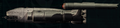 Port view
 -
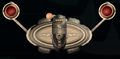 Bow view
 -
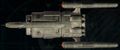 Dorsal view
 -
 Starboard aspect
 -
 Bow aspect
 -
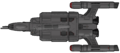 Dorsal aspect
 -
 Stern aspect
 -
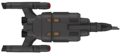 Ventral aspect

.png)
.jpg)
.jpg)
.png)
.png)
.png)
.png)
.png)
Alt Sources
Notes
- Some ship names attributed to the Conestoga class are:
- Guide: Conestoga, Spirit, Ascender
- References to "Alpha Centauri A II" are changed to Proxima Centauri (aka, Alpha Centauri C III), to represent a part of the trinary system not yet already settled by the Centaurians. Similarly, Khi Ceta A , an alternate spelling of Chi Ceti A, was changed to GJ 1048 A, which happens to be located behind the nebula as Timo indicated and is not directly related to Ingraham B, a alpha-canon star located in the Alpha Quadrant.