Guide:Galileo: Difference between revisions
No edit summary |
No edit summary |
||
| (26 intermediate revisions by the same user not shown) | |||
| Line 1: | Line 1: | ||
:''For the ''Galileo'' subclass scoutcraft, see [[Guide: Mission]]''. | |||
{{Sidebar Guide ship | {{Sidebar Guide ship | ||
|image= [[File:Galileo ( | |image= [[File:Galileo eps (stbd).png|150px|Galileo experimental propulsion ship]] | ||
|classname= ''Galileo'' | |classname= ''Galileo'' | ||
|category= experimental propulsion ship | |category= [[ISA]] experimental propulsion ship | ||
|years= [[2028]] | |years= [[2028]] | ||
|constructed= 1 | |constructed= 1 | ||
| Line 9: | Line 10: | ||
|height= 119.4 m | |height= 119.4 m | ||
|mass= 15,000 mt | |mass= 15,000 mt | ||
|maxspeed= 0. | |maxspeed= 0.35c (projected) | ||
|endurance= 27 years | |endurance= 27 years | ||
|crew= 98 | |crew= 98 | ||
| Line 24: | Line 25: | ||
|design= | |design= | ||
|name= | |name= | ||
|history= | |history= ''Spaceflight Chronology" (p 50) | ||
|delta= [http://starshiptracker.com/sfcwiki/images/b/b3/SRM_Report_-303_Galileo_experimental_propulsion_ship.pdf ''SRM #303''] | |||
}} | }} | ||
==Background | ==Background: Delta Dynamics== | ||
By the mid-[[2020s]], there was a small but growing number of commercial spacecraft designs that followed the introduction of the [[Guide:DY_sublight_series#DY-120_interplanetary_transport_.26_DY-120_Brenton_mission_spacecraft|DY-120 interplanetary transport]]. These ships represented a myriad of purposes: orbital facility construction, asteroidal ore offloading, main belt exploration, near-[[Earth]] scientific explorers, junk retrieval, personnel and tourist transports, most anything relatively local that was not [[Mars]]-bound (which was still considered “off limits”). | |||
By the mid-2020s, there was a small but growing number of commercial spacecraft designs that followed the introduction of the DY-120 interplanetary transport. These ships represented a myriad of purposes: orbital facility construction, asteroidal ore offloading, main belt exploration, near-Earth scientific explorers, junk retrieval, personnel and tourist transports, most anything relatively local that was not Mars-bound (which was still considered “off limits”). | |||
The Grand Mission was ongoing, with one ''Aventeur'' (the ''Stephen Long'') left to launch. The perceived inherent danger of long-distance solar exploration was magnified by the extreme length of these missions; ''Aventeur | The Grand Mission was ongoing, with one ''[[Guide:Aventeur|Aventeur]]'' (the ''Stephen Long'') left to launch. The perceived inherent danger of long-distance solar exploration was magnified by the extreme length of these missions; ''Aventeur IV'' had [[2025|just arrived]] at [[Saturn]] after eleven years, and was not expected back to Earth for [[2039|another fourteen]]. As ion propulsion technology steadily evolved, some astronautical engineers sought to create a drive that would figuratively and literally boost the output and velocity of Earth spacecraft, in order to—at first—dramatically decrease the time that passed to get from one inner system point to another, and then extend the range of those missions. These technologists saw exploration and resource gathering of the Oort cloud as achievable within the next two decades, not something that was a century or longer away, as was commonly accepted. | ||
The propulsion vehicle they had their eye on was of an experimental nuclear thermal rocketry (NTR) design. With nuclear fusion on the cusp of becoming viable for spacecraft, the hyper-expensive ''Galileo'' concept envisioned the NTR drive using a reactor utilizing laser | The propulsion vehicle they had their eye on was of an experimental nuclear thermal rocketry (NTR) design. With nuclear fusion on the cusp of becoming viable for spacecraft, the hyper-expensive '''''Galileo''''' concept envisioned the NTR drive using a reactor utilizing laser exciters to allow the necessary miniaturization. This endeavor would be fueled by liquid hydrogen stored in the bulk of the spacecraft’s hull and could conceivably achieve—with consistent acceleration—an unheard of 0.35 c velocity. With such a drive, the inner boundaries of the Oort cloud could be only months away. The nearest star, [[Proxima Centauri]], which was over 35 years distant with the present ion drive technology, would only be a mere 12 years away; a round trip would come out to six years less than the entire mission of the ''Lewis and Clark'' system explorer. | ||
The ''Galileo'' test vehicle had a particularly specific design, | The ''Galileo'' test vehicle, as commissioned by the [[ISA]], had a particularly specific design, with a massive (nearly 88,000 m3) liquid hydrogen-2 tank dominating. While not specifically necessary for trial runs, it was thought best to provide an over-abundance of fuel lest a test burn that could not be not be decisively shut off at the intended conclusion left the ship continuing into the void of the outer system and beyond, far out of range of any rescue attempt. There was no considerable concern for this scenario, but the enlarged tank supported a secondary goal that a successful test run would also validate follow-on vessels that were equipped with enough fuel to both retro-burn for approach to the destination and then return to Earth. | ||
-- | The “bow” of the vessel was a broad flat circular area serving as the top of the two-deck habitat ring. Cargo hatches and emergency vents adorned this region of the vessel, with a prominent navigational dome serving to take in star positions every fraction of a second, to ensure a precise positional awareness. A low-frequency dish antenna served as a back-up method of communication through deep-space relays placed outbound of the ship and as the main method when returning from the completed trial run. Twenty-four linear antennas—fixed just forward of the fuel transfer module and almost mid-way down the engineering module—served a unique purpose on the ultra-high frequency range, as it was conceptually possible that the thrust of the NTR would otherwise interfere with transmissions and reception of radio signals with a dish design. Though appearing to serve as (completely unnecessary) tie-down straps, their placement instead was meant to address the off-axis angle of the ship’s outbound vector in relation to the observation stations on Earth and [[Luna]], enhancing the integrity of essential distance-delayed data and voice transmissions. Four structural stability monitors were installed at non-symmetrical but equidistant positions about the aft module (though forward of the NTR drive itself). | ||
[[File:Galileo II.png|left|200px|thumb|''Galileo'' interstellar explorer concept]] | |||
The ''Galileo'' testbed entered the history books, not for the achievement of any of these grand designs, but from its catastrophic and early conclusion. What was to have been a simple start-up test of the laser-fusion exciters (the fusion reactor itself was still in the design phase) out at the L5 orbital point instead turned into a silent but huge conflagration as the helium | Conceptual plans for post-testing operations saw an additional fuel tank—of identical proportions—added to the fore of the ''Galileo'', with a similar habitat ring ahead of that. The original ring, now sandwiched between the two tanks, would be converted into an atmospheric mining space, from which a scoop drogue and rig could be extended into the upper atmosphere of a gas giant, replenishing the fuel tanks with free hydrogen. The habitable areas would accommodate the supplies, including foodstuff and spare parts, that would be deemed necessary for mankind’s first interplanetary voyage. | ||
The ''Galileo'' testbed entered the history books, not for the achievement of any of these grand designs, but from its catastrophic and early conclusion. What was to have been a simple start-up test of the laser-fusion exciters (the fusion reactor itself was still in the design phase) out at the L5 orbital point instead turned into a silent but huge conflagration as the helium inadvertently leaked from internal supply lines during the excitation warm-up procedures. All 98 crew members, as well as eleven observers, perished immediately. | |||
==Gallery== | ==Gallery== | ||
===''Galileo''=== | ===''Galileo'' experimental propulsion ship === | ||
<gallery> | <gallery> | ||
File:Galileo eps (stbd).png | |||
File:Galileo eps (bow).png | |||
File:Galileo eps (dorsal).png | |||
File:Galileo eps (stern).png | |||
File:Galileo eps (ventral).png | |||
</gallery> | </gallery> | ||
| Line 51: | Line 60: | ||
<gallery> | <gallery> | ||
File:Sternbach Galileo.png | File:Sternbach Galileo.png | ||
File:Galileo (rough).png | |||
File:Interstellar Galileo.png|Unrealized interstellar concept | File:Interstellar Galileo.png|Unrealized interstellar concept | ||
File:Galileo class-sfc.jpg | File:Galileo class-sfc.jpg | ||
</gallery> | </gallery> | ||
==Supporting Documents== | |||
* [http://www.starshiptracker.com/deltadynamics/index.php/File:Galileo_blueprints.zip Blueprints] | |||
* [http://starshiptracker.com/sfcwiki/images/b/b3/SRM_Report_-303_Galileo_experimental_propulsion_ship.pdf ''Starship Recognition Manual - Report #303: ''Galileo'' Experimental Propulsion Ship'']] | |||
==Notes== | ==Notes== | ||
| Line 60: | Line 74: | ||
* ''FSC'' vol 3 has a brief statement on page 9 indicating the Galileo was a transport class that entered in 2028. Page 14 gives a half-page to the ship indicating the importance of the class both in Sol system exploration and during the Kzin wars, and includes a color image with an asteroid. A brief section on page 32 provides a sketch and some repeated or additional specs. | * ''FSC'' vol 3 has a brief statement on page 9 indicating the Galileo was a transport class that entered in 2028. Page 14 gives a half-page to the ship indicating the importance of the class both in Sol system exploration and during the Kzin wars, and includes a color image with an asteroid. A brief section on page 32 provides a sketch and some repeated or additional specs. | ||
* I agree we should forego the transport aspect and focus on this as an experiment in rapid acceleration via fusion. But because the loss of 14 lives with the AFP-1 seemed to be more notable, it would seem that the failure of the Galileo would have been an entire spacecraft one that was seen as both "financial and technological." I'm thinking the EM emissions of the activated fusion drive probably overwhelmed the shipkeeping systems of the vessel, making the entire endeavor a waste of time and funds. The bulbous front section will probably contain the fuel for the drive (hydrogen?), instead of being a cargo pod. The year [[2028]] seems to be reasonable. | * I agree we should forego the transport aspect and focus on this as an experiment in rapid acceleration via fusion. But because the loss of 14 lives with the AFP-1 seemed to be more notable, it would seem that the failure of the Galileo would have been an entire spacecraft one that was seen as both "financial and technological." I'm thinking the EM emissions of the activated fusion drive probably overwhelmed the shipkeeping systems of the vessel, making the entire endeavor a waste of time and funds. The bulbous front section will probably contain the fuel for the drive (hydrogen?), instead of being a cargo pod. The year [[2028]] seems to be reasonable. | ||
* For SRM Timeline purposes, I'm having construction start in [[2025]], despite it not being in the text (presently). | |||
<br><br> | |||
---- | ---- | ||
* [[Guide: Timo's Guide to Star Fleet|Back to the Table of Contents]] | * [[Guide: Timo's Guide to Star Fleet|Back to the Table of Contents]] | ||
* [[Guide: Before 2063 - The Playground|Back to "The Playground"]] | * [[Guide: Before 2063 - The Playground|Back to "The Playground"]] | ||
* [[Guide: Of Ship Statistics|Appendix A: Of Ship Statistics]] | * [[Guide: Of Ship Statistics|Appendix A: Of Ship Statistics]] | ||
* [[Guide: Glossary|Appendix B: Glossary]] | * [[Guide: Glossary|Appendix B: Glossary]] | ||
* [[Guide: | * [[Guide: Star Fleet Organization - General Outline|Appendix C: Star Fleet Organization - General Outline]] | ||
* [[Guide: Abbreviations From Outside|Appendix D: Abbreviations From Outside]] | * [[Guide: Abbreviations From Outside|Appendix D: Abbreviations From Outside]] | ||
[[Category:Guide|{{PAGENAME}}]] | |||
Latest revision as of 19:22, 14 July 2023
- For the Galileo subclass scoutcraft, see Guide: Mission.
.png)
| |
| Galileo | |
|---|---|
| Class Overview | |
| Category | ISA experimental propulsion ship |
| Operational | 2028 |
| Constructed | 1 |
| Dimensions | |
| Length | 300.7 m |
| Beam | 119.4 m |
| Height | 119.4 m |
| Mass | 15,000 mt |
| Performance | |
| Max Speed | 0.35c (projected) |
| Endurance | 27 years |
| Complement | |
| Crew | 98
|
| Canonicity | |
| History | Spaceflight Chronology" (p 50) |
| Delta Dynamics | SRM #303 |
Background: Delta Dynamics
By the mid-2020s, there was a small but growing number of commercial spacecraft designs that followed the introduction of the DY-120 interplanetary transport. These ships represented a myriad of purposes: orbital facility construction, asteroidal ore offloading, main belt exploration, near-Earth scientific explorers, junk retrieval, personnel and tourist transports, most anything relatively local that was not Mars-bound (which was still considered “off limits”).
The Grand Mission was ongoing, with one Aventeur (the Stephen Long) left to launch. The perceived inherent danger of long-distance solar exploration was magnified by the extreme length of these missions; Aventeur IV had just arrived at Saturn after eleven years, and was not expected back to Earth for another fourteen. As ion propulsion technology steadily evolved, some astronautical engineers sought to create a drive that would figuratively and literally boost the output and velocity of Earth spacecraft, in order to—at first—dramatically decrease the time that passed to get from one inner system point to another, and then extend the range of those missions. These technologists saw exploration and resource gathering of the Oort cloud as achievable within the next two decades, not something that was a century or longer away, as was commonly accepted.
The propulsion vehicle they had their eye on was of an experimental nuclear thermal rocketry (NTR) design. With nuclear fusion on the cusp of becoming viable for spacecraft, the hyper-expensive Galileo concept envisioned the NTR drive using a reactor utilizing laser exciters to allow the necessary miniaturization. This endeavor would be fueled by liquid hydrogen stored in the bulk of the spacecraft’s hull and could conceivably achieve—with consistent acceleration—an unheard of 0.35 c velocity. With such a drive, the inner boundaries of the Oort cloud could be only months away. The nearest star, Proxima Centauri, which was over 35 years distant with the present ion drive technology, would only be a mere 12 years away; a round trip would come out to six years less than the entire mission of the Lewis and Clark system explorer.
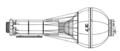
The Galileo test vehicle, as commissioned by the ISA, had a particularly specific design, with a massive (nearly 88,000 m3) liquid hydrogen-2 tank dominating. While not specifically necessary for trial runs, it was thought best to provide an over-abundance of fuel lest a test burn that could not be not be decisively shut off at the intended conclusion left the ship continuing into the void of the outer system and beyond, far out of range of any rescue attempt. There was no considerable concern for this scenario, but the enlarged tank supported a secondary goal that a successful test run would also validate follow-on vessels that were equipped with enough fuel to both retro-burn for approach to the destination and then return to Earth.
The “bow” of the vessel was a broad flat circular area serving as the top of the two-deck habitat ring. Cargo hatches and emergency vents adorned this region of the vessel, with a prominent navigational dome serving to take in star positions every fraction of a second, to ensure a precise positional awareness. A low-frequency dish antenna served as a back-up method of communication through deep-space relays placed outbound of the ship and as the main method when returning from the completed trial run. Twenty-four linear antennas—fixed just forward of the fuel transfer module and almost mid-way down the engineering module—served a unique purpose on the ultra-high frequency range, as it was conceptually possible that the thrust of the NTR would otherwise interfere with transmissions and reception of radio signals with a dish design. Though appearing to serve as (completely unnecessary) tie-down straps, their placement instead was meant to address the off-axis angle of the ship’s outbound vector in relation to the observation stations on Earth and Luna, enhancing the integrity of essential distance-delayed data and voice transmissions. Four structural stability monitors were installed at non-symmetrical but equidistant positions about the aft module (though forward of the NTR drive itself).

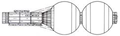
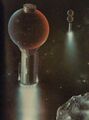
Conceptual plans for post-testing operations saw an additional fuel tank—of identical proportions—added to the fore of the Galileo, with a similar habitat ring ahead of that. The original ring, now sandwiched between the two tanks, would be converted into an atmospheric mining space, from which a scoop drogue and rig could be extended into the upper atmosphere of a gas giant, replenishing the fuel tanks with free hydrogen. The habitable areas would accommodate the supplies, including foodstuff and spare parts, that would be deemed necessary for mankind’s first interplanetary voyage.
The Galileo testbed entered the history books, not for the achievement of any of these grand designs, but from its catastrophic and early conclusion. What was to have been a simple start-up test of the laser-fusion exciters (the fusion reactor itself was still in the design phase) out at the L5 orbital point instead turned into a silent but huge conflagration as the helium inadvertently leaked from internal supply lines during the excitation warm-up procedures. All 98 crew members, as well as eleven observers, perished immediately.
Gallery
Galileo experimental propulsion ship
.png)
.png)
.png)
.png)
Other Images
-
-
-
 Unrealized interstellar concept
 -

.png)


Supporting Documents
Notes
- In Guide: Columbus series, the ship is described completely with the statement "the hyperexpensive Galileo laser-fusion/NTR project ended in utter financial and technological disaster." It is referencing an experiment in fusion propulsion that occurred prior to the Guide: AFP-1 disaster.
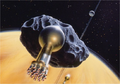
- FSC vol 3 has a brief statement on page 9 indicating the Galileo was a transport class that entered in 2028. Page 14 gives a half-page to the ship indicating the importance of the class both in Sol system exploration and during the Kzin wars, and includes a color image with an asteroid. A brief section on page 32 provides a sketch and some repeated or additional specs.
- I agree we should forego the transport aspect and focus on this as an experiment in rapid acceleration via fusion. But because the loss of 14 lives with the AFP-1 seemed to be more notable, it would seem that the failure of the Galileo would have been an entire spacecraft one that was seen as both "financial and technological." I'm thinking the EM emissions of the activated fusion drive probably overwhelmed the shipkeeping systems of the vessel, making the entire endeavor a waste of time and funds. The bulbous front section will probably contain the fuel for the drive (hydrogen?), instead of being a cargo pod. The year 2028 seems to be reasonable.
- For SRM Timeline purposes, I'm having construction start in 2025, despite it not being in the text (presently).