Guide:Class F2: Difference between revisions
created |
No edit summary |
||
| (7 intermediate revisions by the same user not shown) | |||
| Line 1: | Line 1: | ||
{{Sidebar Guide ship | |||
|image=[[File:F2 primary (stbd).png|250px|Class F2 / MSI(U)-2 'Matchbox' light shuttle]] | |||
|classname= Class F2 / MSI(U)-2 'Matchbox' | |||
|category= light shuttle | |||
|years= [[2231]]-[[2268]] | |||
|constructed= 993 | |||
|length= 11.6 m | |||
|beam= 6.4 m | |||
|height= 3.6 m | |||
|mass= 112.3 tons | |||
|cruisespeed= | |||
|maxspeed= w 1.1 | |||
|endurance= 9 weeks | |||
|officers= | |||
|enlisted= | |||
|troops= | |||
|passengers= 6 | |||
|patients= | |||
|crew= 1-2 | |||
|cargo= | |||
|beamweapons= <br> | |||
* 2x phaser IV emitters (forward cockpit) | |||
|missileweapons= | |||
|otherweapons= | |||
|shields= <br> | |||
* Navigational deflector (bow) | |||
* 1-layer globular forcefield | |||
|labs= | |||
|transporters= | |||
|auxcraft= | |||
|historicalships= | |||
|design= STIX: Star Trek | |||
|name= own | |||
|history= own | |||
}} | |||
[[Star Fleet]]’s earliest efforts to procure a lighter counterpart to the [[Guide: Class F1|F1]] officially stumbled on problems of miniaturization. Yet lack of vision could be cited as well, for the light shuttle had rather lenient design requirements: it was intended to haul no more than eight people from orbit to surface and back while also possessing the ability to take them to minimum warp. Contractors struggled on trying to mount a warp drive onto a smaller version of the aerodynamically smooth and graceful F1 design, attempting for example a design where a single nacelle was ventrally embedded and the passenger compartment straddled the engine, with four seats per side, while a forward cockpit featured a classic rounded nose. Deck footprint issues flunked most such designs outright, yet the utilizability of the interiors was of low [[22nd century]] standards as well. | |||
[[File:F2 action.png|left|250px|thumb|Two light shuttles abandon the doomed ''USS Kelvin'' (NCC-514) in [[2233]] and begin their long voyage to safety. Warp propulsion drastically increased the odds of survival for those fortunate enough to fit into the warp shuttlecraft their starship might be carrying. Yet only certain special missions saw starships embark more than half a dozen of such craft, leaving most survivors in traditional sublight survival craft unless a warp towing scheme could be implemented.]] | |||
A complete paradigm change on lander design had to be forced on Star Fleet in the final design competition of [[2229]]. Pitted against each other were the [[VXT]] lifting body craft with twin PB-424 engines on the upturned winglets—and a graceless [[Chiokis]] flying brick with its PB-730 engines nonchalantly utilized as landing pontoons! Yet the flyoff of the two craft favored the aerodynamics-free design that used sheer maneuvering power, gravitics and deflector fields to bend the atmosphere to its will. The Chiokis C31 design became the long-awaited '''MSI(U)-2''' personnel and liaison craft, and rounded aerodynamic shapes were abandoned for good. | |||
The MSI(U)-2 ‘Matchbox’ packed her ion cascade powerplant in the aft third of the hull, channeling power along protected conduits on pylons that branched out laterally from hull centerplane and then kinked down twice to meet the nacelles. Impulse systems fed directly from the main powerplant, their coils and vents cowled at the stems of the warp engine pylons. | |||
A single portside door opened to the level-floored main cabin. A two-crew cockpit to the left of the door could be separated from the main space with telescoping doors if necessary, but typically only some privacy curtains were installed. Underfloor spaces held key subsystems that could be accessed either externally from the ground, or internally in flight through floor hatches. Additional support systems and communications gear was stowed on the roof. A forward flat-plate window provided for manual flying, but offered no side or ground vision; piloting was mostly done via instrumentation and synthetic views. Workload on the early models was high, but constant upgrades soon allowed single-pilot operations. | |||
Special models were also added to the inventory, as the small deck footprint of the design made it possible for a single starship to carry multiple sub-types for multiple tasks. Exploration versions featured extra stowage and more rugged landing gear (most later models had three-point underhull pads in place of the quadruple nacelle pad arrangement of the first production batch), casevac craft carried medical gear and integrated stretcher/operating table arrangements, and there was even a | |||
dedicated flying workshop called "Tesla" for repair work, featuring an airlock and external manipulators. | |||
The Class F2 shuttle was gradually replaced by the more elegant [[Guide: Class F3|F3]], also a Chiokis product. By the late sixties, the F2 was all but gone, and Star Fleet surplus yards filled with terminally fatigued hulls – and minimally worn warp engines, standing testimony to the limited role of warp travel in light starship auxiliary operations. | |||
==Gallery== | ==Gallery== | ||
<gallery> | <gallery> | ||
File:F2 (stbd).png | File:F2 (stbd).png|Medical variant | ||
</gallery> | </gallery> | ||
==Notes== | |||
* Text indicates two crew were originally required, but upgrades soon allowed single-pilot operations. Sidebar changed to reflect this. | |||
<br> | |||
---- | |||
* [[Guide: Timo's Guide to Star Fleet|Back to the Table of Contents]] | |||
* [[Guide: Shuttlecraft|Back to Shuttlecraft]] | |||
* [[Guide: Of Ship Statistics|Appendix A: Of Ship Statistics]] | |||
* [[Guide: Glossary|Appendix B: Glossary]] | |||
* [[Guide: Star Fleet Organization - General Outline|Appendix C: Star Fleet Organization - General Outline]] | |||
* [[Guide: Abbreviations From Outside|Appendix D: Abbreviations From Outside]] | |||
[[Category:Guide|{{PAGENAME}}]] | |||
Latest revision as of 10:40, 16 December 2022
.png)
| |
| Class F2 / MSI(U)-2 'Matchbox' | |
|---|---|
| Class Overview | |
| Category | light shuttle |
| Operational | 2231-2268 |
| Constructed | 993 |
| Dimensions | |
| Length | 11.6 m |
| Beam | 6.4 m |
| Height | 3.6 m |
| Mass | 112.3 tons |
| Performance | |
| Max Speed | w 1.1 |
| Endurance | 9 weeks |
| Complement | |
| Crew | 1-2 |
| Passengers | 6
|
| Tactical Systems | |
| Beam Weapons |
|
| Shields |
|
| Canonicity | |
| Design | STIX: Star Trek |
| Name | own |
| History | own
|
Star Fleet’s earliest efforts to procure a lighter counterpart to the F1 officially stumbled on problems of miniaturization. Yet lack of vision could be cited as well, for the light shuttle had rather lenient design requirements: it was intended to haul no more than eight people from orbit to surface and back while also possessing the ability to take them to minimum warp. Contractors struggled on trying to mount a warp drive onto a smaller version of the aerodynamically smooth and graceful F1 design, attempting for example a design where a single nacelle was ventrally embedded and the passenger compartment straddled the engine, with four seats per side, while a forward cockpit featured a classic rounded nose. Deck footprint issues flunked most such designs outright, yet the utilizability of the interiors was of low 22nd century standards as well.

A complete paradigm change on lander design had to be forced on Star Fleet in the final design competition of 2229. Pitted against each other were the VXT lifting body craft with twin PB-424 engines on the upturned winglets—and a graceless Chiokis flying brick with its PB-730 engines nonchalantly utilized as landing pontoons! Yet the flyoff of the two craft favored the aerodynamics-free design that used sheer maneuvering power, gravitics and deflector fields to bend the atmosphere to its will. The Chiokis C31 design became the long-awaited MSI(U)-2 personnel and liaison craft, and rounded aerodynamic shapes were abandoned for good.
The MSI(U)-2 ‘Matchbox’ packed her ion cascade powerplant in the aft third of the hull, channeling power along protected conduits on pylons that branched out laterally from hull centerplane and then kinked down twice to meet the nacelles. Impulse systems fed directly from the main powerplant, their coils and vents cowled at the stems of the warp engine pylons.
A single portside door opened to the level-floored main cabin. A two-crew cockpit to the left of the door could be separated from the main space with telescoping doors if necessary, but typically only some privacy curtains were installed. Underfloor spaces held key subsystems that could be accessed either externally from the ground, or internally in flight through floor hatches. Additional support systems and communications gear was stowed on the roof. A forward flat-plate window provided for manual flying, but offered no side or ground vision; piloting was mostly done via instrumentation and synthetic views. Workload on the early models was high, but constant upgrades soon allowed single-pilot operations.
Special models were also added to the inventory, as the small deck footprint of the design made it possible for a single starship to carry multiple sub-types for multiple tasks. Exploration versions featured extra stowage and more rugged landing gear (most later models had three-point underhull pads in place of the quadruple nacelle pad arrangement of the first production batch), casevac craft carried medical gear and integrated stretcher/operating table arrangements, and there was even a dedicated flying workshop called "Tesla" for repair work, featuring an airlock and external manipulators.
The Class F2 shuttle was gradually replaced by the more elegant F3, also a Chiokis product. By the late sixties, the F2 was all but gone, and Star Fleet surplus yards filled with terminally fatigued hulls – and minimally worn warp engines, standing testimony to the limited role of warp travel in light starship auxiliary operations.
Gallery
-
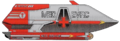 Medical variant
.png)
Notes
- Text indicates two crew were originally required, but upgrades soon allowed single-pilot operations. Sidebar changed to reflect this.