Guide:Hubble: Difference between revisions
No edit summary |
No edit summary |
||
| (10 intermediate revisions by the same user not shown) | |||
| Line 5: | Line 5: | ||
|years= [[2219]] - [[2262]] | |years= [[2219]] - [[2262]] | ||
|constructed= 374 total:<br> | |constructed= 374 total:<br> | ||
* Mk I: 180 | * Mk I: 180 ([[2219]]-[[2225]]) | ||
* Mk II (''Penzias''): 194 | * Mk II (''Penzias''): 194 ([[2226]]-[[2229]]) | ||
|length= 33.0 m | |length= 33.0 m | ||
|beam= 22.1 m | |beam= 22.1 m | ||
| Line 15: | Line 15: | ||
|cruisespeed= | |cruisespeed= | ||
|maxspeed= w 2.9 | |maxspeed= w 2.9 | ||
|endurance= 4 weeks | |endurance= <br> | ||
* Mk I: 4 weeks | |||
* Mk II: 3 weeks | |||
|officers= | |officers= | ||
|enlisted= | |enlisted= | ||
| Line 34: | Line 36: | ||
|transporters= none (some refitted w/ 1 2-pad Mk I) | |transporters= none (some refitted w/ 1 2-pad Mk I) | ||
|auxcraft= | |auxcraft= | ||
|historicalships= | |historicalships= ''USS Vercellino'' (NCC-B116) | ||
|design= TOS-R (Diane Carey: ''Final Frontier'') | |design= TOS-R (Diane Carey: ''Final Frontier'') | ||
|name= Diane Carey | |name= Diane Carey | ||
|history= | |history= Timo | ||
}} | }} | ||
The '''''Hubble''''' runabout was one of the first adaptations of modern lightweight warp engines for [[Star Fleet]]’s high speed liaison needs. At the time the class was created, the starbase network of the [[UFP]] was only gradually taking shape, with a base built per five years or so. Distances separating the starbases were considerable, and the mission of runabouts was not one of shuttling between the bases. Instead, the small liaison craft were supposed to extend the range of local operations around a starbase, moving crews and supplies between starports and planets in the vicinity of the base. | |||
Key to the construction of Star Fleet’s inaugural high speed runabouts was the DB-01 engine, whose two 18 m, 750 ton nacelles for the first time matched the local interstellar average in small engine performance. The compactness was due rather to the maturity of technology than to any radical breakthroughs: DB-01 was still very much a "second-generation" engine. A simple SPCR-20 fusion powerplant at centerline was used to energize the spooled coils to 60 c field strength equivalent, | |||
affording a top speed of warp 2.9. Deuterium-tritium fuel purity requirements were higher than for earlier systems, and user-serviceability somewhat lower. Nevertheless, the engine marked yet another milestone in Star Fleet’s quest for technological parity with its competitors. | |||
The | |||
The midpart of the craft was dedicated to a two-level cargo hold, where either level was also | The 33 m long, oval cross section hull of [[VXT Interstellar]] make was built to be as lightweight as possible. The mass of the warp engines was supported by sturdy pylons that featured a short, slightly trapezoid vertical part and a broader horizontal wing box that ran between the main decks. The reactor was bolted atop the wing box at centerline, with fuel tanks and impulse systems directly aft. | ||
configurable as passenger space; customers could specify portholes for this space as needed. A wide aft door was provided on the lower hold for cargo | |||
loading and offloading, opening into an undercut beneath the reactor, while a central elevator ahead | The midpart of the craft was dedicated to a two-level cargo hold, where either level was also configurable as passenger space; customers could specify portholes for this space as needed. A wide aft door was provided on the lower hold for cargo | ||
of the holds enabled loading of the upper hold under the influence of gravity. The doors and the | loading and offloading, opening into an undercut beneath the reactor, while a central elevator ahead of the holds enabled loading of the upper hold under the influence of gravity. The doors and the elevator were structurally quite affordable, since the major strongbacks of the craft were the upper and lower keeps and lateral spars running level with the upper deck floor, not the thin tritanium hull itself. | ||
elevator were structurally quite affordable, since the major strongbacks of the craft were the upper | |||
and lower keeps and lateral spars running level with the upper deck floor, not the thin tritanium hull | |||
itself. | |||
[[File:Hubble.png|left|250px|thumb|The Mark I ''USS Vercellino'' (NCC-B116) on approach to [[Starbase 2|SB 2]]. Liaison craft crews were understandably proud to operate vessels with full starship-like names painted on the hulls, yet whether the little ''Hubbles'' were deserving of the honor is a matter of opinion.]] | [[File:Hubble.png|left|250px|thumb|The Mark I ''USS Vercellino'' (NCC-B116) on approach to [[Starbase 2|SB 2]]. Liaison craft crews were understandably proud to operate vessels with full starship-like names painted on the hulls, yet whether the little ''Hubbles'' were deserving of the honor is a matter of opinion.]] | ||
The four-person flight deck was at the bow, slightly raised from the upper deck level, and featured | The four-person flight deck was at the bow, slightly raised from the upper deck level, and featured one forward porthole. A dorsal personnel airlock and observation dome were provided aft of this control room. The ''Hubbles'' could be armed with two 180 MW lasers for self-defense or system approach lane clearing operations; these would be installed in upper level spaces flanking the airlock. Below the flight deck was the bunking compartment with accommodation for a crew of three (short runs) to six (multi-shift sorties), including galley facilities and a lavatory. | ||
one forward porthole. A dorsal personnel airlock and observation dome were provided aft of this | |||
control room. The ''Hubbles'' could be armed with two 180 MW lasers for self-defense or system | |||
approach lane clearing operations; these would be installed in upper level spaces flanking the | |||
airlock. Below the flight deck was the bunking compartment with accommodation for a crew of | |||
three (short runs) to six (multi-shift sorties), including galley facilities and a lavatory. | |||
Ventral supports on the pylons next to each nacelle extended skidlike landing pads for landing, yet | Ventral supports on the pylons next to each nacelle extended skidlike landing pads for landing, yet retracted them for atmospheric flight. Two smaller pads were provided below the bow, along with a small retractable sensor turret mainly serving as a landing aid. Two sensor/deflector dishes were provided at the pylon kinks, representing the simplest possible hard- and software. Also, conformal shields were applied for micrometeoroid protection. No lifepods let alone auxiliary craft were | ||
retracted them for atmospheric flight. Two smaller pads were provided below the bow, along with a | carried on the Star Fleet craft, since the runabouts were supposed to operate well within range of rescue vessels and an overall support infrastructure. | ||
small retractable sensor turret mainly serving as a landing aid. Two sensor/deflector dishes were | |||
provided at the pylon kinks, representing the simplest possible hard- and software. Also, conformal | |||
shields were applied for micrometeoroid protection. No lifepods let alone auxiliary craft were | |||
carried on the | |||
rescue vessels and an overall support infrastructure. | |||
In second-batch craft (the ''Penzias''), built by VXT in [[2226]]-[[2229|29]], the warp engine room was slightly modified to | In second-batch craft (the ''Penzias''), built by VXT in [[2226]]-[[2229|29]], the warp engine room was slightly modified to house a smaller fusion reactor and shorter, more compact nacelles. This off-the-shelf item from starbase inventories replaced the original high endurance system, resulting in significant weight and operating cost reduction. Theoretical range of operations was decreased by some 30%, yet other performance figures remained practically unchanged. The greater frequency of refueling stops barely affected the operating procedures of the craft. Investment in a larger number of the craft could be made now, yet the technology still remained relatively immature, and the odds of finding a ''Hubble'' in a given star system low as ever. | ||
house a smaller fusion reactor and shorter, more compact nacelles. This off-the-shelf item from starbase inventories replaced the | |||
original high endurance system, resulting in significant weight and operating cost reduction. | |||
Theoretical range of operations was decreased by some 30%, yet other performance figures | |||
remained practically unchanged. The greater frequency of refueling stops barely affected the | |||
operating procedures of the craft. Investment in a larger number of the craft could be made now, yet | |||
the technology still remained relatively immature, and the odds of finding a ''Hubble'' in a given star | |||
system low as ever. | |||
The ''Hubbles'' saw service until the [[2250s]], when even further miniaturized warp systems began to | The ''Hubbles'' saw uninterrupted service until the [[2250s]], when even further miniaturized warp systems began to appear, benefiting from dilithium regulation technologies. The direct successor design, the ''[[Guide:Mission|Mission]]'' class, was produced in some quantity both for Star Fleet and the civilian market. The various Class F and G warp-capable shuttles emerged as the true inheritors of the in-system liaison vessel role, however. Since these shuttles were also carried by starships, Star Fleet was happy to retire the last ''Hubbles'' in [[2262]] to simplify and commonalize equipment. | ||
appear, benefiting from dilithium regulation technologies. The direct successor design, the ''[[Guide:Mission|Mission]]'' | |||
class, was produced in some quantity both for | |||
and G warp-capable shuttles emerged as the true inheritors of the in-system liaison vessel role, | |||
however. Since these shuttles were also carried by starships, | |||
''Hubbles'' in [[2262]] to simplify and commonalize equipment | |||
On the civilian market, ''Hubble'' was already something of a commercial standard. Various models were available, including VIP transports, interplanetary personnel haulers, light cargo craft and assorted utility types. The modest speed and range, falling short of most Star Fleet interstellar requirements, still satisfied the nonmilitary clients. Even when faster and more practical interstellar runabout types began to emerge in the [[2260s]], the ''Hubbles'' (going by a variety of commercial names) remained popular among those ill able to afford the latest technology. No doubt dozens of these craft remain in service as of this writing, although most users finally abandoned the design in the early [[24th century]]. | |||
==Gallery== | ==Gallery== | ||
| Line 122: | Line 76: | ||
File:Hubble Mk II (stern).png|Stern | File:Hubble Mk II (stern).png|Stern | ||
File:Hubble Mk II (ventral).png|Ventral | File:Hubble Mk II (ventral).png|Ventral | ||
File:Aurora NC-17740.png|''USS Aurora'' | |||
File:Heading Out.png|"Heading Out" | |||
</gallery> | </gallery> | ||
==Notes== | ==Notes== | ||
* The Mk II ''Penzias'' are represented here by the Class J starship used in ''Mudd's Women'', with shorter nacelles and lacking any portholes. The paragraph describing the ''Penzias'' has been altered to represent these details, and a new mass added for the sub-class. The statement regarding [[ | * The Mk II ''Penzias'' are represented here by the Class J starship used in ''Mudd's Women'', with shorter nacelles and lacking any portholes. The paragraph describing the ''Penzias'' has been altered to represent these details, and a new mass added for the sub-class. The statement regarding [[Star Fleet]] choosing not to opt in for portholes (on the Mk I) has been removed. The in-text image was altered to identify the ship as a Mk I. | ||
* A distinction is made that the ''Hubbles'' operated as the sole runabouts into the [[2250s]], as they were not retired as a class until [[2262]]. | |||
* Per [[Guide: Chameleon]], the ''Hubble'' represented the cutting edge in light craft propulsion in [[2247]]. | |||
<br> | |||
---- | ---- | ||
*[[Guide: Timo's Guide to | * [[Guide: Timo's Guide to Star Fleet|Back to the Table of Contents]] | ||
*[[Guide: Small Craft|Small Craft]] | * [[Guide: Small Craft|Small Craft]] | ||
*[[Guide: Of Ship Statistics|Appendix A: Of Ship Statistics]] | * [[Guide: Of Ship Statistics|Appendix A: Of Ship Statistics]] | ||
*[[Guide: Glossary|Appendix B: Glossary]] | * [[Guide: Glossary|Appendix B: Glossary]] | ||
*[[Guide: | * [[Guide: Star Fleet Organization - General Outline|Appendix C: Star Fleet Organization - General Outline]] | ||
*[[Guide: Abbreviations From Outside|Appendix D: Abbreviations From Outside]] | * [[Guide: Abbreviations From Outside|Appendix D: Abbreviations From Outside]] | ||
[[Category:Guide|{{PAGENAME}}]] | [[Category:Guide|{{PAGENAME}}]] | ||
Latest revision as of 08:46, 18 November 2022
.png)
| |
| Hubble | |
|---|---|
| Class Overview | |
| Category | runabout |
| Operational | 2219 - 2262 |
| Constructed | 374 total: |
| Dimensions | |
| Length | 33.0 m |
| Beam | 22.1 m |
| Height | 11.5 m |
| Mass |
|
| Performance | |
| Max Speed | w 2.9 |
| Endurance |
|
| Complement | |
| Crew | 3-6
|
| Tactical Systems | |
| Beam Weapons |
|
| Shields |
|
| Transporters | none (some refitted w/ 1 2-pad Mk I) |
| Historical | |
| Ships of Note | USS Vercellino (NCC-B116) |
| Canonicity | |
| Design | TOS-R (Diane Carey: Final Frontier) |
| Name | Diane Carey |
| History | Timo
|
The Hubble runabout was one of the first adaptations of modern lightweight warp engines for Star Fleet’s high speed liaison needs. At the time the class was created, the starbase network of the UFP was only gradually taking shape, with a base built per five years or so. Distances separating the starbases were considerable, and the mission of runabouts was not one of shuttling between the bases. Instead, the small liaison craft were supposed to extend the range of local operations around a starbase, moving crews and supplies between starports and planets in the vicinity of the base.
Key to the construction of Star Fleet’s inaugural high speed runabouts was the DB-01 engine, whose two 18 m, 750 ton nacelles for the first time matched the local interstellar average in small engine performance. The compactness was due rather to the maturity of technology than to any radical breakthroughs: DB-01 was still very much a "second-generation" engine. A simple SPCR-20 fusion powerplant at centerline was used to energize the spooled coils to 60 c field strength equivalent, affording a top speed of warp 2.9. Deuterium-tritium fuel purity requirements were higher than for earlier systems, and user-serviceability somewhat lower. Nevertheless, the engine marked yet another milestone in Star Fleet’s quest for technological parity with its competitors.
The 33 m long, oval cross section hull of VXT Interstellar make was built to be as lightweight as possible. The mass of the warp engines was supported by sturdy pylons that featured a short, slightly trapezoid vertical part and a broader horizontal wing box that ran between the main decks. The reactor was bolted atop the wing box at centerline, with fuel tanks and impulse systems directly aft.
The midpart of the craft was dedicated to a two-level cargo hold, where either level was also configurable as passenger space; customers could specify portholes for this space as needed. A wide aft door was provided on the lower hold for cargo loading and offloading, opening into an undercut beneath the reactor, while a central elevator ahead of the holds enabled loading of the upper hold under the influence of gravity. The doors and the elevator were structurally quite affordable, since the major strongbacks of the craft were the upper and lower keeps and lateral spars running level with the upper deck floor, not the thin tritanium hull itself.

The four-person flight deck was at the bow, slightly raised from the upper deck level, and featured one forward porthole. A dorsal personnel airlock and observation dome were provided aft of this control room. The Hubbles could be armed with two 180 MW lasers for self-defense or system approach lane clearing operations; these would be installed in upper level spaces flanking the airlock. Below the flight deck was the bunking compartment with accommodation for a crew of three (short runs) to six (multi-shift sorties), including galley facilities and a lavatory.
Ventral supports on the pylons next to each nacelle extended skidlike landing pads for landing, yet retracted them for atmospheric flight. Two smaller pads were provided below the bow, along with a small retractable sensor turret mainly serving as a landing aid. Two sensor/deflector dishes were provided at the pylon kinks, representing the simplest possible hard- and software. Also, conformal shields were applied for micrometeoroid protection. No lifepods let alone auxiliary craft were carried on the Star Fleet craft, since the runabouts were supposed to operate well within range of rescue vessels and an overall support infrastructure.
In second-batch craft (the Penzias), built by VXT in 2226-29, the warp engine room was slightly modified to house a smaller fusion reactor and shorter, more compact nacelles. This off-the-shelf item from starbase inventories replaced the original high endurance system, resulting in significant weight and operating cost reduction. Theoretical range of operations was decreased by some 30%, yet other performance figures remained practically unchanged. The greater frequency of refueling stops barely affected the operating procedures of the craft. Investment in a larger number of the craft could be made now, yet the technology still remained relatively immature, and the odds of finding a Hubble in a given star system low as ever.
The Hubbles saw uninterrupted service until the 2250s, when even further miniaturized warp systems began to appear, benefiting from dilithium regulation technologies. The direct successor design, the Mission class, was produced in some quantity both for Star Fleet and the civilian market. The various Class F and G warp-capable shuttles emerged as the true inheritors of the in-system liaison vessel role, however. Since these shuttles were also carried by starships, Star Fleet was happy to retire the last Hubbles in 2262 to simplify and commonalize equipment.
On the civilian market, Hubble was already something of a commercial standard. Various models were available, including VIP transports, interplanetary personnel haulers, light cargo craft and assorted utility types. The modest speed and range, falling short of most Star Fleet interstellar requirements, still satisfied the nonmilitary clients. Even when faster and more practical interstellar runabout types began to emerge in the 2260s, the Hubbles (going by a variety of commercial names) remained popular among those ill able to afford the latest technology. No doubt dozens of these craft remain in service as of this writing, although most users finally abandoned the design in the early 24th century.
Gallery
-
 Hubble (bow)
 -
 Dorsal
 -
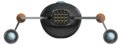 Stern
Stern -
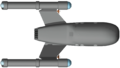 Ventral
 -
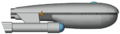 Mk II Penzias (stbd)
 -
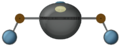 Bow
Bow -
 Dorsal
 -
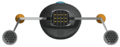 Stern
Stern -
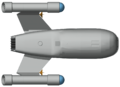 Ventral
 -
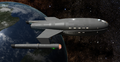 USS Aurora
 -
 "Heading Out"
.png)
.png)
.png)
.png)
.png)
.png)
.png)
.png)
.png)


Notes
- The Mk II Penzias are represented here by the Class J starship used in Mudd's Women, with shorter nacelles and lacking any portholes. The paragraph describing the Penzias has been altered to represent these details, and a new mass added for the sub-class. The statement regarding Star Fleet choosing not to opt in for portholes (on the Mk I) has been removed. The in-text image was altered to identify the ship as a Mk I.
- A distinction is made that the Hubbles operated as the sole runabouts into the 2250s, as they were not retired as a class until 2262.
- Per Guide: Chameleon, the Hubble represented the cutting edge in light craft propulsion in 2247.