Guide:Tal'Kyr/Otrera
.png)
| |
| Tal'Kyr/Otera | |
|---|---|
| Class Overview | |
| Category | scout/priority courier |
| Operational | |
| Constructed | |
| Dimensions | |
| Length | 180.0 m |
| Beam | 59.5 m |
| Height | 62.8 m |
| Mass | 23,000 mt |
| Performance | |
| Max Speed | w 4 |
| Endurance | 1 year |
| Complement | |
| Crew | 25 |
| Troops | 50-200
|
| Tactical Systems | |
| Beam Weapons |
|
| Shields | hull armor |
| Transporters |
|
| Canonicity | |
| Design | ENT |
| Name | Star Trek Online |
| History | Star Trek Online
|
.jpg)
Background: Hobbyist's Guide
The scouting forces of the Vulcanian star empire were an excellent example of Surakian thinking applied as a military doctrine. Rather than probe bravely into the unknown at warp speed, they mainly operated sublight vessels deployed by warp-capable motherships in star systems where Vulcan space superiority was undisputed. Such vessels were excellent tools for scouting relatively passive targets: local cultures of suitably low technology levels, local resources, and possible outside agents attempting to exert their influence over the first two.
Scouting out the positions of more mobile things such as enemy star fleets called for warp drive, but also for survivability that was best provided by cruiser size and armament. The niche for a warp-powered reconnaissance craft thus was narrow indeed, and Vulcans were not ones for idle engineering experimentation. It took a very specific tactical need to create a medium warp scoutship, then, and even when one did emerge, the Vulcans were loathe to confess to it. What they created in the 1930s was formally a “rescue vessel”—in practice, a means of extraction for agents operating in environments where larger warships dare not dwell or better not be witnessed. The reverse mode of operations was naturally also included, allowing Vulcans to quickly intervene with small but decisive force in disputes where an orbiting voidship would have undermined the Vulcanian position.
The extraction craft was thus designed for maximum stealth affordable at warp four, for the carrying of two platoons of special forces, and for the ability to defend herself against peer-level civilizations in cases of exposure, at least long enough to reach the safety of a T’Khut mothership. This combat voidship was specifically designed to carry large auxiliaries within her pivotable warp ring. The cruiser offered superb protection and significant range boost for her chattel and was an ideal host for the new Tal’Kyr class in every respect.
.jpg)
Although the rescue vessel was but one of the potential loads for the cruiser, T’Khut dimensions nevertheless dictated those of the Tal’Kyr, limiting overall length and prompting the installation of warp power systems in a separate ventral hull, opposite the somewhat longer mission hull atop the warp ring. A pylon ran vertically through the ring, connecting the two hulls and also housing the stealthy impulse propulsion system. Both the hulls were exceptionally featureless, lacking portholes or protrusions other than the dorsal bridge dome and the surrounding sensor empennage. Their surfaces could be supercooled for spatial stealth and polarized for reflection scattering. Sensors were carried at main hull lower bows; active scanners were only operated in exceptional situations.
The 180-meter vessel was somewhat large to be nudged into an atmosphere and was not provided with landing gear, but could hover low over ground targets if necessary; the ventral hull featured openings, ramps, and other systems for physically deploying or extracting personnel or vehicles. More typically, agents were inserted and extracted using one of the six transporters available onboard. Assaults in force would involve the two nine-pad units and some fifty commandos would typically be deployed. Onboard accommodation could be arranged for up to 200 troops or evacuees, however. No auxiliary craft were carried, but docking systems at lower bows could interface with alien craft as well as with the mothership.
Various small caliber beam weapons and fine manipulation tools accompanied the docking system for breaching purposes (or, in theory, for more peaceful assist and repair work). Three plasma or phase cannon were available for heftier defense. The main gun was among the systems hidden at upper hull ventral bows, while rear guard was provided by lighter weapons at engineering hull stern. Relatively few Tal’Kyrs ever saw combat, though, as advanced mission planning systems and seasoned tacticians aboard the scouts made sure there were no close encounters of any kind with local defenses.
Of the fifty T’Khut vessels in existence, some thirty regularly shipped Tal’Kyrs on their missions of peace enforcement. A total of 109 scouts had been constructed and some operated independently, while others were deployed aboard the smaller Vokal vessels. The warp assets replaced the combined use of Tshin sublight boats and high-warp motherships for the 21st and early 22nd centuries and were effectively used against advanced starfaring civilizations, such as Andorians and, according to some sources, Romulans. They were themselves conceptually outdated by the Romulan War and the retirement of the T’Khut force.
Beyond that conflict, Vulcan operated very few Tal’Kyrs, yet the manufacturing license was acquired by Star Fleet Division. The warp four engine system represented quite a leap from the humbler drives obtained earlier on for the Pirithous and Hippolyte programs and it took SFD almost two decades to get production going. The Otrera class lacked most of the stealth features of the original design, but adopted a light photon torpedo system while reverting to plasma gun armament; the sixty units produced were all utilized as priority couriers until the 2220s.

Gallery
-
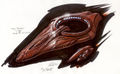 Tal'Kyr alongside T'Khut combat cruiser
 -
 Tal'Kyr docked (closeup)
 -
 En route to assigned sector
.jpg)
.jpg)

External Sources
Notes
- I've decided "almost two decades" means 17 years (for production of the Otrera variant to begin).
- The Tal'Kyr apparently did not enter UFP Star Fleet service, but its variant, the Otrera did, in 2178. The Otrera subclass operated with registry in the NCC-D range.
- The infobox must still be updated with Timo's named ships (only). (Remove this entire line when complete.)