Guide:Columbus series
.png)
| |
| Columbus series | |
|---|---|
| Class Overview | |
| Category | ISA/NASA interstellar (sublight) explorer |
| Operational | 2040 - 2104 |
| Constructed | 5 |
| Dimensions | |
| Length | 121.0 m |
| Beam | 35.9 m |
| Height | 35.9 m |
| Mass | 8,600 mt |
| Performance | |
| Max Speed | 0.23c |
| Endurance | 58 years (recorded) |
| Complement | |
| Crew | 40
|
| Tactical Systems | |
| Beam Weapons | 4x Sorac 0.36 Class laser emitters (UNSS Columbus only, 2046) |
| Missile Weapons | 1x nuclear missile launcher (25 Mk III nuclear missiles) (UNSS Columbus only, 2051) |
| Shields |
|
| Laboratories | 1 GP/planetary sciences |
| Auxiliary Craft |
|
| Canonicity | |
| Design | Spaceflight Chronology, Timo |
| Name | Spaceflight Chronology |
| History | Spaceflight Chronology, Timo |
| Class Report | Columbus class |
| Delta Dynamics | SRM #308 |
| Worksheet | Columbus class |
Background
Hobbyist's Guide

Despite the setbacks suffered by the TAU explorers, international competition had driven the US-led alliance to undertake a more complex program of interstellar sublight flight. While fission-powered vessels already plied the skies in some quantity, fusion propulsion remained a dream—a pipe dream, some insisted, after the hyperexpensive Galileo laser-fusion/NTR project ended in utter financial and technological disaster. In 2035, the multi-nationally manned prototype AFP-1 experimented on e-beam pulsed fusion detonation drive hybrid NTR/EmDrive thruster but met with a disaster of a more concrete kind, with 14 lives lost.
Yet scientists and engineers everywhere agreed that fission systems of known types could never attain the power/mass ratio required for successful interstellar flight, not even with the non-Newtonian trickery of Singh-type reaction drives. And the threshold of unacceptable casualties kept climbing with each personnel-hour spent in space: by the 2040s, some 600 people had already perished off-Earth. The AFP-1 accident barely made the news, even though secrecy and paranoia around the project was somewhat less intense than the global norm of the day. In this callous atmosphere, it was hardly surprising that the first successful interstellar fusion-based propulsion system would be one forgoing innovation and relying on a combination of previously failed solutions.
In 2040, the state of the art enabled the construction of a 0.23 c maximum speed, using methane as the primary propellant and deuterium as the fusion fuel. Main acceleration propellant was stored in four jettisonable wedgelike tanks, surrounding a cylindrar core stage roughly 15 meters in diameter, with an instrumentation and habitat compartment riding atop the core. The fusion reactor would initially work much like the fission powerplants of typical Singh drives, providing both hot exhaust gases and MHD-tapped energy for an exhaust accelerator, which would in turn drive the methane propellant. After the acceleration phase, fusion would be spiked with antimatter for pulsed detonation drive. The huge combined thrust chamber and exhaust accelerator was rightfully called “the most expensive compromise in the history of mankind”, featuring the worst of both worlds – but working.
Fusion fuel and some propellant for deceleration were stored in the core stage, in two large spherical tanks, but in situ propellant production was to be used to fill the tanks up to capacity again. And what would this situ be? Nothing less than the atmosphere of a planet circling an alien sun. The primary goal of the craft was to propel mankind to its first interstellar journey. Secondary goals were set as well, since the core stages were capable interplanetary or extrasolar explorers on their own right; in fact, on acceleration mode, they were just greatly expanded versions of the boosters routinely used for manned missions launched to Mars and the asteroid belt. Still, all the five vessels of Columbus class were furnished with cryosleep systems that could sustain life across interstellar instead of mere interplanetary distances. The significant improvements in propulsion technology had already made interplanetary cryosleep virtually unnecessary, and the test run of UNSS Columbus to Saturn and back was performed with the test crew of thirty fully awake.
In 2045, all five spaceframes included in the program were ready. Equipment was mounted for interstellar exploration, including a versatile atmospheric shuttle with a fission drive of its own, a battery of wide-spectrum telescopes, a laboratory adaptable for various planetary studies and a series of small lander probes for planetary surveys. Interferometry telescopy and probe flybys had already confirmed the existence of at least seven planets in the Alpha Centauri system, assured the scientists that return propellant could be manufactured there, and hinted at the presence of carbon-based life on the third and fourth planets of Alpha Centauri A. Four other systems visited by Earth probes were also chosen, and five ships fueled for launch.
A serious accident during the fueling of UNSS Columbus in late September 2045, led to eight fatalities and damaged the spacecraft. Her mission to Alpha Centauri had to be given to UNSS Icarus and the journey of that ship to 40 Eridani delayed indefinitely. UNSS Nautilus was thus the first ship to boost out of Earth orbit, on January 21st, 2046, on her way to Tau Ceti. Other ships launched within six months of the Nautilus, each carrying 40 men and women in cryosleep. But tragedy struck on May 5th: the Nautilus, traveling at almost 0.2 c, hit an interplanetary object too large for the meteoroid protection system to handle. Apparently, not only was the ionic activity in the inner Oort cloud badly underestimated, so was the density of macrometeoroids and cometary fragments. What little communications with the Nautilus could be maintained through the exhaust plume were now disrupted as the vessel entered uncontrollable oscillatory movement. Hundreds of successive meteoroid impacts and dangerous charge buildup were recorded before total communications loss. The onboard computer could not handle the situation, and Earth controllers could only watch through space telescopes as the ship tore herself apart in a matter of days.
There were heated demands of recalling the other three vessels, but such complex instructions could not be sent to the ships – the crews would have to have been awakened prematurely, which would have been an extremely dangerous procedure. Resignedly, the various governments wrote off the intrepid explorers as total losses, shut down telemetry networks when the ionization storms cut communications with the rest of the fleet, and down-scaled their interstellar programs.
Evidently, mankind was not destined to reach the stars quite yet, and there was much to do on Earth in the meantime. For one, there was again a war in the brewing. The repaired Columbus was appropriated by the United States and equipped with four laser cannon and a rack for 25 fusion missiles for inner system offensive use, but destroyed in 2053 by an Econ kinetic-kill missile in Earth orbit before she had the chance to fire a single shot.
Yet after demanding, decades-long journeys (lasting physically only years from the viewpoint of the relativistic-speed ships, and biologically mere days or weeks for the crews in hibernation), the Icarus, Hector and Prometheus did get through to Alpha Centauri A, Arcturus and Epsilon Indi, respectively. The crews awoke, extended their sensor gear, and were hit by radio-frequency broadcasts, low enough in power not to be discernible outside the systems’ ionization bubbles but still undoubtedly marks of advanced civilizations. Excitedly, the crews set to work to prepare for first contact with extraterrestrial cultures, not knowing that this had already taken place on Earth several years ago.
The rest, as the approximately 1,800 Human-visited inhabited worlds now stand witness, was history. Before this history could be written, however, there were two more chapters to be added to the Human spaceflight chronicles: the midpoint of the 21st century would mark the birth of a unified combat fleet for Earth, and the launch of a bold experiment that would take this fleet to the stars.
Delta Dynamics
By the time of the unfortunate demise of the AFP-1 and its crew (in 2035), the Singh-type ion engines—largely due to the “spookiness” of the then-unrealized subspace influence—had achieved propulsion dominance in both military and commercial spacecraft applications. While the technology always remained somewhat mysterious to all, it was generally reliable and reproducible, important factors for any agency supporting a space exploration program. Notwithstanding the losses of the Galileo, the AFP-1, and two of the five NASA TAU missions over the preceding decade, the interstellar office within the International Space Agency was committed to moving ever forward and delivering a crewed vessel to another star system before the mid-century...or, at least, literally on the way.
And not just one vessel: the ISA and its NASA partner had the full-throated support of the Western Alliance in producing up to seven interstellar explorers to examine neighboring systems with the Human eye. There were absolutely no dissenting voices from within the WA block of the New United Nations and certainly not from the space industry. Among the positions for such a large construction order was the indubitable cost advantage of serial production and the inevitable continuation of interstellar ship development while these first vessels were still charging towards their respective destinations. It was also a position that building all vessels in an uninterrupted serial fashion before launch would allow for the discovery and rectification of any errors or weaknesses in all of them. Afterall, none of these vessels could simply turn around for repairs after decades of travel downrange. Each mission was binary: go or no-go.
The initial plan was to develop and build a prototype ship, the Columbus, for intrasystem testing, before assembling the remaining six ships to the finalized form. Key to this grandiose plan was a fusion-powered (rather than fission) ion engine. As one populist physicist of the time, in his aggrandizement of the Columbus missions, stated: “Fission-powered ion engines need fissile materials to keep going. In addition to that, ion drives typically use heavy noble gasses as reaction mass. Neither of which you are guaranteed to find in abundance on an alien world that you're visiting for the very first time. What will be a safer bet? Hydrogen and hydrogen derivatives, full-stop...no pun intended. This is the kind of fuel that fusion drives use happily. Furthermore, hydrogen-based fuels require far less refining in order to use versus noble gasses and fissile material, and this can be done onboard by these ships.”
The decision to use fusion-powered ion drives was an apparent political hot-topic at the time. NASA’s proposal was to introduce a second-generation pulse detonation drive—an early competitor to ion drives in the commercial industries—with the antimatter spiking of the methane exhaust replacing the first-gen nuclear warhead capsules. This was shot down as infeasible, as the technology for suspending significant amounts of antimatter was still in its infancy and the containment systems would have to be automated and un-maintained for decades on these sleeper ships. Despite some recent historians’ proclamations that such propulsive technology had been utilized in this early stage of Humanity’s interstellar program and specifically tied with the Columbus mission, all evidence indicates otherwise. The surviving engineering plans for the ship clearly demonstrate the complete lack of associated features, such as an on-board antimatter storage system, a pusher plate, or the various types of required shock absorbers. The fusion ion engine, selected instead, was fueled for the length of the journey to the destination star system by the primary 14.8-meter diameter deuterium tank and assisted in the acceleration of the expelled methane propellant by energy from the magnetohydrodynamic drive in the exhaust acceleration module.
The habitable areas of the ship—aside from the mandated control, habitation, life support and engineering spaces—sported a planetary sciences laboratory, automated sensor arrays, and wide-spectrum telescopes, a launch bay for small lander probes (for planetary body surveys), a variable-resource refiner, and an externally-mounted delta-wing shuttle. This craft was never intended to land on terrestrial surfaces, but rather perform manned atmospheric surveys and, most importantly, scoop hydrogen and methane from the target system’s gas giants. The refinery space within the Columbus’ hull was located adjacent to the crew access passageway for the shuttle, allowing for easy connections for offloading the acquired resources, which would then be transferred to the respective fuel tanks.
One new technology that was incorporated into the Columbus’ design was a predecessor to the modern-day inertial damping field. This “inertial stabilizer” had been developed in 2036 by a space industry partnership (that included a Dinyan-Yoyodyne Conglomerate subsidiary) and functioned as a series of low-strength electromagnetic fields that attempted to absorb and counteract the velocity forces generated by the ship’s maneuvers. It was rather slow to react (compared to our contemporary standards) and required its own dedicated control computer; while the UNSS Columbus’ test crew reported they could not physically detect its effects, sensors proved it had a stabilizing influence on inanimate objects (including slumbering astronauts).
Serial Tragedies
In early 2040, the UNSS Columbus launched from lunar orbit on an uneventful test run to Saturn and back. Commanded by veteran space master Marina Nieri, an Italian with a full career in the ISA, the ship tested out its ion propulsion, sensor suites, and the shuttle in the upper atmosphere, fully replenishing both tanks for the return leg of the mission. The team’s meticulous report recommended detailed alterations to the design, but was overall positive and complimentary. A production order for four ships was made in short order (down from six, as significant concerns regarding radiation from two target stars suggested deferment). A series of launches for all five craft was set for mid-2044, then pushed back to late 2045 due to some class-wide iterative equipment alternations. However, in September of that year, as UNSS Columbus prepared for the inaugural launch, a serious mishap during methane fueling resulted in the loss of eight crew and support service lives. Damage to the ship, while not extensive, would require a complete safety overhaul.
A few weeks of working the schedule and crew rosters resulted in UNSS Icarus taking over the Alpha Centauri mission from Columbus, with her original destination of 40 Eridani deferred, possibly until the class ship was fully operational again. Instead, the first launch—now in January 2046—would be assigned to UNSS Nautilus, her crew of 40 charging for Tau Ceti at a distance of 6.12 lightyears downrange. UNSS Hector launched in mid-February for Arcturus, UNSS Prometheus for Epsilon Indi in March, and Icarus in April. Each ship had nearly identical mission itineraries for the intrasystem transit, with all crews fully suspended in cryosleep prior to passing Martian orbit. The news streams constantly relayed each vessel’s relative position to Earth, including on May 5th, as Nautilus proceeded through the Oort cloud and auto-reported an allision with an object too massive to be countered by the hull protection measures. Sensors had been reporting an increasing level of ionic activity upon entry into the phenomenon and now indicated an extremely higher-than-anticipated amount of macrometeoroids and cometary fragments. The ship appeared to have suffered non-catastrophic casualties with that first event and, as the Earth-based incident management team considered options, she proceeded on at her high velocity. Telemetry had already been spotty due to the interference of the ion exhaust plume, but was suddenly interrupted by what was determined to be “uncontrollable oscillatory movement,” or wild spinning. The minimal transmissions received from Nautilus suggested a continuous barrage of meteoroid collisions and multiple onboard fires. Space telescopes witnessed the vessel's demise within days.
Voices all around the planet clamored for the imminent recall of the three remaining ships and their 120 slumbering passengers. However, ISA was adamant that each of the vessels, even the Icarus (which had not yet entered the cloud), would be well into the same relative region by the time forward momentum was overcome and then each would have to traverse back again, exposed to the exact same threats. There was no certainty that the overwriting tasks transmitted from Earth would even be completely received, due to the high ionic activity experienced by Nautilus. It was forecasted that the interplanetary objects would be more dispersed in the outer cloud, if the original movement directives stood. The ships continued their pre-plotted routes as mission-reserved data frequencies grew more and more quiet with each passing hour; the partner agencies all but shuttered their telemetry monitors within weeks. The four operational vessels—and their Human crews—were considered lost to the depths of deep space.
Premature Conclusion (Earth)
UNSS Columbus, as the last remaining vessel, saw all efforts to prepare her for her own mission (to 40 Eridani) canceled shortly after the final decision regarding the other three ships was made. She had been completely repaired from her fuel accident, but there was no discussion as to how she might be tasked. She remained in a near-mothball state until 2049, when the United States Strategic Command took over authority of the ship from NASA (ignoring the ISA’s stake) and had her transferred from lunar orbit to one of Space Station Freedom’s assembly berths, in response to the Eastern Coalition’s construction order for five cruisers of the Akademik Mstislav Keldysh class. Over the next two years, as tensions on and above Earth simmered, Columbus received an overhaul—primarily on her forward section—that included a weapons package of four laser cannons and a missile launcher for 25 fusion warheads. The vessel performed low-profile patrols, generally in Earth orbit, during her brief operational period before her destruction in a preemptive ECON attack in 2053, just days before the outbreak of the Third World War.
Arrival: Alpha Centauri Prime
UNSS Icarus, though the last to depart the Sol system, was the first to arrive at its assigned destination, the trinary suns of Alpha Centauri, in early 2065. Interferometry telescopy and other observations had confirmed the presence of seven planets, at least five of which were known to be jovian in nature, excellent sources for her necessary fuels, hydrogen and methane. Equally important was the relatively short distance of 4.33 light-years from Earth and the seductive hint of carbon-based life on two of the inner planets. Icarus began waking her crew as she approached the inner edges of that system’s Oort cloud. The reception of strong radio signals, once analyzed, confirmed an intelligent species inhabited both the third and fourth planets. Commander Lucilla Ricks, following her pre-planned responses, fired a repeating radio burst to Earth reporting the discovery and then announced their presence to the alien civilization.
It was much to their own surprise to find very familiar faces responding on the video screens: Centaurians have an indisputable genetic relation to Humans (though that could not be presumed at the time). To be greeted—though in an unfamiliar language—by a Human-appearing face was both welcome and perplexing. Fortunately, by the time Icarus had made orbit of the fourth planet—named Velestus by its inhabitants—the team’s three linguists had received a basic language database from their hosts and translated it as an apparent derivative of the classical language of Greece, circa 300 BCE.
Their visit was peaceful and well-received. They found their hosts generous and welcoming as they toured several cities and regions over the 13-month visit, meeting world leaders and common people alike. The Centaurians (an Earth eponym by which they were consistently referred to within transmitted reports from the explorers) were clearly in an early interplanetary stage of development, as they had colonized the third planet of their system (Seldarian) approximately twenty years earlier and were developing large tracts of farmland with native Velestian crops and domesticated animals, on the otherwise fauna-less world (Class L by modern terminology). However, their spacecraft were hyper-local in comparison to equivalent Human interplanetary craft, as they had not yet explored their outer planets in any capacity, much less made any attempts to reach the remote third sun’s intrinsic planetary system. On Velestus itself, the Centaurian society was more of a late industrial stage, with cultivated land primarily purposed for agrarian development. Industry was zoned only within the numerous mid-sized (by Human standards) cities, leaving large undeveloped areas in a natural and unpolluted state.
Eager to report in detail on what the Icarus’ crew believed to be Humanity’s first extraterrestrial contact (unawares of the Vulcan arrival at Earth two years prior), Ricks said farewell to the Centaurians and promised a return visit with a full diplomatic contingent within fifty years (accounting for the round trip). They were greeted back on Earth in July 2085 by a few familiar Centaurian faces, who had warped in years earlier on their own diplomatic mission, courtesy of the Vulcans.
Arrival: Draylax, Tarl (Epsilon Indi system)
The crew of the UNSS Prometheus had, up until a point, a very similar encounter to that of the Icarus upon their arrival in the Epsilon Indi system in May 2080. Like their sister ship, they awoke to low-level radio signals, this time between the second planet of Epsilon Indi A and the first planet of Epsilon Indi C. Where their story diverged was with the first video contact: they were also greeted by a relatively familiar visage, but this time it was actually Human. The Verne class survey cruisers had started departing the Sol system as early as the late Sixties and the first Human footprint was left in the sands of Draylax in the early Seventies. Even the news of the Icarus’ first contact with the Centaurians had made its way to the alien system, so the arrival of the Prometheus was not unexpected by the Human guests of the Vulcan diplomats already on-planet.
An astounded crew got to meet three new alien races shortly after making orbit: the Vulcans had established a mere outpost of an embassy in the Draylaxian capital city and provided shuttle service to Tarl, the long-established and extensive domed colony on the Kesh class world of Epsilon Indi C I. The Tarl, a large, green-skinned people could not recount much of their origins, as their own recoverable history only went as far back as a point well after the presumed construction date of the environmental domes. To the newly-arrived Humans, they were an odd encounter: friendly, pre-disposed to engineering (primarily of life support equipment), and incessantly imbibing alcohol, from which they derived their sustenance. They avoided more typical solids and most especially acid-based foodstuffs, such as citrus juices, which quickly left them inebriated.
Back on Draylax, a Harauk class world most noted for its seas of sandy dunes and hard-pan plains, the Prometheus crew learned how the early (per Vulcan policy) first contact by Humans the previous decade had jump-started an interplanetary industry. This had allowed the two civilizations in the large trinary system to finally meet and establish ongoing relations, 30 years after first making radio-only contact. The Draylaxians, a feline species with significantly leonine facial features, were already working to develop their own interstellar capabilities, to correct what was threatening to become a trade imbalance precipitated by the steady arrivals of aliens from other warp-capable societies.
Historical accounts of the Prometheus crew’s reactions indicate they were far more astounded by their interactions with these unexpected alien cultures and their own home world’s post-launch achievements than they were disappointed to not be “the first” to contact another species. The ship itself was mothballed—with considerable ceremony by the Draylaxians—in the Epsilon Indi A system, while the crew returned—quite rapidly—to Earth via a scheduled Vulcan envoy ship.
Arrival: Arcturus
When the UNSS Prometheus arrived in the Epsilon Indi system in 2080, it proved that the Columbus missions had a far better success rate than the early loss of UNSS Nautilus suggested. As UNSS Hector was the last of the four with an undetermined fate, the progress of her course was calculated and the Vulcans were convinced to “keep an eye out for her,” as they scouted the region in the direction of Arcturus. In 2088, the low-emitting vessel’s location was reported by VSS Ugelik Stukhtra, of the familiar Voroth surveyor class, just where she was expected. Discussions back on Earth pivoted on whether to wake the crew or not, as their journey still had 16 years to complete. Arcturus had already been contacted by yet another Verne mission 11 years previously and trade runs had since been established. However, the prevailing argument was that the crew had no living dependents on Earth and wakening them before they were able to experience their system approach seemed like an unnecessary spotlight on what they had sacrificed by taking on the mission in the first place. The repatriated crew of the Prometheus almost completely agreed with this viewpoint, so the decision was made to prepare for the Hector’s 2104 arrival, while also keeping an eye on the vessel’s forward progress.
The wakening of the crew occurred as programmed and while the ship was decelerating, chase ships provided by the Vulcans remained in her drive plume shadow, to allow the Humans the chance to become immersed in their pre-arrival procedures. Commander Jacob Fielding and his command team quickly detected a large volume of interplanetary signals; a few hours later they transmitted the preordained arrival report to Earth. However, before they could turn their attentions to the fourth planet orbiting the star Alpha Bootis, the computer indicated they had a reply on the command channel. Commanders Lucilla Ricks (UNSS Icarus) and Ademar Guerra (UNSS Prometheus), two very familiar faces from pre-launch training, welcomed them to the Arcturus system and provided an “elevator pitch” summary of what had transpired, as it related to the Columbus missions. Waiting for them planetside were another 23 former crewmembers of the two sister ships and the vice chairman of the United Earth Defense Pact (the de facto world government). They were enthusiastically greeted by their Human counterparts and Arcturian hosts, while the Vulcans observed stoically.
Once shuttled to the ground, they were introduced to the planet’s chief executive and minister of state and the resident Vulcan ambassador, as well as representatives from other alien species present in the system. Professional in all matters, the individual Hector teams insisted on their primary mission, to learn about the Arcturus system and its martial but fashionable people, if only for their own enlightenment. A dedicated transport did depart for Earth six weeks later, but a third of the crew, including Commander Fielding, did ask for a longer respite on-planet before their own return to a world very much transformed and elevated since their departure 58 years earlier. Hector was decommissioned with practiced and ceremonious Arcturian solemnity mere minutes before Fielding warped for home at the end of the Sol year.
Missions
Vessels of the Columbus series were named after the famous Italian explorer, the ship that circumnavigated Earth in 1892-1894 (Nautilus), and the rest from mythological characters.
- UNSS Columbus (2040-2053): destroyed in Earth orbit
- UNSS Nautilus (2046): Tau Ceti mission; destroyed in Sol's Oort cloud in the days after 05 May.
- UNSS Hector (2046-2104): G03-0516 mission; departed for Arcturus on 16 February 2046, arriving 09 February 2104; upon arrival, they discover not only an advanced (and friendly) alien civilization of Arcturians, but also the presence of Humans that had arrived earlier via warp drive. The ship is eventually mothballed in the Arcturian system, with the crew delivered home via a warp ship.
- UNSS Prometheus (2046-2080): A-12-0106 mission; departed for Epsilon Indi on 17 March 2046, arriving 11 May 2080; upon arrival, they discover not only an advanced (and friendly) alien civilization of Draylaxians, but also the presence of Humans that had arrived earlier via warp drive. The ship is eventually mothballed in the system, with the crew delivered home via a warp ship.
- UNSS Icarus (2046-2085): K-0104-15 mission; departed for Alpha Centauri on 02 April 2046, arriving 12 May 2065; visited with inhabitants of Alpha Centauri III and IV for 13 months, radioing back to Earth about their first contact (unawares of the events of 05 April 2063); departed the Alpha Centauri system on 20 June 2066; arrived back at Earth on 30 July 2085, to a new reality at home.
Gallery
Columbus interstellar explorer
-
 Profile
 -
 Bow
Bow -
 Dorsal
 -
 Stern
Stern -
 Ventral
.png)
.png)
.png)
.png)
Other Images
-
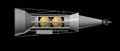 Side view
 -
 Bow view
 -
 Stern view
 -
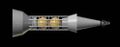 Dorsal/ventral view
 -
 3/4th perspective (I)
 -
 3/4th perspective (II)

.jpg)
.jpg)
.jpg)
.jpg)
.jpg)
Supporting Documents
- Blueprints
- DeviantArt: Columbus interstellar explorer (2040)
- Starship Recognition Manual Report #308: Columbus interstellar explorer
Alt Sources
- Review page 61 of Mandel's FSC Terran Orientation (Modified Okuda Timeline) for examples of the explorer and militarized versions of the Columbus.
Notes
- The Greek symbols "α" and "ε" have been replaced by "Alpha" and "Epsilon" (respectively) for sake of simplicity and to match official canon.
- The three successful missions to Alpha Centauri A, Epsilon Indi and Arcturus would have actually arrived in 2050, 2060 and 2061 respectively, well before First Contact (2063). However, in this SFC RPG, the sublight speeds have been adjusted to account for their arrivals well after the Vulcans' arrival on Earth.
- The operational period has been extended from Timo's 2075 to the year 2104, reflecting the calculated arrival time of the Hector at Arcturus.
- The original Guide had these ships no longer operational by 2075. However, at the best mission estimates, the Epsilon Indi mission could not return before the end of the century.
- The probe explorations of Alpha Centauri A now indicate possible life on the 3rd and 4th planets, instead of 7th, to reflect other sources.
- In order to not have the Columbus series craft as too fast (arriving at destinations pre-First Contact), all max speeds have been drastically reduced, (except for the DY-50).
- Changed personnel to "crew", from the less-appropriate indicated officers/enlisted.
- This "launch configuration" makes little sense to me: while it is certainly meant to refer to attaining solar escape velocity, the same feature would be unavailable for the return leg. Since DD's version of history shows increasingly-dependable ion drive technology, I'm striking the language regarding "main acceleration propellant" as being jettison-able: if there is not enough fuel to both accelerate and decelerate in the core tanks, then there would be no way for the vessel to decelerate upon its return to the Sol system.
- Timo's reference to the "e-beam pulsed fusion detonation drive" on the AFP-1 has been struck, to prevent any confusion with the DD-verse's use of the hybrid NTR/EmDrive thruster.
- The references to the core stage diameter being 40 meters has been corrected to 15. Adrasil measured them as 14.8 meters.
- The season three Strange New Worlds episode, "The Sehlat Who Ate Its Tail", revealed that the Asaasllich was originally a Human-crewed vessel launched post-WW III, but prior to First Contact. Like the Nautilis, it was built by the United States, had a mission to contact other civilizations, and was lost and presumed destroyed. Though the original hull form viewed briefly from the USS Farragut is notably different, I've decided that somehow the Nautilus survived its transit through the Oort cloud after all and became the scavenger vessel that menaced the outer worlds.