Guide:Messier
.png)
| |
| Messier | |
|---|---|
| Class Overview | |
| Category | heavy cruiser/attack cruiser |
| Operational | 2078 - 2162 |
| Constructed | 32 total
|
| Dimensions | |
| Length | 258.0 m |
| Beam | 113.8 m |
| Height | 72.1 m |
| Mass |
|
| Performance | |
| Cruise Speed | w 2.75 |
| Max Speed |
|
| Endurance |
|
| Complement | |
| Officers |
|
| Enlisted |
|
| Troops | 500-700 (Verdun)
|
| Tactical Systems | |
| Beam Weapons | Original:
Refit 2154-56:
|
| Missile Weapons | Original:
Refit 2154-56:
|
| Shields | Original:
Romulan War refit:
|
| Laboratories |
|
| Auxiliary Craft | Messier:
Romulan war contingent, typical:
Verdun:
|
| Historical | |
| Ships of Note |
|
| Canonicity | |
| Design | Spaceflight Chronology, William Forstchen “The Forgotten War” |
| Name | Spaceflight Chronology, William Forstchen “The Forgotten War” |
| History | Spaceflight Chronology, dates altered; William Forstchen “The Forgotten War”
|
Background: The Hobbyist's Guide
The Messier class of heavy space cruisers was the first major Earth interstellar vessel type to be built primarily for space combat against non-Human adversaries. Yet this attempt at enabling Humans to pursue an independent interstellar agenda in fact came to symbolize the onset of Human-alien integration and cooperation, in more ways than one. During its exceptionally long service career, the Messier class evolved from an in-system power projection force to a vanguard of interstellar exploration, accumulating new systems, software, experiences, operating practices, and even ideologies on the way.

The cruisers of Messier class were built on Bonaventure principles, initially shunning all Vulcan influences. The powerful sublight propulsion consisted of two large fusion-heated reaction engines, mounted on a huge elongated engineering hull of complex angular shapes. The hull mainly served as a fuel tank and support frame for the reaction engines and the large dorsal and ventral radiator surfaces astern and had few crew-accessible spaces. Forward of this hull was a wedge-like habitat and command section, also mounting a shuttle hangar and the primary sensors and armament of the vessel. Four lasers and two missile tubes, plus a self-defense suite of plasma cannon, would allow the ships to patrol space to Saturn and beyond and intercept intruders similar to the Tellarite expedition that had so alarmed Earth governments in 2073.
The 2076 inclusion of warp propulsion in the design requirements did more than decrease in-system intercept times. A separate fusion reactor inside the forward hull powered the two 40,000-ton spooled-coil, cylindrar warp nacelles via angled plasma shafts. Cruising at warp 2.75 was achieved through brute force; an interstellar range of operations in turn was made possible by the sheer bulk of the vessel. Fuel reserves in the engineering hull gave four-year propulsive endurance. The forward hull, already enlarged to house the warp reactor, was further expanded to provide increased life support. Once the interstellar drive had successfully been integrated to the design, further additions followed in rapid succession.
Subspace communications were introduced for near-realtime contact with Space Central across the 0.5 ly range of defensive operations. Relay buoys, sown every two lightyears, could extend the range almost indefinitely; fifty were typically carried on a deep space sortie. Computing was handled by a versatile Gotherin optical mainframe, capable of in-warp processing of navigational data so that the need for "orientation stops" was greatly diminished.
Flat reflective armor plating covered most of the surface of the Messiers, making them shine brightly against the blackness of space in the vicinity of stars, yet blending them to the background in dim interstellar lighting. No laser-absorbing colors were risked on pennants or other hull decoration. Jutting from the armor were sensor domes and a bridge bubble on the forward hull. Ablative coating was applied on the bow surfaces for navigational protection, although powerful electromagnetic fields were the primary means of preventing interstellar particle damage.
Significantly better protection was already seen as a theoretical possibility, however, as Earth teetered on the verge of a breakthrough in gravity control. The first experiments with polarizing the gravitic field of a flat-plate mass had yielded limited practical applications, but once scientists learned how to intensify the field with artificially-created gravitons, obvious uses were found. First came onboard artificial gravity for spacecraft of all kinds; then followed higher-power systems that could be used for impact protection against all threats with a mass component. By the first quarter of the 22nd century, such technology could already repel electromagnetic radiation to great efficiency and the first devices capable of projecting the gravitons at a distance were being sketched.
The early Messiers could not yet reap the full benefits of this research, but they did enjoy an artificial gravity system that featured longitudinal decks individually polarized to 0.92 gravities at floor level, and 0.75 g at 2-meter height. Complete field attenuation at reverse lobes and overlap areas could not yet be achieved and several interesting resultant force nodes could be observed in the early systems. The ten decks at the bow still provided comfortable and physiologically sound accommodation for the 93 crew, meeting the medical requirements of potentially decades-long journeys.
The improving gravitic technology also greatly affected the economics of orbital construction. Thanks to major advances in the field, significant numbers of the Messiers were completed, some 25 between 2078 and 2100 alone, despite the difficult economic and environmental problems plaguing the participating nations or coalitions. Gravitics also increased the traffic flow to Mars and the Jovian moons and the assembling of actual colonies was begun there. Higher priority was of course given to the class M colonies at Alpha Centauri A II and 36 Ophiuci III, which needed no advanced life support technologies to thrive.

When first fielded in the 2080s, the Messiers were used to establish and maintain a military presence near Earth, freeing the numerous other types of warp-converted vessels to exploration and expansion. A series of confrontations with feline Xindi intruders in the late 2090s justified the investment, as warp-jump interception techniques made possible the relatively bloodless repelling of the aggressive felinoids. Had Liberty class or similar sublight vessels still been used as the backbone of Earth’s defenses in the nineties, the outcome of the skirmishes might have been far more gruesome. As the fourth and last Kzinti fleet retreated in 2098, the UESN could pride itself on decisive victory in its first armed space conflict ever—a victory made all the sweeter by the fact that the Vulcans had again acted with great restraint and deliberation, engaging in self-defense of their vessels only.
In their heyday between 2090 and 2130, the Messiers also actively participated in exploration, as part of the failed attempt to establish a "Dominion of Earth". The Messier design underwent three major upgrades to the warp engine systems in 2091, 2115, and finally 2135 to keep up with the expansion of Earth-controlled space. Yet none of the upgrades was fleet-wide, for a very simple practical reason: missions lasting for thirty years were not uncommon for the type. A ship returning from a stage-by-stage cruise to a distant star would either be scrapped as hopelessly outdated or extensively refurbished using the best technologies of the day. Very seldom would even two Messiers be processed at the same time and with the same methods. In any case, this "steady-state" method paid off in terms of mission availability: space up to twenty lightyears from Earth was charted to some accuracy, several longer sorties made, and trade routes to the hubworlds Denobula Triaxa, Vega, and Altair tentatively secured.
None of these worlds could be brought under Earth control, however, and the search for further unoccupied class M locations for Human strongholds proved futile. Detailed scientific studies were not conducted as part of the missions, because the UESN’s interest in deep space was a purely military one at the time. The long years of travel would offer research opportunities for various civilian organizations purchasing onboard space and time, but the releasing of results would be tightly controlled by the frustrated UESN. It appeared that very little was available for satisfying mankind’s appetite for interstellar prominence.
The Romulan threat changed the rules of the game. Striking from within a region of space heretofore neglected by the explorers of both Earth and its neighboring cultures, a mysterious race staged a series of surprise attacks, usually against vulnerable and unthreatening targets. No connection was initially made between the attacks and the recent disappearance of UESS Balboa (CA-177), a Messier cruiser visiting 128 Trianguli on long-range survey duty. Nevertheless, self-defense became a priority for all UESN vessels operating in the Triangulum Australe direction and exploration ground to a virtual halt.
UESS Intrepid (CA-170) of Messier class, commanded by Captain Henry McKenna, was the first Earthship to report back on a Rihannsu raid in 2151. She herself was not attacked, but recovered the wreckage of civilian Earth liner SS Diana and found evidence of the previously unknown attackers’ identity. However, the full evidence never made it back to Earth, as the Intrepid was lost somewhere near Tau 1 Eridani soon afterward.
The mystic-heroic disappearance of the Intrepid had three immediate consequences. The newest Triton cruiser became her namesake. Outrage and intrigue surrounding the Diana raid intensified. And the term "Romulans", coined earlier by the crew of UESS Carrizal, became the household name behind virtually all incidents of ships missing or colonies falling silent (much to the relief of the Orion and Nausicaan pirate captains who still operated behind a veil of secrecy). When the cruiser Enterprise (NX-01) in 2152 encountered a Rihannsu wide patrol in the process of fortifying a recent conquest at Theta Eridani, UESF Command jumped to understandable conclusions and began preparing for a punitive expedition to be mounted in this direction. The double error was left uncorrected by the Vulcans, who nevertheless did their best to moderate the Human quest for vengeance.

The Xindi strike of 2153 soon put the Romulan question on hold for three unnerving years. The Messiers were recalled closer to home. Along with providing an illusion of increased defensive potential, this facilitated the refitting of the aged cruisers into useful combatants. The number of lasers was now doubled, with four emitters mounted on the aft hull. Two powerful phased particle beam cannon were installed in the bow to be used against capital ships from the relative safety of warp speed, away from the talons of the missile boats and fightercraft so prominent in the strikes against Earth assets. In turn, berths for up to sixteen fightercraft were added on the Messier dorsal spines, to give an agile offensive weapon to the virtually unmaneuverable juggernauts.
On the renamed Antietam (CA-187), Constantine (CA-190), Ebro (CA-184), Mukden (CA-191), and Verdun (CA-182), assault barges were carried instead and the voluminous primary hulls were furnished for the carrying of up to seven hundred planetary assault troops. These vessels were collectively known as the Verdun class of attack cruisers, even though each vessel had several unique features. Of little use against the Xindi, the Verduns nevertheless were deemed an essential element in any future attempt of UESF to project its power across practical interstellar ranges.
In both the space combat cruisers and troop transports, polarizable armor coating was applied in as many places as mass limitations allowed, to replace the now useless reflective plating. Also, warp engines were once again upgraded with new coils and with reactors of larger power output. With all the add-on features, the ships began to resemble hermit crabs that carry borrowed shells and sea anemones for protection.
Frustratingly, the enemy still remained faceless when the first punitive missions in 2155 were mounted. No Romulan body was ever found even remotely intact, no Romulan ships or bases fell into UESF hands, and very little could be achieved by reconnaissance missions mounted in wrong directions. But now the Romulans had been declared guilty and their continuing malevolent silence in face of Earth overtures also dictated the sentence: a full-scale interstellar war was inevitable. That Romulans were the ones to first openly engage in that military action was not to the liking of the badly surprised UESF, but it did fill the political majority of Earth with grim satisfaction.

The major military confrontation known as the Romulan War stretched UESF to its limits and beyond, and was to be the final hurrah of the aged Messiers. In the unexplored depths of the battlefield, Starfleet strikes often hit empty space—and with barely navigable warp 2.9 ships, a miss might mean a year wasted. But when a Messier formation did locate a target, the effect could be devastating. Cruisers Halsey (CA-141), Gorshkov (CA-143), and Yamamoto (CA-147) made history when they—in 2159—surprised and overran a Rihannsu forward staging post in deep Sierra Sector, reducing to scrap dozens of enemy vessels. Alas, the Halsey and the Yamamoto were lost soon thereafter, as a Rihannsu self-destruct detonation crippled the drive systems of the vessels and made retreat impossible. Rihannsu retaliation forces nearly caught up with the Gorshkov as well, but the cruiser managed to limp back to Chi Eridani with the survivors from aboard her lost sisters.
After the war, most of the remaining Messier class ships were immediately decommissioned. Two of the troop transports, the Verdun and the Constantine, were in 2162 pressed to duty against the Tarn, but the ship shortage that had necessitated their continuing use also meant the cruisers mostly traveled unescorted. Both disappeared without a trace, taking over 700 lives with them. The wreckage of the Verdun was discovered by chance during a joint UFP-Tarn survey of Torgu-Va in 2366, the descendants of the original crew still in the throes of a bitter battle with a similar group of Tarn castaways. The remains of the Constantine have not been located by the time of this writing.
The last Messier to be retired, UESS Braxton (CA-195), was in 2162 on her way to be preserved in the recently founded Fleet Museum when her warp drive system—its newest components almost thirty years old at that point—created a catastrophic asymmetry and tore the ship into pieces. The skeleton crew of fifteen was killed instantly.
Gallery
-
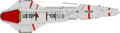 profile
 -
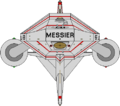 bow
bow -
 dorsal
 -
 stern
stern -
 ventral
.png)
.png)
.png)
.png)
Other Images
_.png)
.png)
.png)
.png)
.png)

External Sources
- Vintage Starships: "2106 – Messier (Type 1)": includes 3D views
- Vintage Starships: "2106 – Messier (Type II)": includes 3D views
Notes
- Guide:
- UES Antietam (CA-187)
- UES Balboa (CA-177)
- UES Braxton (CA-195)
- UES Carrizal[1]
- UES Chester W. Nimitz[2]
- UES Constantine (CA-190)
- UES Ebro (CA-184)
- UES Gorshkov (CA-143)
- UES Halsey (CA-141)
- UES Intrepid (CA-170)
- UES Messier
- UES Mukden (CA-191)
- UES Raymond Spruance[2]
- UES Resolute [3]
- UES Verdun (CA-182)
- UES Yamamoto (CA-147)
- The Kzin and "feline Xindi" are linked here.
- Early reference to the UE Starfleet was changed to United Earth Stellar Navy, since it referenced the year 2098. Some/most/all of the ships—in the text, infobox, and above list will have the "UES" changed to "UESS" once they are transferred to the UE Starfleet, and some to "USS", if/when transferred to the UFP Star Fleet.
- The infobox must still be updated with Timo's named ships (only). (Remove this when complete.)
- I've decided the Messiers were planned—from the first planning sessions of the Federation's new Star Fleet—to be decommissioned and not transferred over. However, the emerging Tarn conflict necessitated the temporary transfer of Constantine and Verdun from Earth Fleet and immediate assignment, with a waiver to continue with their present prefixes and registries (i.e., they "served", but without NCCs).
References
- ↑ Note: The addition of the Carrizal as a Messier class is assumed, based on a discussion held with Timo as to the similarity of the names.
- ↑ 2.0 2.1 Guide: Christopher
- ↑ Guide:Stuart/Siebel/Neptune