Cargo Containers
Type DY
With the introduction of the DY series of transport spacecraft (and related variants) came a standardized cargo module. Sixteen of these modules could be affixed to the spine of the DY-100 and accessed from within the spine itself. The modules were manufactured to handle different cargo types, but even the general type could be adapted to carry liquids and gases when the proper bladders were installed. They had an interior volume of 726 m3 and were rated to carry up to 472 metric tons.
-
 A close up of a mounted container
 -
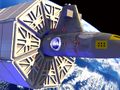 A full ring of cargo wedges
 -
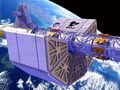 Example of the mounting gear of a DY-100


Type II
Type II containers became the standard with the introduction of the G class freighter in 2090, and were more commonly associated with the three variants of the Y class. Each was rated to hold up to (5,000) metric tons.
-
 Type II side seen from external to the ship
 -
 Forward view
 -
 Dorsal view
 -
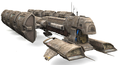 8 Type II containers loaded onto a Y class freighter.
.png)
.png)
.jpg)
.png)
Type III
The Type III container was introduced in 2099 for the purpose of bulk ore hauling. They were rated to carry of to (7,500) metric tons of materials and were quickly modified to handle other non-mineral resources, too, especially on the J class freighters.
-
 Type III side view
 -
 Forward view
 -
 Dorsal view
 -
 Ventral view
 -
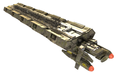 Five Type IIIs suspended under a holding spar and interconnected to the J class tug.
.jpg)
.jpg)
.jpg)
.jpg)
.png)
Durance style
The cargo container designed exclusively for the Durance class transport in 2130 carried up to 12,400 metric tons apiece. Variance in mass distribution due to the attaching of multiple containers aboard the transport was handled by a balancing system that moved propellant and ballast between tanks in the spine of the optional dorsal support structure (the triangular object just forward of a lone container placed on the stern section of the ship). When a ship visited an orbital port without cargo handling equipment, the versatile grappling arms would un-stow from the forward side of the structure and maneuver the pods away from the ship; if the Durance carried the optional shuttlebay, then the two cargo handling pods helped reduce the transition time, as well as improved the safety of the evolution. When energized, magnetic clamps on the ship would close position and lock on to the metallic portions of the container's hull.
These cargo containers had enormous hatches on their rear side, reminiscent in style and function to personnel and shuttlepod ports found on starships. However, rarely were these pods pressurized and the massive hatches were intended to allow for the ingress and egress of cargo pods and workbees retrieving or stowing the various items in the container's inventory. Temperature management systems, power, and required fluids were husbanded directly from the transport itself, but restricted to only one pod. When a single pod was carried, these services came through a direct connection of the ports from the dorsal support structure. In order to carry two pods, the Durance would be required to shed the structure, and the services came directly to the forward container from the rear side of the forward hull section. Trailing containers, attached by the magnetics contained within the rear-side seals, could never receive such services. As was standard, supply runs would often shuttle containers to their destination, unload them, and then depart with pre-loaded containers.
-
 Durance style cargo container (side)
 -
 Top
Top -
 Front
Front -
 Back
Back -
 Bottom
.png)
.png)
.png)
.png)
.png)
Types IV, V and VI
Type IV containers were introduced in 2141 for civilian usage, well before the acquisition of the Murmansk transport by the future UFP Star Fleet. They were intended for bulk transport, not only of raw and refined ores and liquids, but packaged and large scale products, as well. The Type IV was rated to carry up to 15,000 metric tons. The Type V was introduced three years later and was of a similar style, but just over twice the size of the Type IV and was rated for 35,000 metric tons. It saw many variants developed over the next 30 years, to include habitable volumes intended to transport people and livestock. In the 2160s, in order to meet the growing demands of habitable volumes, the Type VI was introduced. This was far easier to customize to meet the living requirements for long-range transport and cargo variants were also common, rated up to 45,000 metric tons.
-
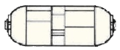 Type IV, side view
 -
 Type V, side view
 -
 Type VI, side view
.png)
.png)

Type W and A
Type W and Type A containers were very large assets to two very large freighter classes. The Type W series was developed for the Senator/W class freighter in 2165 and came in two sizes: 75,000 ton and 100,000 ton. The containers were great for large amounts of raw or refined resources, but smaller standardized and pressurized containers could easily stack within these, as well. In 2186, Starfleet commissioned six of these Senators to their own requirements, in the Alexandria class. Originally intended to support the Pointer class corvettes, the ships had the Type W freight containers customized (and painted purple, to denote fuel) to carry tritium and deuterium respectively (Type A FUL-75t and -100t). When attached to the spine of the Alexandria, the fuel connections would transfer the liquids to the two customized, semi-automated, fuel service containers (Type A SRVC-BRG). And for the embarked corvette crews, four community containers, or 'barges' (Type A COMM-BRG), were provided, to house, feed, entertain and sustain many more than the 100 'Fleeters' expected for long-hauls, with one of the four filled with communication facilities and training classrooms for the Pointer crews. With the decommissioning of the corvettes, the Alexandrias continued in service hauling the Type W containers.
-
 Type W FRT-75t 75,000 ton container
 -
 Type W FRT-100t 100,000 ton container
 -
 Type A COMM-BRG community barge
 -
 Type A FUL-75t 75,000 ton fuel tank
 -
 Type A FUL-100t 100,000 ton fuel tank
 -
 Type A SRVC-BRG semi-automated service barge


Type VII
The concept of modular transport containers is far from new. As far back as the DY-100 class, interchangeable components have been used to ease cargo transition as well as allow mission-specific transportation without requiring an entirely new ship. Through the history of the United Earth Stellar Navy, the United Earth Starfleet, and finally the Federation Starfleet, however, the problem of a ‘standard’ container system, as well as a military-grade interchange system, has kept modular transportation systems just out of reach.
In 2222, a new consideration was added for the developing Ptolemy project: a design for modular transports. Within a few years, both the first ship and pods were completed and the new system was born. For transport ships following the modular transport design, the primary hull and drive system is linked to an ‘interlock’ port, a strong locking device which clamps the transport pod to the host ship by way of a joined pylon. In this way, a starship can make use of a variety of cargo containers, fulfilling different needs. For transport duties, the docking system has proven remarkably successful. The ability to switch cargo types, and even ‘ferry’ cargo between ships without loading and unloading has proven to be a valuable asset in the spacelanes.
Of course, it didn’t take long for some to consider combat applications for the transport pod system, and new designs for troop and shuttle transports, as well as ‘battle barge’ systems, were quickly drawn up for testing. The results of the ‘military application’ pods have been mixed. While ‘cheap transport’ may make sense in wartime, particularly when resources are short, their performance in peacetime lags well behind dedicated ships of the same function. Also, since the expected rise in tensions with the Klingon Empire did not come to pass, the designs have largely been shelved, with only a few applications coming to fruition in limited numbers.
A number of the below series of Type VII containers include two modernization variants, first introduced in 2265 (-002) and then again in 2275 (-003).
Antimatter (FAM-001, -002, -003)
Antimatter, specifically anti-deuterium, is a vital component in the fuel of integrator-type (and later reaction assembly) propulsion power plants. It must be transported from it's generation facilities located onboard solar collection stations to the final (starship) customer, and every point in-between in 100% total magnetic containment. The antimatter is kept contained by magnetic conduits and compartmentalized tankage within the purpose-built container pod (considerably shorter than standard containers, to ensure complete control). During normal refueling, antimatter is passed through the loading port, a 1.75 meter-wide circular probe-and-drogue device equipped with twelve physical hard-dock latches and magnetic irises. The design of the easily jettison-able pods is, like many on the Type VII series, in common civilian use.
-
 FAM-001 (bow/stern)
 -
 FAM-001 (dorsal)
 -
 FAM-001 (side)
 -
 FAM-002 (bow/stern)
 -
 FAM-002 (dorsal)
 -
 FAM-002 (side)
 -
 FAM-003 (bow/stern)
 -
 FAM-003 (dorsal)
 -
 FAM-003 (side)
.png)
.png)
.png)
.png)
.png)
.png)
.png)
.png)
.png)
Bulk (FDB-001, -002, -003)
The ‘dry bulk’ container pod is basically the ‘stripped down’ transport pod, where little equipment is used for special handling and environmental concerns. For its design, the ‘dry bulk’ pod is basically a stripped-down and somewhat more economical pod when compared to the general products design and can carry large amounts of material, such as ore and grain. Starfleet does keep a large number of these pods on hand, and are often referred to as ‘snail mail’ pods, since they often deliver stellar mail between ships, starbases, and Federation worlds. Each typically masses 121,600 tons and is 203 meters in length (44 meters height/beam).
Like the other ‘standard’ container types, the FDB-001 type would find common use in civilian roles and be in common use for decades following their release.
-
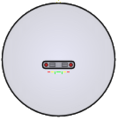 FDB-001 (bow/stern)
 -
 FDB-001 (dorsal)
 -
 FDB-001 (side)
 -
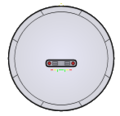 FDB-002 (bow/stern)
 -
 FDB-002 (dorsal)
 -
 FDB-002 (side)
 -
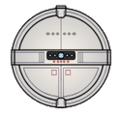 FDB-003 (bow/stern)
 -
 FDB-003 (dorsal)
 -
 FDB-003 (side)
.png)
.png)
.png)
.png)
.png)
.png)
.png)
.png)
.png)
Colony (CLN-002, -003)
The ‘wagon train’ pod is designed to transport a large number of people (400 for standard use and as much as 700 in emergency conditions) and all their belongings, as well as basic materials to begin a colonization program. As such, rooms are small and spartan, with design efficiency decidedly given over to ‘making the most of any room that’s available’. Each is quipped with six shuttlebays, masses 242,747 tons, is 203 meters in length (44 meters height/beam) and has a cargo capacity just over 10% that of the FDB series.
Starfleet maintains very few of these pods on their own, preferring to allow civilians to colonize safe worlds on their own. However, colony transport protection is a very high priority for Starfleet, and these pods sometimes seem to be magnets for raiders.
-
 CLN-002 (bow)
 -
 CLN-002 (dorsal)
 -
 CLN-002 (side)
 -
 CLN-003 (bow)
 -
 CLN-003 (dorsal)
 -
 CLN-003 (side)
.png)
.png)
.png)
.png)
.png)
.png)
Combat Support (TCS-002, -003)
The Marine Combat Support container provides an advanced command, control, and communications (C3) facility that far outstrips that found within the TCV series of Marine transports. Generally placed in orbit of a planet where there is little concern enemy starships will interfere, but when capable Starfleet or allied starships can not be depended upon to provide constant on-scene C3 support. The vessel has numerous information centers designed to prosecute land, aerospace, nautical and landing operations within various planetary regions and even areas of concern within the located solar system. The container has 8 single-mount phaser emplacements, 2 torpedo launchers and 2 dedicated shuttlebays (16 single- and dual-mount, 2 torpedo launchers and 4 shuttlebays on the -003) . Each typically masses 235,179 tons, is 211 meters in length (44 meters height/beam) and has a cargo capacity just over 15% that of the FDB series.
-
 TCS-002 (bow)
 -
 TCS-002 (dorsal)
 -
 TCS-002 (side)
 -
 TCS-003 (bow)
 -
 TCS-003 (dorsal)
 -
 TCS-003 (side)
.png)
.png)
.png)
.png)
.png)
.png)
Deuterium (FDM-002)
-
 FDM-002 (bow)
 -
 FDM-002 (dorsal)
 -
 FDM-002 (side)
.png)
.png)
.png)
Engine Repair (ERP-002, -003)
The purpose of the Engine Repair Container is the transportation and installation of warp nacelles. While the Ptolemy and other similar tender classes can independently haul nacelles, the container can carry up to three nacelles with facilities and shops for repair work. Located on the bottom of the container are 12 large shutter doors (18 on the -003) that allow the engine from a distressed ship to be put inside without disassembly for easier repair work. Each typically masses 110,201 tons and is 203 meters in length (44 meters height/beam) and has a non-nacelle cargo capacity just under 4% that of the FDB series.
-
 ERP-002 (bow)
 -
 ERP-002 (dorsal)
 -
 ERP-002 (side)
 -
 ERP-003 (bow)
 -
 ERP-003 (dorsal)
 -
 ERP-003 (side)
.png)
.png)
.png)
.png)
.png)
.png)
Factory (FTY-002, -003)
The Factory Container is designed to be transported to various locations so materials can be manufactured on the spot. The container is equipped with extensive fabrication equipment and shops for processing and manufacturing. The container is also equipped with a 6-bay (4-bay for -003) hanger deck used for the transportation of materials and products. Each typically masses 264,921 tons and is 211 meters in length (44 meters height/beam) and has a cargo capacity just over 11% that of the FDB series.
-
 FTY-002 (bow)
 -
 FTY-002 (dorsal)
 -
 FTY-002 (side)
 -
 FTY-003 (bow)
 -
 FTY-003 (dorsal)
 -
 FTY-003 (side)
.png)
.png)
.png)
.png)
.png)
.png)
Large Products (FPL-002, -003)
The purpose of the Large Product Container is the transportation of large items that cannot be towed by tractor beam. This container is equipped with a large door located on the rear to allow items to be placed inside. Each typically masses 119,642 tons and is 203 meters in length (44 meters height/beam) and has a cargo capacity just under 114% that of the FDB series.
-
 FPL-002 (bow)
 -
 FPL-002 (dorsal)
 -
 FPL-002 (side)
 -
 FPL-003 (bow)
 -
 FPL-003 (dorsal)
 -
 FPL-003 (side)
.png)
.png)
.png)
.png)
.png)
.png)
Liquid (FGL-001, -002, -003)
The ‘liquids’ pod is designed with 162 seperate pressure and temperature-controlled compartments to handle the transportation of liquids of various types, ranging from common water to low-yield hydrogen plasma. The pod’s systems are designed to keep each compartments’ liquids as stable and secure as possible. Each typically masses 121,600 tons and is 203 meters in length (44 meters height/beam) and has a cargo capacity just under 96% that of the FDB series.
Since the FGP pod has similar capacities of its own, the FGL pods are reserved for large-scale transport of liquids, such as initial colony supplies. Because of this, there are significantly fewer ‘liquids’ pods than general products pods in the space-lanes.
-
 FGL-001 (bow/stern)
 -
 FGL-001 (dorsal)
 -
 FGL-001 (side)
 -
 FGL-002 (bow/stern)
 -
 FGL-002 (dorsal)
 -
 FGL-002 (side)
 -
 FGL-003 (bow/stern)
 -
 FGL-003 (dorsal)
 -
 FGL-003 (side)
.png)
.png)
.png)
.png)
.png)
.png)
.png)
.png)
.png)
Long Products (FLL-002, -003)
The purpose of the Long Product Container is the transportation of items of considerable length and should not be transported with a tractor beam. This container's endcaps can be released from the container clamps and moved out of the way of the products being maneuvered inside it. Each typically masses 213,848 tons, is 357 meters (360 for the -003) in length (44 meters height/beam) and has a cargo capacity just under 203% that of the FDB series.
-
 FLL-002 (bow)
 -
 FLL-002 (dorsal)
 -
 FLL-002 (side)
 -
 FLL-003 (bow)
 -
 FLL-003 (dorsal)
 -
 FLL-003 (side)
.png)
.png)
.png)
.png)
.png)
.png)
Marine Transport (TCV-002)
The primary purpose of the Marine Transport Container is the transportation and support of Federation peace keeping forces. The container is equipped with facilities and supplies to support the troops, both during transits and during landing operations (and beyond). The vessel is equipped with 22 shuttlebays used for the fighters and assault craft. Each typically masses 228,558 tons, is 203 meters in length (44 meters height/beam) and has a cargo capacity just over 3% that of the FDB series. It can carry up to 3,000 Marines in primarily barracks style quarters, but can carry an additional 2,000 in emergency conditions. Limited self-defense is provided by 4 single-mount phaser emplacements.
Starfleet ordered a couple of dozen pods of this type during its initial appropriations after the Axanar conflict, but they have seen little use outside of training exercises since that time. Though effective, it’s likely the Marines will simply opt for a new dedicated ship design as the TCV pods are decommissioned.
-
 TCV-002 (bow/stern)
 -
 TCV-002 (dorsal)
 -
 TCV-002 (side)
.png)
.png)
.png)
Medical (MCC-002)
The Medical Container is an independent mobile medical facility providing support and emergency medical care throughout the Federation. The container is also equipped with 12-bay hanger deck (8 bays in the -003) used for patient transfers. The container has 80 operating rooms and beds for 300 patients. Each typically masses 125,972 tons, is 211 meters in length (44 meters height/beam) and has a cargo capacity just over 4% that of the FDB series.
-
 MCC-002 (bow)
 -
 MCC-002 (dorsal)
 -
 MCC-002 (side)
 -
 MCC-003 (bow)
 -
 MCC-003 (dorsal)
 -
 MCC-003 (side)
.png)
.png)
.png)
.png)
.png)
.png)
Mobile Repair (MRS-001)
A lifesaver for more than one starship captain, the ‘missus’ pod acts as a limited-facility drydock, capable of handling emergency repairs and minor system refits in the field. It’s the ‘next best thing’ to a real drydock, and can get all but the most severely damaged starships up and running in short order. The main and rear ‘clamps’ are shown as retracted, though they can extend out to encompass the primary hull of current class I starships. Though technically possible, it is against regulations for the facility to be in use while actually docked to its host ship.
-
 MRS-001 (bow)
 -
 MRS-001 (dorsal)
 -
 MRS-001 (side)
.png)
.png)
.png)
Products (FGP-001, -002, -003)
The ‘products’ pod is designed for mass transit of ‘finished’ goods and materials in 1,500 separate compartments. The pod can carry assorted freight, ideal for resupplying starbases and outposts, as well as maintaining supply lines for Starfleet activities. Each typically masses 121,600 tons and is 203 meters in length (44 meters height/beam) and has a cargo capacity just under 92% that of the FDB series.
The FGP pod is designed to carry an assortment of goods, so it maintains several compartments for refrigeration, liquid transport, and so on. Due to its general purpose use and large capacity, the FGP pod is the most common type of transport container currently in use.
-
 FGP-001 (bow/stern)
 -
 FGP-001 (dorsal)
 -
 FGP-001 (side)
 -
 FGP-002 (bow/stern)
 -
 FGP-002 (dorsal)
 -
 FGP-002 (side)
 -
 FGP-003 (bow/stern)
 -
 FGP-003 (dorsal)
 -
 FGP-003 (side)
.png)
.png)
.png)
.png)
.png)
.png)
.png)
.png)
.png)
Q-Pod (FDB(Q)-001, -002)
Q-pods were first developed in 22xx as a way to surprise pirates and Klingon raiders as they struck (apparently) helpless convoys. A transport ship would sacrifice one container for the innocuous Q-pod, which was usually manned for the duration of the convoy by a detachment from the origin base. When notified on the approach of a potential raider, the pod's torpedo weapon systems would be slaved to the command ship's sensors, providing a form of passive targeting sensors. Upon ordered release, all three torpedo banks (or however as many had a firing solution) would open their otherwise concealed panels and fire simultaneously, with the intent to surprise and distract, if not cripple, at least one of the raiders. In 2265, a modernized version of the FDB(Q)-001 eschewed photon torpedoes for 11 twin Type VI phaser banks, hidden within 11 false shuttlecraft hangers. Limited to use by Pompey subclass destroyers, the weapons crews were provided by the host ship and would evacuate the pod immediately before the ship "dropped" the pod to conduct offensive maneuvers, oftentimes right after the first volley of phaser fire. Both iterations of the Q-Pods would employ false livery, to disguise the intent of their presence.
-
 FDB(Q)-002, bow
 -
 dorsal
 -
 port
port -
 stern
stern -
 ventral
 -
 All bays open/extended
.png)
.png)
.png)
.png)
.png)
_(profile).png)
Reefer (FRF-001, -002, -003)
The ‘reefer’, or refrigeration pod, is used to transport materials that are environment-sensitive. ‘Refrigeration’ may be a misnomer, since the pods are capable of transporting and delivering goods while maintaining ‘high heat’ conditions as well, in 1,500 separate climate-controlled compartments. Each typically masses 121,600 tons and is 203 meters in length (44 meters height/beam) and has a cargo capacity just under 96% that of the FDB series.
Since the FPG pod has refrigeration capabilities of its own, the FRF pods are reserved for large-scale transport of environmentally sensitive goods. Consequently, there are significantly fewer ‘reefer’ pods than general products pods in the spacelanes.
-
 FRF-001 (bow/stern)
 -
 FRF-001 (dorsal)
 -
 FRF-001 (side)
 -
 FRF-002 (bow/stern)
 -
 FRF-002 (dorsal)
 -
 FRF-002 (side)
 -
 FRF-003 (bow/stern)
 -
 FRF-003 (dorsal)
 -
 FRF-003 (side)
.png)
.png)
.png)
.png)
.png)
.png)
.png)
.png)
.png)
Shuttlecarrier (SCV-002, -003)
A design for a war that never came, the SCV ‘shuttlecarrier’ transport was intended as a ‘cheap fighter emplacement’ system. The pod carries a sizable number of heavy shuttlecraft, capable of defending a colony or outpost in potential hazard zones. The -002 has 12 shuttlebay doors, while the -003 has that reduced to 8. Each masses 201,360 tons, is 211 meters (203 for the -003) in length (44 meters height/beam) and has a cargo capacity just over 2% that of the FDB series.
Though the design is retained as a ‘war time eventuality’, few of these pods were actually constructed, and the four in service are used primarily for training purposes for Starfleet and Starfleet Marines. It’s likely that this pod type will be phased out entirely in favor of dedicated light carrier ship designs in the future.
-
 SCV-002 (bow)
 -
 SCV-002 (dorsal)
 -
 SCV-002 (side)
 -
 SCV-003 (bow)
 -
 SCV-003 (dorsal)
 -
 SCV-003 (side)
.png)
.png)
.png)
.png)
.png)
.png)
Starliner (SLR-001, -002, -003)
The ‘starliner’ pod is normally in use by civilian agencies with auxiliary ships rather than formal use by Starfleet, though there have been a few exceptions - mostly for diplomatic purposes or the large-scale transportation of troops. Each typically masses 218,435 tons, is 203 meters in length (44 meters height/beam) and has no cargo capacity of any note (outside of normal operations for the staff and passengers).
An SLR-001 type pod can accommodate between 300 to 500 guests in high luxury, with a wide variety of entertainment services, spacious rooms, and fully stocked galley. Six hanger bays are availsble for shuttlecraft. To get an understanding of the luxury found within this starliner, the NCC-C4000 itself (somewhat modified from spec) is the ‘Presidential Liner’, reserved for the Federation President and his staff.
-
 SLR-001 (bow)
 -
 SLR-001 (dorsal)
 -
 SLR-001 (side)
 -
 SLR-002 (bow)
 -
 SLR-002 (dorsal)
 -
 SLR-002 (side)
 -
 SLR-003 (bow)
 -
 SLR-003 (dorsal)
 -
 SLR-003 (side)
 -
 SLR-001 2-view
.png)
.png)
.png)
.png)
.png)
.png)
.png)
.png)
.png)
.png)
Station (STA-001)
The Station Container is a hub for the attachment of various other containers and equipment, providing a prefabricated space station where ever one is deemed to be needed, either immediately or for a limited time that does not warrant a starship remaining on location. The container is equipped with extensive support equipment and a six-bay hanger deck for auxiliary hanger space. Eighteen attachments are provided, but additional containers and equipment can be attached to connection points located on the ends of the station-attached containers. Quarters, conference rooms and galleys are built into each container, but modular re-designing allows for brigs, hospital and operating rooms, barracks, cargo bays, equipment spaces, as well as more of the previous, to be configured. Each typically masses 127,033 tons, is 207 meters in length (44 meters height/beam) and has a cargo capacity just over 4% that of the FDB series.
-
 STA-001 (bow)
 -
 STA-001 (stern)
 -
 STA-001 (side)
 -
 STA-001 (attached)
.png)
.png)
.png)
.png)
Surveyor (SVY-002, -003)
The primary purpose of the Surveyor Container is exploration, charting and research. The container is equipped with extensive laboratories and sensors and with a 6-bay hanger deck (4 for the -003) used for location specific surveys. Each typically masses 254,739 tons and is 211 meters in length (52 meters height, 44 beam) and has a cargo capacity just under 7% that of the FDB series.
-
 SLR-002 (bow)
 -
 SLR-002 (dorsal)
 -
 SLR-002 (side)
 -
 SLR-003 (bow)
 -
 SLR-003 (dorsal)
 -
 SLR-003 (side)
.png)
.png)
.png)
.png)
.png)
.png)
Tender (TDR-001)
The Tender Container carries parts and repair facilities normally too large or obscure to be included in a starship's inventory. When attached to a container tug, this vessel can reach stranded ships and replace their warp core, navigational deflector dishes, inertial damping field generators or any other large-sized equipment. Repairs of massive hull breeches can help prevent the scuttling of a valued starship. Starfleet has saved much time and many an asset with this system of field repair. Each typically masses 255,716 tons and is 208 meters in length (52 meters height, 44 beam) and has a cargo capacity just over 3% that of the FDB series.
-
 TDR-001 (bow)
 -
 TDR-001 (dorsal)
 -
 TDR-001 (side)
 -
 TDR-001 (ventral)
.png)
.png)
.png)
.png)
Type VIII
Type VIII containers were introduced in 2231, alongside the Ishinomaki class fuel transport, to provide a stop-gap measure for refueling the fleet's spaceships until enough "supercruise" transports could be produced. Each container can hold 10 serial tanks, themselves holding 4,500 tons of neutronic hydrogen.
-
 Type VIII

Type S
The Type S containers refer to six extremely varied modules developed over decades for the Sherman class light transports/cargo drones. The larger two were mounted forward and aft of the central structure and were produced alongside the original sub-class, while the smaller tanks were clipped on above the crane, aft of the dorsal structure; they were developed by Starfleet in the 2250s to fulfill the military replenishment role. The final larger containers were designed to be clipped on under the crane, in place of the Aft main hold module; they entered services in the 2260s. (See Guide: Sherman for additional details.)
-
 Forward main hold module, 750 mt (bulk) and 600 mt (compartment)
 -
 Aft main hold module, 750 mt
 -
 Antimatter tank, 300 mt
 -
 Deuterium tank, 300 mt
 -
 Fuel tank, 300 mt
 -
 Liquids tank, 300 mt
 -
 Bulk Dry module, 30,679 mt
 -
 Antimatter module, 36,268 mt
 -
 Volatile Liquids module, 58,435 mt


