Guide:Santee/Coronado
.png)
| |
| Santee/Coronado | |
|---|---|
| Class Overview | |
| Category | shuttlecarrier/through-deck cruiser |
| Operational | 2255-2292 |
| Constructed | 10 total: |
| Dimensions | |
| Length | * Santee: 285.5 m
|
| Beam | 127.1 m |
| Height | * Santee: 66.3 m
|
| Mass |
|
| Performance | |
| Cruise Speed | w 6.0 |
| Max Speed |
|
| Endurance | 5 years |
| Complement | |
| Officers |
|
| Enlisted |
|
| Tactical Systems | |
| Beam Weapons | Santee
Coronado
|
| Missile Weapons | Santee
Coronado
|
| Shields |
|
| Laboratories | Santee
Coronado
|
| Transporters | Standard
All ships (after 2270)
|
| Auxiliary Craft | exploration operations (standard)
planetary assault operations (standard)
also sometimes carried
|
| Historical | |
| Ships of Note |
|
| Canonicity | |
| Design | FSCC/Mark Wilson, SotSF |
| Name | FSCC/Mark Wilson, SotSF |
| History | FSCC/Mark Wilson, SotSF
|

The success of the Constitution program spawned several growth designs, the most ambitious of which was the three-nacelled Federation class dreadnought. Since the original cruisers proved so versatile by themselves, though, the growth programs were often cut in mid-production, or never even saw construction phase. One of the planned variants was still considered essential even in face of the vast capabilities of the Constitutions themselves: a dedicated small shuttlecarrier, of which up to thirty were desired for supporting operations ranging from planetary assault to disaster relief.
To many admirals, the concept of a shuttlecarrier was something of a relic in the era of advanced phaser fire control systems which had already rendered sublight fighters obsolete in most applications. But there was still plenty of use for small craft in orbit-to-surface operations of all sorts, and the three new designs were intended to provide these craft with an agile and fast mother vessel.
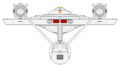
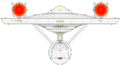
Propulsive-ly and structurally the most ambitious was the Santee class (registry numbers NCC-1925 through 1934 allocated) which sported PB-47 mod 2 engines for warp 9 dash speed. The engines were mounted on horizontal pylons extending from a large, blocky engineering section on the trailing edge of the primary hull. The secondary hull of the Santees featured a ‘Kadek’ deflector dish at bow, but dedicated the stern to a two-deck flight deck and hangar complex wherein small craft entered through the upper bay and were launched through a lower set of doors. Up to twenty fightercraft could be stowed on the flight decks and in the hangars forward of these. A heavy offensive and defensive armament was included in the form of full Constitution-type phaser VII banks and extra phaser VI units, although twin ‘Awalt’ Mk 3 torpedo launchers were chosen over the more potent but also bulkier and more complex Constitution ‘Wolf’ Mk 2 multi-tube torpedo armament.
The ship was to fight as a full-fledged cruiser in addition to protecting her small craft – an approach radically different from the lumbering shuttlecarriers of ages past. She would not embark major Marine units, nor be able to carry much in the way of ground vehicles and other combat gear. Rather, her forte would be the rapid deployment of precision strike teams and tactical support craft. As the selection of craft to be embarked was highly flexible, the ship could support interdiction operations, evacuations, surveys and search and rescue missions. The cruiser-like sensor and communications systems catered for a secondary role as a task force command ship as well, although other facilities for this mission were lacking.
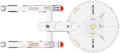
In the Coronado class (NCC-1975-84), emphasis was put on auxiliary craft capacity. The bow deflector was dropped, and engineering arrangements in the primary hull were much more modest, as top speed was not to exceed warp 8. The secondary hull featured a fly-through flight deck rather than a two-level one, and had its hangars and workshops below the flight deck level, in many ways simplifying operations and increasing capacity. However, departures through the bow doors conflicted with the cones of fire of the primary hull ventral armament. Omission of the deflector dish also cut down FTL sensor range and speed. In comparison with the Santee, the Coronado thus was much more a carrier than a cruiser.
The Princeton class (NCC-1950-59) was intended to represent the middle ground in terms of registry numbers only. There would be no high performance powerplant, no long range deflector and sensor assembly, no torpedo armament, and no high throughput flight deck. Instead, the secondary hull would be optimized for the carrying of troops, riding to their meeting with the enemy in assault barges and hoppers deployed through four ventral drop bays. Ample command facilities would be installed in the primary hull, but for coordinating planetary assault operations, not fleet maneuvers.
USS Santee was completed in May 2255, right on schedule, and underwent the testing phase smoothly and uneventfully. USS Coronado followed in September 2257, slightly delayed and already under budgetary pressures that were certain to limit production numbers. By the time USS Princeton was cancelled in 2258, it had become clear that no more keels would follow the fourth Santee or the sixth Coronado. For all purposes, the two existing classes performed technically just as planned. Operational efficiency was the stumbling block, as the carrier-cruisers were having great difficulty proving their superiority over standard heavy cruisers. Those had reached their pinnacle with the introduction of the final Victory subclass of the Constitution family; Defense Command had no further roles for complex and overspecialized cruiser variants. For the following decade, resources would be concentrated on inexpensive bread-and-butter cruisers of the Achernar type on one hand – and the budget-busting Defenders on the other.
Naming practices for the oddball designs changed with time. Originally conceived as ‘heavy cruisers, augmented’, the ships were reclassified as shuttlecarriers during production. For the Coronado class, this designation was in 2270 changed to the historical but here surprisingly accurate euphemism ‘through-deck cruiser’. The Santee class was no longer around to witness such a change; two ships had been retired due to damage from ramming attacks, and the remaining two had sailed to reserves in 2268 under an ‘escort carrier’ designation. The Princeton concept had been replaced entirely by dedicated assault transports of Makin class.
The primary mission for the Coronados turned out to be one of exploration support, with shuttle pilot training and special operations coming in as distant second and third. Planetary assault was still frequently trained for but, save for the abortive campaign that ended in the Organian peace treaty, never undertaken operationally.
The Coronado ships were retired one by one from active operations in the late 2280s and early 2290s due to their degrading warp performance and awkward engineering facilities that (as per a thorough feasibility study performed on the Oriskany) did not lend themselves to refitting. The loss was not particularly devastating: Star Fleet was in the process of fielding a successor family consisting of the Aleo and Jenshahn classes, and had also come up with several alternate concepts for the missions performed by the through-deck cruisers. More regrettable from the economic and operational viewpoint was the Fleet’s inability to down-select from these alternatives in time. The demand for low-key planetary warfare operations during the Klingon conflict was never great enough to warrant the use of one let alone three types of through-deck cruiser alongside two distinct types of strike frigate. High-key operations did not benefit significantly from the existence of the Coronado class, either.
Gallery
-
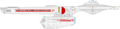 Santee class
 -
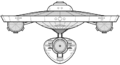
-
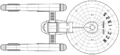
-
 Coronado class
 -
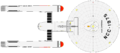
-
-
-
.png)
.png)
.png)
.png)
.png)
.png)
.png)
Notes
- The text regarding the Princeton subclass says "it had become clear [in 2258] that no more keels would follow the fourth Santee or the sixth Coronado", which I interpret to mean that funding for additional ships of both those classes was not forthcoming. I have construction of the final Santee conclude that year, and the final Coronado a year later.
- Mismatch between the text and the sidebar for the retirement of the Coronados ("...in the...early 2290s" and "2299", respectively) leads to the sidebar being changed to "2292".