Guide:Podish
.png)
| |
| Podish | |
|---|---|
| Class Overview | |
| Category | scout |
| Operational | 2160-2227 |
| Constructed | 31 |
| Dimensions | |
| Length | 62.1 m |
| Beam | 35.0 m |
| Height | 26.8 m |
| Mass | 76,700 mt (PB-2) 215,200 mts (PB-25) |
| Performance | |
| Cruise Speed | w 3 (PB-2) w 4 (PB-25) |
| Max Speed | w 4.2 (PB-2) w 8.0 (PB-25) |
| Endurance | 1 year |
| Complement | |
| Officers | 12 |
| Enlisted | 89
|
| Passengers | 10-20
|
| Tactical Systems | |
| Beam Weapons | Romulan War only
|
| Shields |
|
| Laboratories | 1 total:
|
| Transporters | 1x GP (1-pad); Mk I |
| Auxiliary Craft | 2x spatial pods |
| Historical | |
| Ships of Note |
|
| Canonicity | |
| Design | TOS-R |
| Name | Detroyat Blueprints/Star Fleet Enginery Sheet |
| History | Detroyat Blueprints/Star Fleet Enginery Sheet, Timo
|
Background: Delta Dynamics
The Romulan War was a time of desperation for Starfleet in many different ways. In 2159, the leading cause was lack of clear Romulan targets to strike at. An opponent shrouded in obscurity and deceit so dense as to amount to a cloak of invisibility could not be easily defeated even when UESF warships were getting the upper hand in individual engagements through their superior speed and firepower. Cruisers were still too few and far in between to score major intelligence coups; upper tier scoutships with cruiser engines were hardly more numerous yet much more vulnerable.
Yet there remained an alternative to be tried out: construction of Daedalus corvettes could finally be scaled back now that proper fighting vessels were available and the resources could be diverted to producing lower tier scoutships in hopefully sufficient numbers.
The required design was finalized in August 2159. Adoption of a more capable powerplant was but one facet of the plan to boost performance over the Daedalus standard. Total mass would be reduced by doing away with most of the secondary hull: the powerplant section would attach directly to the command sphere. Even more significant would be the reduction in dimensions, allowing for the warp field to be compacted. The engineering cylinder was just 19 meters in diameter, domed in front and tapering down astern and with a prominent undercut so that the two short PB-2SP nacelles outriggered well below centerplane would encase the entire ship in just the upper lobe of the asymmetric field.
Haste was mother to many shortcuts. The matter/antimatter power technology of the day required cooling systems that did not scale down easily with the rest of the hardware. There was also the inductive subspace field of the reactor itself to worry about, with little space available for safety barriers. The solution was to extend the reactor shield outside the hull in a series of ten cortenide rods, bleeding off heat and duonetic field astern of the ship where the leakage did the least damage to stealth.
Much Daedalus gear was left ashore: only two laser emitters would be carried and the pared down life support would only accommodate a hundred crew for one year at most, yet every single member of the crew would be heavily tasked with keeping the drive system running. To bolster survivability, the scout was given a forcefield shielding device, but the early technology could not be made to cooperate with the warp fields and had to be dropped after trials cost Starfleet two spaceframes and sixteen lives. The losses went almost unnoticed despite the low level of censorship in UE press—such was the intensity of fighting on all theaters, the ferocity of Rihannsu in retreat, the general brutality of space warfare where the difference between a warning shot and a fatal hit was a matter of mere meters, milliseconds, or megawatts.
The new scouts entered the fray under the class name Podish, with ten units produced in the first quarter of 2160. Orders to proceed to the front at warp three had to be moderated by warnings to mind the engines; two scouts were lost in transit nevertheless, to what records today still call “unknown reasons.” Once deployed, the ships spread further out in search of targets of opportunity, logistics routes, tactical patterns, anything solid to strike at in the increasingly chaotic battlefield. There is no doubt that some sort of success would have followed eventually, as Romulan strategic thinking was as stilted as its UE counterpart: the scouts would have found lines of defense to be routed, centers of command and logistics to be attacked, preparations for decisive fleet action to be disrupted. None of this was necessary in the end, as the choice of Cheron as a target unexpectedly allowed the coalition forces to achieve all the aims in one stroke.
The stunning news of ceasefire took their time to reach the Podish fleet, operating as it was under careful communications silence. None of the scouts had taken part in the crucial set of raids; none remained on station beyond the armistice. The low endurance vessels were swiftly lined up for deactivation. Production of further units ceased overnight.

The joint Star Fleet of the UFP had a pressing need for scouting assets from the very beginning. The major problem was that only Earth’s UESPA was aware of this need. Its means of acting were limited, however: the older and more established members of the Federation were unwilling to either deploy or lend their high-speed, long-range assets to reckless exploration sorties, and UESF surplus was ill suited for the mission. UESPA nevertheless set out to modify the Daedalus force for the purpose. Podish got to play a key role, with more than a dozen scouts becoming testbeds and receiving new registries in the NX-310 range. Among the technologies to be tested were new sensor suites for the Daedalus primary hull, novel ways of utilizing the transporter for exploration and sampling, and PB-7, -10, and eventually also -12 and -15 warp engines.
Having completed this mission, the Podish class slowly faded to obscurity. The design itself was not a solution to the scout shortage, despite select ships being pressed to the duty alongside Placidos and later Apaches, in lieu of alternatives. The early years of Klingon aggression revealed its many flaws, often fatally so. Star Fleet sought improvements through designs ranging from the lithe Lowell to the gargantuan Hermes, finding no single solution but a concord of wildly dissimilar ones.
Thrown into the mix was a final Podish upgrade project. The goal was to properly channel the power of a SSWR-VIII reactor into warp fields through the use of two sets of PB-25 warp coils, outriggered on reinforced pylons. The "Perth" warp drive system had a faster dilithium decay rate and a shorter operational life than other contemporary models but provided faster acceleration times between incremental warp factors. The complex design entered operational trials in parallel with a similar Tuverlind modification and was eventually cleared for a dash speed of warp 7.3. The "Perth" saw applications in numerous destroyer and scout programs of the early 23rd century. The modified Podishes were quietly retired after proving the concept.
Although consistently classified as scouts throughout their long service, the Podishes saw little operational use at any point. Stories of outstanding heroism or tragedy do not endure, nor is there a lineage or school of design to perpetrate the ungainly lines of these tadpole scouts. A single hull serves as an orbital storage capsule at Vega, another as a beaconship near Hephaistos. Pleshun displays the original flight article of NCC-310’s Perth warp engine in the company museum. Related utility designs are legion, however: with the substitution of any number of commercial engines on the hull, a range of high speed couriers and light transports could readily be derived and saw widespread civilian service in the early years of the UFP. Such vessels could still be found in local duties in the late 23rd century.
Gallery
-
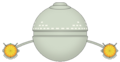 Podish class scout (bow)
 -
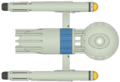 Dorsal
 -
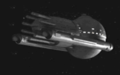 On assignment
.png)
.png)

Notes
- The narrative originally indicated 30 (of 31) ships were completed within six months of the design's completion in August 2159. However, all construction was halted with the September 2160 armistice, which means only 1 additional ship was completed in the six months following the first 30. Instead, the run is spread out over that (roughly) 12-month period, so that it ends with full production to the 31st ship.
- Thirteen Podishes were transferred to the UFP Star Fleet, with the others deactivated. The ones selected for continued service operated as testbeds for the Daedalus class, with registries starting in the NX-310 range.
- Six "select" vessels of the 13 Podishes transferred to Star Fleet were pressed into scouting (in 2173), assigned NCC-Q hull numbers, and worked alongside Placidos and Apaches. Some were lost to Klingons, and all were retired no later than 2227.
- The testing of the PB-25 nacelles started in 2213, from external sources (and in DD-verse). It appears those specific testbeds were "retired after proving the concept."