Guide:Tshin
.jpg)
| |
| Tshin | |
|---|---|
| Class Overview | |
| Category | sublight gunboat |
| Operational | 1907 - 2202 |
| Constructed | 1,016 (built 1907 - 2104) |
| Dimensions | |
| Length | 36.0 m |
| Beam | 12.0 m |
| Height | 10.1 m (landing gear retracted) 10.7 m (landing gear extended) |
| Mass | 2,150 mt |
| Performance | |
| Max Speed | sublight |
| Endurance | 3 weeks |
| Complement | |
| Crew | 3 - 5
|
| Tactical Systems | |
| Beam Weapons | 1x phased particle cannon (100 GW) (ventral bow)
|
| Shields | Hull armor |
| Canonicity | |
| Design | ENT |
| Name | Timo |
| History | Timo
|
Background: Hobbyist's Guide
The classic Vulcan gunboat design has changed little in the past half a millennium. Even drastic improvements in performance, such as addition of rudimentary FTL capability, have resulted in few departures from the teardrop aerodynamic form that was established as superior thousands of years ago, or from the arrangement of subspace coils around the stern of the craft that give them their superb agility and interplanetary reach.
One reason for the lack of variation or evolution is naturally the long-practiced Vulcan policy of pacifism from the position of superior firepower and the related untouchability of the Vulcan homeworld. The last gunboat type to have been tested in battle is the Tshin class, dating to the mid- 20th century. These 36-meter craft participated in the last colonial conflicts of pre-Federation Vulcan and remained an element of colonial and homeworld defenses till the beginning of the 23rd century.
Elements typical of the Tshin included gigajoule-tuning particle cannon and a trio of propulsion units, an elegant paring down from previous models. Gone were external hardpoints for missile weaponry, given the versatility of the phase gun armament. Reduction of drive unit numbers from the six or five of the preceding types was also due to the increased capabilities of modern systems. The gunboats could achieve 800 g acceleration for two days straight, although there were few applications for this; typical combat operations took place within a lightsecond of the point of deployment.
What the craft mostly were tasked with was planetary defense, involving interception tasks from well-equipped planetary bases, and additional patrol duty in systems that lacked full defensive sensor networks. However, up to ten craft could also be carried on a T’hyla cruiser, or two on a Surak. As there were many power projection duties for the Vulcan fleet in the 20th and 21st centuries, such deployments were common. By the 22nd century, a much more standoffish policy was adopted, and interventions became indirect in nature. A pair of Tshins would now typically move down a special forces unit, then possibly loiter for fire support and surveillance—a task that called for neither the speed nor the agility of the aerodynamically and propulsively-refined design.
On the other hand, there were many useful stealth features built into the craft, at least when the observers to be fooled did not possess technologies to detect subspace or gravitic emissions. The hull had sufficient superconductivity to cool down almost instantaneously after atmospheric entry, with the gravity generator acting as the internal heat sink. Reflectivity could be adjusted to near zero across a broad EM wavelength range, and atmospheric turbulence was minimal even at medium supersonic speeds. Gravitics-only landings could be performed with precision, the craft coming to rest on two large landing pads on the stern and one near the bow. Lying horizontally, she would be easy to camouflage by a variety of techniques built in to the hull. She was thus much preferable to certain more generic types of shuttlecraft in the operative insertion and support mission.
There were generic characteristics of utility value to the type as well, to be sure. Two 2 x 4 meter hatches on the lower flanks amidship allowed loading and offloading of various gear, including surface reconnaissance vehicles. A centrally-mounted lift provided further access to the amidship holds, and served as the standard means of personnel ingress. A small hatch integrated with the forward landing gear was also available for the purpose below the bow and compatible with the docking adapters of daughtership bays on T'Khut or M’Lat ships for transfer of crews in space. A tractor beam of moderate power could be deployed from above the cockpit area as a docking aid.

High Command ultimately expressed its displeasure of continuing use of cruiser deck space for gunboats, condemning the Tshins to homeworld defense tasks and the odd colonial mission by 2150. The banishment turned out to be a mistake in the Romulan War, resulting as it did in a lack of experience on shipboard operations. While large numbers of gunboats were involved in the Romulan conflict, their performance was often sub-par. Especially damning was slow deployment or recovery of the craft from cruisers newly shielded with forcefield devices; infamous examples of voidships caught “with their pants down” include the Lanama and the D’kan at the Battle of 198 Eri.
While almost a thousand craft were manufactured originally, replacements in the following centuries totaled barely a hundred. No craft were built after 2104, and only about two hundred persisted after the Battle of Cheron. The last Tshin combat units were disbanded in 2190 and individual craft used as trainers or range support vessels ceased operations by 2202.
Gallery
-
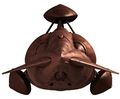 Bow view
 -
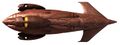 Dorsal view
 -
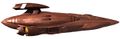 Side view
 -
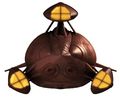 Stern view
 -
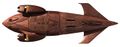 Ventral view
 -
 Landing
.jpg)
.jpg)
.jpg)
.jpg)
Star Fleet Registry
- NCC-L01
- NCC-L06
- NCC-L15
- NCC-L21
- NCC-L26
- NCC-L29
- NCC-L31
- NCC-L34
- NCC-L36
- NCC-L40
- NCC-L42
- NCC-L46
- NCC-L54
- NCC-L60
- NCC-L68
- NCC-L81
- NCC-L84
- NCC-L85
- NCC-L89
- NCC-L91
- NCC-L96
- NCC-L98
- NCC-L100
- NCC-L105
- NCC-L107
- NCC-L108
- NCC-L114
- NCC-L124
- NCC-L130
- NCC-L145
- NCC-L147
- NCC-L166
- NCC-L173
- NCC-L174
- NCC-L175
- NCC-L180
- NCC-L186
See Also
External Sources
Notes
- Up to six of the Tshin were utilized on the Kahs'khiori class corvette.[1]
- Timo uses the name D'Kyr, when he was the one that established T'Khut as the class name. It has been changed.
- This article indicates no new ones were built after 2104, while Guide: Powers writes, "Toj Lol and Tshin production continued for Star Fleet use," up until presumably 2164 (when the "Vulcans were asked to consider the construction of markedly larger scoutships"). I've decided to re-word the Powers statement so that transferals from Vulcan service to Star Fleet was occurring. Afterall, over a thousand were produced.
- This article does not indicate how it was used in the UFP Star Fleet, nor in what quantity. There were "only about two hundred" after the Battle of Cheron and it sounds like ("Tshin combat units") they might have been used in squadrons (3-10) or divisions (2-4). I think the DD-verse take on this is that the Vulcan Masu'er operated the craft—as a compromise—in the defense role as system responders, both for Vulcan and allied star systems. They were never used offensively (as they are sublight vessels).
- I've decided 37 Tshins were transferred to Star Fleet service, starting in 2161. They'll be registered under the NCC-L code.
References