Guide:Minuteman
.png)
| |
| Minuteman | |
|---|---|
| Class Overview | |
| Category | destroyer |
| Operational | 2158 - 2175 |
| Constructed | 29 |
| Dimensions | |
| Length | 160.0 m |
| Beam | 66.1 m |
| Height | 46.5 m |
| Mass | 189,500 mt |
| Performance | |
| Cruise Speed | w 3 |
| Max Speed | w 5.1 |
| Endurance | 6 months |
| Complement | |
| Officers | 8 |
| Enlisted | 42
|
| Tactical Systems | |
| Beam Weapons |
|
| Missile Weapons |
|
| Shields | |
| Auxiliary Craft |
|
| Historical | |
| Ships of Note |
|
| Canonicity | |
| Design | ST:Legacy computer game |
| Name | ST:Legacy computer game |
| History | ST:Legacy computer game
|
Background: Hobbyist's Guide
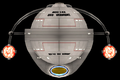
The UESF fighting forces of the 2150s were dedicated to system defense in doctrine and equipment alike. Yet with the introduction of a working dilithium-focus powerplant and plasma recharger technology, ambition was understandably directed at controlling greater swaths of space. An optimistic timetable called for the construction of combat-dedicated deep space patrol vessels between 2158 and 2165 for the fielding of a fighting force in the late 2160s and possible punitive expeditions against pirate strongholds in the 2170s. For this, some two dozen destroyer-type starships would have to be procured.
System defense would not be among the mission profiles of the deep space destroyers. The designers bidding for the project thus abandoned aerodynamics and lifting body configurations. Variations of the Marshall class were suggested, with modern cruiser engines to hike up the already considerable cost. Growth versions of the Djartanna and Cavalry system defense destroyers were also offered. The winning bid was the child of a different era, though: put forth in 2157, when extensive fighting in deep space already was grim reality, it expanded on an unexpected success story of the early war years. No longer needing to guess about the nature of the enemy and no longer at liberty to experiment much, Starfleet chose as its next champion a direct development of the Daedalus class.
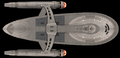
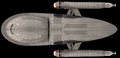
The austere simplicity and ease of manufacture for the primary hull was retained, even if the new structure was longitudinally stretched to twice the volume. A strong secondary hull structure of almost boatlike grace would now cradle the habitat section at its bow, eliminating the weak point of the connecting neck now that extreme measures for protecting the crew from the hazards of the drive system no longer were necessary or possible.
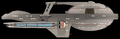
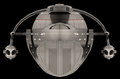
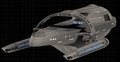
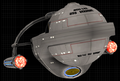
Starfleet’s faith on the warp five engine may not have been matched by the trust the crews placed on its reliability and safety, but the performance edge was welcome indeed. The drive system rode like a saddle with twin PB-5 engine nacelles as its stirrups and with stubby horizontal struts attaching it to the loins of the secondary hull. The struts pumped energized plasma from the annihilation reactor into the warp coils, but also featured pathways through which antideuterium could be fed—for engine spiking and for the external photonic torpedo launchers, the main weapon of the vessel. At the high point of the saddle arch sat an impulse drive block feeding off main drive plasma. Radiators and expander vents along the arch helped manage the quirks and spikes of the high-strung power system and jettisoning of the entire saddle assembly served as the last line of defense against a feedback cascade. The system was still sturdily secured, with a horizontal boom connecting the top of the arch to the primary hull and also providing maintenance access.
For all its structural complexity over the Daedalus counterpart, the secondary hull seemingly accommodated little new. The main reactor and its armored antimatter tanks were well protected in the middle, with the all-important plasma rechargers venting upwards and the IMRF units also masked from enemy view at the primary/secondary hull juncture. A sensor and deflector array at the ventral midhull was of modest Daedalus standard, only boosted in strength by the greater available overall power. However, the stern of the hull cradled another ovoid citadel making all the difference in combat: this facility would house Andorian shield generators, as soon as those became available. Also protected within were secondary power systems. The primary citadel was left for crew accommodation, command and control spaces, a fifth torpedo launcher incapable of using antimatter warheads, and two side-loading bays, typically also permanently accommodating a single atmospheric auxiliary and some work pods.

The upper and lower bows held gunports for directed energy armament, which initially was thought to consist of mid-caliber phase guns. However, by the time the Minuteman was completed in 2158, mankind was already at open war with a culture that could resist these marvels of weapon technology. Delta laser weaponry proved much more promising against Romulan shields and was readily installed—yet Starfleet had to rethink the whole concept of the deep space destroyers. Would investment in vessels of lesser than cruiser firepower be wise, when the warp five drive systems could be better spent on further Enterprises, Poseidons, or Achilles?
Production nevertheless continued in parallel with several cruiser projects. The destroyers eventually numbered 29, about half of these reaching completion before the end of the war. They never outnumbered the cruiser force or even significantly challenged any single cruiser class in terms of numbers or availability—in the latter, their over-cautiously positioned weapons and propulsion systems proved an exotic and crucial serviceability weakness. They did contribute to the war effort considerably and provided torpedo punch in many a desperate battle where phase beams failed to penetrate enemy defenses. Yet they had very little future left when the war ended. Only a handful persisted till the 2170s, when block obsolescence pruned Earth Fleet of its last wartime relics.
Gallery
-
-
-
-
-
-
-
-
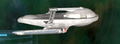 A Minuteman at warp
.png)
.png)
.png)
.png)
.png)
.png)
.png)

Notes
- The prefix "USS" has been changed to "UESS" for ships of the United Earth Starfleet.
- It's my determination that none of the Minutemen transitioned to the UFP Star Fleet.