Guide:Procyon

| |
| Procyon | |
|---|---|
| Class Overview | |
| Category | corvette |
| Operational | 2244-2283 |
| Constructed | 40 |
| Dimensions | |
| Length | 145.0 m |
| Beam | 69.7 m |
| Height | 20.8 m |
| Mass | 200,300 mt |
| Performance | |
| Max Speed | w 6.0 |
| Endurance | 1 year |
| Complement | |
| Officers | 10 |
| Enlisted | 68 (later, 76) |
| Troops | 18
|
| Tactical Systems | |
| Beam Weapons |
|
| Other Weapons | 1x mine tube (w/ 250 gravitic mines; 1,100 with optional ventral dispenser) |
| Shields |
|
| Transporters | 1 GP (2-pad); Mk II |
| Historical | |
| Ships of Note |
|
| Canonicity | |
| Design | Concordance / Brian Pimenta, Kris Trigwell |
| Name | Timo |
| History | Timo
|
The introduction of antimatter-powered Battleaxe corvettes in the early forties provided Star Fleet with an excellent rapid response in-system police vessel. However, this was hardly what Star Fleet needed at the time. With local defenses at risk of falling apart for lack of fast enough starship support, and several planets expressing separatist interests, police action was of low priority. While the numerous Battleaxes could theoretically boost local defenses with their anti-assault capability, Star Fleet hoped to extend these defenses beyond the 100 AU range normally limiting corvette operations, missile defenses, and realtime scanning systems. A mere warp 4 police cutter could not hope to patrol the 5000 AU-radius sphere specified in Staff Requirement 452/2242/5B—it would take almost three days to circumnavigate the patrol area in one plane at such speeds. What was needed was a craft capable of a top speed of warp six within the duonetopause of a star system, reducing the patrol circuit to twenty hours, and enabling a single vessel to intercept, identify, and hopefully deter intruders in time.

Naturally, a vessel far larger than the under-performing Battleaxes (or the fast yet overly experimental Sawyers) was required. Landing capability was abandoned early on; so were the now obsolete sublight rocket weapons. Instead, emphasis was placed on adequate shielding, sufficient sensor and targeting capabilities, and a decisive system defense armament of heavy Type V phasers and gravitic mines. Three phaser emitters and at least 250 mines were to be carried. An antimatter powerplant was required for the desired performance, and a matching set of warp engines had to be created specifically for the type.
The daunting task of designing the extended-range corvette was given to a specially appointed Star Fleet team of engineers. In later years, many of them would go on to serve in the Advanced Starship Design Bureau, Star Fleet’s own "dream factory" whose first major product would be the Excelsior transwarp testbed. For now, the engineers had to cope with a shortage of time, but did have plenty of other resources.
Three major components were designed side by side: the compact 80,000 ton PB-34 warp engines with 75 m nacelles; the RMR-282 antimatter powerplant (later to be replaced by the more reliable KR05-P); and the 60 m diameter primary hull, fully capable of jettison and planetfall. By 2243, test articles of all the components existed, and the problem now became one of systems integration. Physically, this required the designing of a secondary hull and nacelle mounts. A streamlined four deck structure superficially similar to Constitution secondary hulls was chosen, with the saucer mounted directly onto the upper bow so that the uppermost two decks of the engineering section met with the lowest two of the saucer. Then, a constant-profile, half-cylindrar top deck was applied over the length of the vessel to house a variety of mission and support systems. Finally, a Class 4 bridge module was installed atop the forward part of this top deck.
By March 2244, the first corvette was ready for launching as the UFP Star Fleet Starship Procyon, NX-L700; it would not be until the time came to field a successor that a prefix-free registry would be allocated to a corvette, one befitting the size and complexity of this new breed of warship. Below the four-person bridge, the forward-most top deck compartment housed targeting and fire control sensors and scanners; the top deck then tapered slightly into a utility compartment with resupply and docking fixtures, followed by a breach line between the primary and secondary hulls. Aft of the breach line began the long upper engineering section, housing diverse support systems within, a protruding dorsal antimatter fill port forward, and two cowlings for the main battery banks aft.
On the upper saucer level, Deck 3 featured officer accommodation and communications facilities; the engineering hull on this deck in turn held the secondary plasma distribution systems forward and the shuttlebay upper level aft. No shuttles were permanently carried, nor was there a service hangar, and typically the bay was reserved for carrying of additional mine or relay buoy racks. The warp engine pylons branched out laterally at this level. They incorporated plasma expanders and radiator surfaces, and also served as attachment points for under-pylon impulse nozzles. Primary plasma was led to the propulsion systems from the bottom of the secondary hull via conduits faired to follow the hull exterior.
Deck four in the saucer housed starship-standard crew accommodation without a need for hotbunking; a comfortable galley; a well-equipped sickbay; and assorted utilities. Thus furnished, the ships could perform patrol sorties as long as the nominal refueling interval of one year, without endangering the welfare or combat readiness of the crew. The secondary hull part of the deck held the top segments of the M/AM reactor, and the lower level and space doors of the shuttlebay. Deck 5 was the bottom level of the main reactor systems. The navigational deflector machinery was out of necessity significantly larger and more powerful than in preceding corvette designs, and was housed in a separate pod attached to the bow of Deck 5. Also podded was the revolving minelaying system, inset into a berth forward of the reactor. Alternately, an additional fuel tank or a cargo pod could be carried. Finally, the only partially personnel-accessible Deck 6 housed engineering utilities, radiators and matter tankage ports.
In brief but demanding test runs, the original ventral radiator was found insufficient and replaced by a far bulkier assembly girdling half the hull. Corresponding changes were made to the two dozen other corvette hulls already under construction. The overall success of the design, verified by the tests, also meant that two hulls were immediately set aside for conversion to courier and scoutship variants. Operational deployments began in August 2244, when USS Shaula (NCC-L702) took over system patrol of Regulus from three Thunderbolt class corvettes. She was soon joined by USS Vela (NCC-L705), at which point the two elderly Marklin destroyers deployed in the system moved out into deep space. The goals of the corvette program were being met.
A total production run of 40 Procyon class corvettes was completed between 2244 and 2249. In theory, greater production volumes or faster timetables could have been achieved, but the production lines were also utilized for the construction of the promising courier and scout variants of the basic design. Thanks to the lull of Axanar, the corvettes did not see much combat initially. Instead, their high warp speed allowed the extension of operations to true interstellar space along the old Deneva run. While the success of anti-piracy operations in the late 23rd century is generally attributed to the fielding of high numbers of frigates, it must be argued that the Procyon class also played a role in securing most of the spacelane from Earth to Rigel, thereby depriving Orion forces of their most bountiful hunting grounds this side of the Borderlands. The heavy phaser armament of the corvettes proved more than sufficient in deterring or destroying typical pirate vessels. Towards the end of their service, virtually none of the Procyon ships were carrying their intended primary arsenal of gravitic mines. Yet they no longer wore the belittling L prefix, either, having finally been accepted as full members of the starship community.
In the mid-2270s, operational strategies once again changed to favor heavier and faster local defense vessels, and corvettes faced a reassignment back to law enforcement duties. However, the success of the Procyon class was a major factor in encouraging Star Fleet to experiment further with the heavy corvette concept. The relatively high operating costs of the Procyon corvettes were somewhat unexpectedly being countered by the high efficiency of the vessels in traffic protection duty—indeed, there was a clear monetary net gain for the Federation from the pacifying of the spacelanes. Ultimately, the path of heavy corvette development would again lead towards a more openly military operational role, and vessels would close the "lineage gap", with the Okinawa class representing Procyon growth to frigate dimensions and the Daring experimenting with miniaturization of the Surya to corvette size.
When the Darings were fielded in mid-2270s, the Procyon class vessels gradually bowed out. Yet their heritage was being continued, not just on the conceptual level, but also in the form of the directly derived Antares multi-mission corvette series. Constant refinements on propulsion, armament and eventually also spaceframe would carry the Procyon line to the latter half of the 24th century, albeit in a greatly changed form, as described in the Antares and Merced entries.
Gallery
-
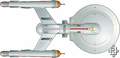 Dorsal
 -
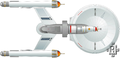 Ventral
 -
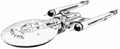 USS Antares (NCC-L717)
 -
 From Concordance
.png)
.png)

Notes
- The mothballing of USS Antares led to its conversion to a Centaurus class refit in 2278.
- It is my opinion, based upon Timo's external description, that the Procyon does not have that dangling pod leading the secondary bow. I believe this feature is more likely to exist on the Centaurus class, instead.
References
Alt Sources