Guide:Proxima
_stbd.png)
| |
| Proxima | |
|---|---|
| Class Overview | |
| Category | battle cruiser |
| Operational | 2226-2260 |
| Constructed | 20 |
| Dimensions | |
| Length | 270.0 m |
| Beam | 149.8 m |
| Height | 60.0 m |
| Mass | 520,000 tons |
| Performance | |
| Cruise Speed | w 4 |
| Max Speed | w 7.1 |
| Endurance | 5 years |
| Complement | |
| Officers | 34 |
| Enlisted | 323
|
| Tactical Systems | |
| Beam Weapons |
|
| Missile Weapons |
|
| Shields |
|
| Laboratories |
|
| Transporters | |
| Auxiliary Craft |
|
| Historical | |
| Ships of Note |
|
| Canonicity | |
| Design | STXI (ST: Legacy computer game) |
| Name | ST: Legacy computer game |
| History | ST: Legacy computer game, own
|
The high cost and high performance in the Detroyat heavy destroyers were relative things, measured
against the changing absolutes of the Klingon threat. The 2220s saw growing desperation as
Starfleet’s stratagem of quality over missing quantity proved insufficient: the two main lines of
destroyers were spread too thin on the battlefronts to amass to decisive strength, the cruisers in the
wrong place in the wrong time. By 2224, the decision was made to crank up cruiser production by
any means necessary and available. The result was a series of ‘war cruisers’, vessels of meager
protection and hard punch that naturally fit in the traditional slot of battle cruisers.

The design bureau started by literally cutting corners. For the novel battlewagon, half a saucer would suffice: a primary hull nearly 150 meters in beam featured heavy particle and plasma armament in an intimidating forward arc, yet terminated at the bridge, only extending aft in the form of a central powerplant block that ended in a slightly boosted SAB-A impulse engine. Thin longitudal booms supported the major innovation of the class, the gargantuan PB-28 warp nacelles of 188 m length, above ship centerplane. The nacelles were further braced by a horizontal pylon structure that facilitated contingency sharing of plasma and featured a torpedo launcher in the middle. This secondary armament, a semi-commonalized unit capable of housing four to six Selenia Mk 1 launchers and originally intended for destroyer and frigate use, actually contributed relatively little to the firepower of the battle cruiser.
Even though many of the classic deep space cruiser elements were trimmed off the design, sensor capabilities were maintained at the state of the art. Two secondary hulls were rigged beneath the warp engines but not directly connected to them; rather, their attachment was by pylons angling up to the power block. High output navigational deflectors got direct primary power feed from the block, and for their part enabled the decisively high top speed of warp 7.1. Advanced navigational and targeting sensors were incorporated in the hulls, while each also held a stern shuttlebay with hangar facilities for a dozen light craft. Various assault missions could thus be undertaken when necessary.
Modular construction in which secondary hulls were separately produced allowed the completion of USS Proxima by late 2225, and commissioning to combat duty followed in January of 2226. The some 350 crew were now proud operators of the most potent attack machine ever built by Earth. Two phased particle cannon, a dozen quadruple plasma cannon and four heavy lasers controlled the forward firing arcs, while paired torpedo tubes in the pod were available both for forward and aft firings. Tolerable acquisition costs allowed the construction of twenty such ships in total, and the cutting of corners enabled four to be completed within 2226 already. Starfleet confidently took the spearhead force to battle.

Early engagements at Hromi and Wazn met with success, largely predicated by the inability of the Klingons to provide ships that could qualitatively challenge the Proximas. Yet the battle of β Thoridor, intended to secure the support of the local Rakelli against the Klingon Empire, ended in a humiliating withdrawal in face of superior Imperial firepower. The D-6 and D-7 battle cruisers, in short supply in the Empire, were able to make an appearance in force at β Thoridor. Their superior shielding allowed them to persist in close combat with their Federation counterparts, and resulted in near-disastrous damage to USS Aquitania and USS Cancer. The former had to be scrapped after several years of fruitless repair attempts, and the latter only returned to service with severe limitations imposed on her warp performance.
Rather than invalidate the design, the casualties suffered supported Starfleet’s dedication to the Proxima concept. The two wounded ships were cheaper to replace than Baton Rouges would have been, and the replacements could be constructed faster. In comparison, it was believed that putting together a warbird of D-7 caliber would take the better part of a decade; some intelligence sources even believed that several key arts pertaining to that ship class had been lost in the years of internecine fighting, and that the Empire would not be able to recover from its losses at all if Starfleet managed to keep up the pressure. A second attempt at forcing β Thoridor was again thwarted, but use of battle cruisers in larger formations made up for their shortcomings in overall defense and rear sector weapons coverage. Klingon forces were sent to disarray on several fronts.
A decline in Klingon activity in the following decade allowed Starfleet to vector some of its Proximas to general exploration duties. Their equipment standards were not comparable to those of Baton Rouges, but their sensors and shuttlecraft facilities could make a useful contribution, essentially providing Starfleet with the capabilities of two Pythea in one spaceframe. The high cruise speed of the PB-28 gave the class operational flexibility, although recall times from long exploration sorties could still be on the order of a full year.

The return of the Klingon threat at Axanar found the Proximas at a disadvantage. Their massive, unique engines had been difficult to modernize or replace, and their propulsive performance had not increased apace with other cruiser types. Even modern ‘war cruisers’ of affordable construction, such as Rochester or Kearsarge, would reach the battlefields faster, never mind first-rate, ‘post- Starship’ ships like Constitution or Surya. The Proxima class still formed an important part of Fleet fighting strength, though, at 18 surviving vessels. Remedial action was launched in 2259, resulting in a propulsive upgrade of intriguing scope. Four PB-31 engines were to be bolted on, two per pylon, to give the battle cruisers an acceptable cruise speed of warp six, and a top speed of warp nine. The only vessel to undergo the experimental modification to the Proxima (II) variant, the original class ship, failed to enter operational service. The considerable expenses of the program did not result in a ship that would have been either more powerful or more affordable than the Federation dreadnoughts, let alone an efficient continuation of the battle cruiser philosophy.
Disappointed, Starfleet mothballed the aging battle cruisers. From 2260 onwards, the surviving specimens languished decommissioned on surplus depots, and the venerable class name was freed for use and promptly applied on a brand new Achernar cruiser. Yet on the verge of scrapping, the veteran combatants found unexpected support. In the 2270s, several ambitious programs to construct a new generation of dreadnoughts were launched. Of these, the Komsomolsk class and its all-new, 185 m primary hull and multiple secondary hulls bore a striking conceptual resemblance to the Proxima (II) class. Its propulsion arrangement of three LN-64C nacelles was intended to yield a sustainable speed of warp eight; by using four of the engines, in the paired arrangement pioneered by the Proxima, the old battle cruisers might well be coaxed to similar speeds. This major performance upgrade, ultimately usurping the Komsomolsk project in its entirety, is described in a later, separate entry.
See Also
Notes
- Text's stated top speed of w 8.1 has been lowered to fit the sidebar's w 7.1.
Gallery
-
 Proxima (I) bow
 -
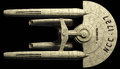 Dorsal
 -
 Proxima II stbd
 -
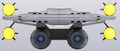 Bow
Bow -
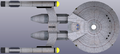 Dorsal
 -
 Port dorsal view
 -
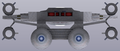 Stern
Stern -
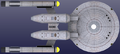 Ventral
 -
 Intended Proxima III configuration, port view
 -
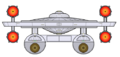 Bow
Bow -
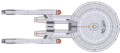 Dorsal view
 -
 ST: Legacy


.png)
.png)
.png)
.png)
.png)
.png)
_(port).png)
_(bow).png)
_(dorsal).png)
